Methyl group-donating vitamins elevate 3-O-methyldopa in patients with Parkinson disease.
Thomas Müller, Constanze Jugel, Siegfried Muhlack, Fabian Klostermann
Index: Clin. Neuropharmacol. 36(2) , 52-4, (2013)
Full Text: HTML
Abstract
Levodopa (LD)/dopa decarboxylase inhibitor application increases 3-O-methyldopa (3-OMD) concentrations in association with methyl group transfers, which demand for the conversion of methionine to homocysteine. This accompanying reaction is partially reversible by methyl group-donating vitamins.The objective of this study was to investigate of the effect of methyl group-donating vitamins on 3-OMD synthesis in LD-treated patients with Parkinson disease.We determined LD, 3-OMD, and homocysteine plasma concentrations in relation to daily LD dosage administered orally or as duodenal infusion with and without vitamins.Orally LD-treated patients with Parkinson disease had a lower LD dose compared with the ones on an LD infusion, but LD, 3-OMD, and homocysteine bioavailability was not different. The same 3-OMD and homocysteine accumulation despite the applied higher LD dosage during the infusion indicates a limited methylation capacity. Higher 3-OMD concentrations occurred during chronic vitamin supplementation, whereas the other parameters did not vary from the ones before vitamin intake.Vitamin supplementation elevated methylation of LD to 3-OMD. We suggest that, to a certain extent, plasma levels of homocysteine may reflect methyl group donation resources, whereas 3-OMD concentrations may mirror methylation capacity.
Related Compounds
| Structure | Name/CAS No. | Molecular Formula | Articles |
|---|---|---|---|
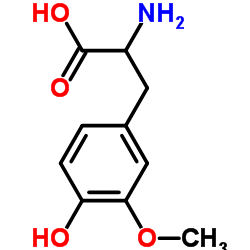 |
(DL)-3-O-Methyldopa
CAS:7636-26-2 |
C10H13NO4 |
|
Cysteinyl-glycine reduction as marker for levodopa-induced o...
2011-02-15 [Mov. Disord 26 , 543-546, (2011)] |
|
Pharmacokinetic-pharmacodynamic modeling of levodopa in pati...
2010-05-01 [Clin. Neuropharmacol. 33(3) , 135-41, (2010)] |
|
Levodopa infusion combined with entacapone or tolcapone in P...
2012-06-01 [Eur. J. Neurol. 19(6) , 820-6, (2012)] |
|
Comparison of 200 mg retarded release levodopa/carbidopa - w...
2007-01-01 [J. Neural Transm. Gen. Sect. 114(11) , 1457-62, (2007)] |
|
Pharmacokinetic-pharmacodynamic interaction between nebicapo...
2009-10-01 [Clin. Ther. 31(10) , 2258-71, (2009)] |