2,2'-dithiobis(5-nitropyridine)
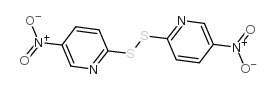
2,2'-dithiobis(5-nitropyridine) structure
|
Common Name | 2,2'-dithiobis(5-nitropyridine) | ||
|---|---|---|---|---|
| CAS Number | 2127-10-8 | Molecular Weight | 310.30900 | |
| Density | 1.65g/cm3 | Boiling Point | 514.2ºC at 760mmHg | |
| Molecular Formula | C10H6N4O4S2 | Melting Point | 155-157 °C(lit.) | |
| MSDS | Chinese USA | Flash Point | 264.8ºC | |
| Symbol |

GHS07 |
Signal Word | Warning | |
|
Heterologous expression of NaV1.9 chimeras in various cell systems.
Pflugers Arch. 467 , 2423-35, (2015) SCN11A encodes the voltage-gated sodium channel NaV1.9, which deviates most strongly from the other eight NaV channels expressed in mammals. It is characterized by resistance to the prototypic NaV channel blocker tetrodotoxin and exhibits slow activation and ... |
|
|
Disinactivation of N-type inactivation of voltage-gated K channels by an erbstatin analogue.
J. Biol. Chem. 279(28) , 29226-30, (2004) In some A-type voltage-gated K channels, rapid inactivation is achieved through the binding of an N-terminal domain of the pore-forming alpha-subunit or an associated beta-subunit to a cytoplasmic acceptor located at or near the channel pore using the ball-an... |
|
|
2,2'-Dithiobis(5-nitropyridine) (DTNP) as an effective and gentle deprotectant for common cysteine protecting groups.
J. Pept. Sci. 18(1) , 1-9, (2012) Of all the commercially available amino acid derivatives for solid phase peptide synthesis, none has a greater abundance of side-chain protection diversity than cysteine. The high reactivity of the cysteine thiol necessitates its attenuation during peptide co... |
|
|
Effects of SH-group reagents on Ca2+ and K+ channel currents of pancreatic B-cells.
Biochem. Biophys. Res. Commun. 200(2) , 860-6, (1994) The whole-cell patch-clamp technique has been applied to elucidate the effects of H2O2 and the SH-group reagent 2,2'-dithio-bis(5-nitropyridine) (DTBNP) on Ca2+ currents of mouse pancreatic B-cells. We also tested the effect of DTBNP on the whole-cell K+ ATP ... |
|
|
A spectrophotometric method for the estimation of polymer-supported sulfhydryl groups.
Anal. Biochem. 189(2) , 173-7, (1990) A sensitive and simple method is described for the quantitative determination of free sulfhydryl (-SH) groups on polymer supports. The method includes the reaction of 4,4'-dimethoxytrityloxy-S-(2-thio-5-nitropyridyl)-2-mercapto ethane (DTNPME) with polymer-su... |
|
|
Studies on deprotection of cysteine and selenocysteine side-chain protecting groups.
J. Pept. Sci. 13 , 81, (2007) We present here a simple method for deprotecting p-methoxybenzyl groups and acetamidomethyl groups from the side-chains of cysteine and selenocysteine. This method uses the highly elecrophilic, aromatic disulfides 2,2'-dithiobis(5-nitropyridine) (DTNP) and 2,... |
|
|
Guided reconstitution of membrane protein fragments.
Biopolymers 102(1) , 16-29, (2014) Structural analysis by NMR of G protein-coupled receptors (GPCRs) has proven to be extremely challenging. To reduce the number of peaks in the NMR spectra by segmentally labeling a GPCR, we have developed a Guided Reconstitution method that includes the use o... |
|
|
The use of 2,2'-dithiobis(5-nitropyridine) (DTNP) for deprotection and diselenide formation in protected selenocysteine-containing peptides.
J. Pept. Sci. 18(3) , 155-62, (2012) In contrast to the large number of sidechain protecting groups available for cysteine derivatives in solid phase peptide synthesis, there is a striking paucity of analogous selenocysteine Se-protecting groups in the literature. However, the growing interest i... |
|
|
Sulfhydryl oxidation induces rapid and reversible closure of the ATP-regulated K+ channel in the pancreatic beta-cell.
FEBS Lett. 319(1-2) , 128-32, (1993) Effects of sulfhydryl modification on the ATP regulated K+ channel (KATP channel) in the pancreatic beta-cell were studied, using the patch clamp technique. Application of the sulfhydryl oxidizing agents thimerosal and 2,2'-dithio-bis(5-nitropyridine) (DTBNP)... |
|
|
Reduced dihydroxyacetone sensitivity and normal sensitivity to glyceraldehyde and oxidizing agent of ATP-sensitive K+ channels of pancreatic beta cells in NIDDM rats.
J. Korean Med. Sci. 12(4) , 286-92, (1997) The inhibition of ATP-sensitive K+(KATP) channels in pancreatic beta cells is a key step of insulin secretion induced by glucose. Glucose-induced insulin secretion from the beta cells is selectively impaired in patients with noninsulin-dependent diabetes mell... |