Cilostazol
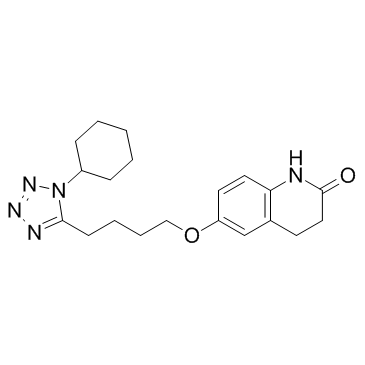
Cilostazol structure
|
Common Name | Cilostazol | ||
|---|---|---|---|---|
| CAS Number | 73963-72-1 | Molecular Weight | 369.461 | |
| Density | 1.3±0.1 g/cm3 | Boiling Point | 664.7±55.0 °C at 760 mmHg | |
| Molecular Formula | C20H27N5O2 | Melting Point | 159-160ºC | |
| MSDS | Chinese USA | Flash Point | 355.8±31.5 °C | |
|
Stimulation of angiogenesis by cilostazol accelerates fracture healing in mice.
J. Orthop. Res. 33 , 1880-7, (2015) Cilostazol, a selective phosphodiesterase-3 inhibitor, is known to control cyclic adenosine monophosphate (c-AMP) and to stimulate angiogenesis through upregulation of pro-angiogenic factors. There is no information, however, whether cilostazol affects fractu... |
|
|
Comparative effects of the anti-platelet drugs, clopidogrel, ticlopidine, and cilostazol on aspirin-induced gastric bleeding and damage in rats.
Life Sci. 110(2) , 77-85, (2014) The present study compared the effects of frequently used anti-platelet drugs, such as clopidogrel, ticlopidine, and cilostazol, on the gastric bleeding and ulcerogenic responses induced by intraluminal perfusion with 25 mM aspirin acidified with 25 mM HCl (a... |
|
|
Practical method for preparing nanosuspension formulations for toxicology studies in the discovery stage: formulation optimization and in vitro/in vivo evaluation of nanosized poorly water-soluble compounds.
Chem. Pharm. Bull. 62(11) , 1073-82, (2014) The present study aimed to develop a practical method for preparing nanosuspension formulations of poorly water-soluble compounds for enhancing oral absorption in toxicology studies in the discovery stage. To obtain a suitable nanosuspension formulation for t... |
|
|
Role of Ser102 and Ser104 as regulators of cGMP hydrolysis by PDE5A.
PLoS ONE 9(9) , e107627, (2014) Phosphodiesterases (PDEs) cleave phosphodiester bonds in cyclic nucleotides and play diverse roles in cell biology. PDE5A is a cytoplasmic phosphodiesterase which specifically degrades cyclic guanosine monophosphate (cGMP), a cell signaling molecule that play... |
|
|
Simultaneous exposure to Escherichia coli heat-labile and heat-stable enterotoxins increases fluid secretion and alters cyclic nucleotide and cytokine production by intestinal epithelial cells.
Infect. Immun. 82(12) , 5308-16, (2014) Enterotoxigenic Escherichia coli (ETEC) is a significant cause of diarrheal disease and death, especially in children in developing countries. ETEC causes disease by colonizing the small intestine and producing heat-labile toxin (LT), heat-stable toxin (ST), ... |
|
|
Cilostazol attenuates ovariectomy-induced bone loss by inhibiting osteoclastogenesis.
PLoS ONE 10 , e0124869, (2015) Cilostazol has been reported to alleviate the metabolic syndrome induced by increased intracellular adenosine 3',5'-cyclic monophosphate (cAMP) levels, which is also associated with osteoclast (OC) differentiation. We hypothesized that bone loss might be atte... |
|
|
Preparation and evaluation of oral controlled-release cilostazol formulation: pharmacokinetics and antithrombotic efficacy in dogs and healthy male Korean participants.
J. Pharm. Pharmacol. 66(7) , 961-74, (2014) To prepare oral controlled-release cilostazol formulations and evaluate their pharmacokinetics and pharmacodynamics in dogs and humans compared with a commercial twice-daily immediate-release formulation (Pletal), thereby showing the potential for the develop... |
|
|
Physical and dissolution characterization of cilostazol solid dispersions prepared by hot melt granulation (HMG) and thermal adhesion granulation (TAG) methods.
Int. J. Pharm. 473(1-2) , 458-68, (2014) A growing number of poorly water-soluble drug have been discovered, but the poor bioavailability is a critical problem. In this study, physical properties and dissolution profiles of cilostazol solid dispersions prepared by hydrophilic/lipophilic excipients (... |
|
|
Beneficial effect of cilostazol-mediated neuronal repair following trimethyltin-induced neuronal loss in the dentate gyrus.
J. Neurosci. Res. 93(1) , 56-66, (2014) Cilostazol acts as an antiplatelet agent and has other pleiotropic effects based on phosphodiesterase-3-dependent mechanisms. We evaluated whether cilostazol would have a beneficial effect on neuronal repair following hippocampal neuronal damage by using a mo... |
|
|
Regulation of ecto-apyrase CD39 (ENTPD1) expression by phosphodiesterase III (PDE3).
FASEB J. 27(11) , 4419-28, (2013) The ectoenzyme CD39 suppresses thrombosis and inflammation by suppressing ATP and ADP to AMP. However, mechanisms of CD39 transcriptional and post-translational regulation are not well known. Here we show that CD39 levels are modulated by inhibition of phosph... |