dimethylmaleic anhydride
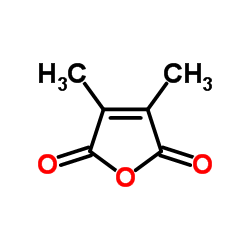
dimethylmaleic anhydride structure
|
Common Name | dimethylmaleic anhydride | ||
|---|---|---|---|---|
| CAS Number | 766-39-2 | Molecular Weight | 126.110 | |
| Density | 1.2±0.1 g/cm3 | Boiling Point | 223.0±0.0 °C at 760 mmHg | |
| Molecular Formula | C6H6O3 | Melting Point | 93-96 °C(lit.) | |
| MSDS | Chinese USA | Flash Point | 95.6±15.9 °C | |
| Symbol |

GHS07 |
Signal Word | Warning | |
|
Surface charge switching nanoparticles for magnetic resonance imaging.
Int. J. Pharm. 471(1-2) , 127-34, (2014) In this study, polypeptide-based nanoparticles [constituted using poly(L-lysine) coupled with deoxycholic acid (DOCA) and conjugated with 2,3-dimethylmaleic acid (DMA)] have high tumor selectivity once electrostatically switched by the acidic milieu of solid ... |
|
|
Multimeric grain-marked micelles for highly efficient photodynamic therapy and magnetic resonance imaging of tumors.
Int. J. Pharm. 471(1-2) , 166-72, (2014) Multimeric grain-marked micelles consisting of an inner core micelle (for Fe3O4 encapsulation) and outer multi-grain micelles (for chlorin e6 (Ce6, a model drug) encapsulation) were fabricated using a micelle-to-micelle conjugation method. Grain micelles (mon... |
|
|
A smart polymeric platform for multistage nucleus-targeted anticancer drug delivery.
Biomaterials 65 , 43-55, (2015) Tumor cell nucleus-targeted delivery of antitumor agents is of great interest in cancer therapy, since the nucleus is one of the most frequent targets of drug action. Here we report a smart polymeric conjugate platform, which utilizes stimulus-responsive stra... |
|
|
DMAA as a dietary supplement ingredient.
Arch. Intern. Med. 172(13) , 1038-9, (2012)
|
|
|
Only multimeric hensin located in the extracellular matrix can induce apical endocytosis and reverse the polarity of intercalated cells.
J. Biol. Chem. 274(25) , 17671-6, (1999) When an intercalated epithelial cell line was seeded at low density and allowed to reach confluence, it located the anion exchanger band 3 in the apical membrane and an H+-ATPase in the basolateral membrane. The same clonal cells seeded at high density target... |
|
|
Charge-conversional poly(amino acid)s derivatives as a drug delivery carrier in response to the tumor environment.
J. Biomed. Mater. Res. A 100(8) , 2027-33, (2012) A charge-converting and pH-dependent nanocarrier was achieved by conjugating 2,3-dimethylmaleic anhydride (DMMA) to the amino group of an octadecyl grafted poly (2-hydroxyethyl aspartamide) (PHEA-g-C(18)-NH(2)) backbone, thereby forming a spherical micelle. P... |
|
|
Yeast nucleosomal particles: structural and transcriptional properties.
Biochemistry 30(23) , 5805-10, (1991) Yeast nucleosomal core particles have been characterized by thermal denaturation, circular dichroism, and digestion with DNase I and with trypsin. Practically all nucleosomal DNA melts in one transition centered at 70 degrees C, and the circular dichroism spe... |
|
|
Self-assembly of apoferritin from horse spleen after reversible chemical modification with 2,3-dimethylmaleic anhydride.
Biochemistry 27(11) , 4089-96, (1988) Apoferritin from horse spleen is composed of 24 subunits that undergo partial dissociation after chemical modification with 2,3-dimethylmaleic anhydride (DMMA), yielding dimeric, trimeric, and tetrameric intermediates, stable at pH 8.5 and 0 degrees C. Deacyl... |
|
|
Structural changes of nucleosomal particles and isolated core-histone octamers induced by chemical modification of lysine residues.
Biochemistry 27(15) , 5635-40, (1988) Treatment of nucleosomal particles and isolated core-histone octamers with dimethylmaleic anhydride, but not with acetic anhydride, is accompanied by a biphasic release of the two H2A.H2B dimers, the first dimer being more easily released than the second. Wit... |
|
|
Reconstitution of the active rat liver 60 S ribosomal subunit from different preparations of core particles and split proteins.
FEBS Lett. 236(2) , 345-51, (1988) Proteins extracted from the 60 S rat liver ribosomal subunit with 50% ethanol/0.5 M K Cl produced only a partial reactivation of the corresponding core particles. In contrast, the same split proteins were able to reactivate the core particles prepared with di... |