4-Chlorobiphenyl
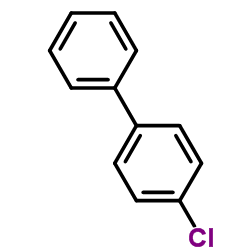
4-Chlorobiphenyl structure
|
Common Name | 4-Chlorobiphenyl | ||
|---|---|---|---|---|
| CAS Number | 2051-62-9 | Molecular Weight | 188.653 | |
| Density | 1.1±0.1 g/cm3 | Boiling Point | 289.0±9.0 °C at 760 mmHg | |
| Molecular Formula | C12H9Cl | Melting Point | 77.7ºC | |
| MSDS | Chinese USA | Flash Point | 127.0±8.6 °C | |
| Symbol |


GHS08, GHS09 |
Signal Word | Warning | |
|
Computational framework for predictive biodegradation.
Biotechnol. Bioeng. 104(6) , 1086-97, (2009) As increasing amounts of anthropogenic chemicals are released into the environment, it is vital to human health and the preservation of ecosystems to evaluate the fate of these chemicals in the environment. It is useful to predict whether a particular compoun... |
|
|
Pathways and products of the degradation of PCBs by the sodium dispersion method.
Chemosphere 68(5) , 871-9, (2007) Nine polychlorinated biphenyl (PCB) congeners (2-chlorobiphenyl, 3-chlorobiphenyl, 4-chlorobiphenyl, 2,3,4-trichlorobiphenyl, 2,2',5,5'-tetrachlorobiphenyl, 2,3',4,4',5-pentachlorobiphenyl, 3,3',4,4',5-pentachlorobiphenyl, 2,2',4,4',5,5'-hexachlorobiphenyl, a... |
|
|
Degradation and mineralization of 2-chloro-, 3-chloro- and 4-chlorobiphenyl by a newly characterized natural bacterial strain isolated from an electrical transformer fluid-contaminated soil.
J. Environ. Sci. (China) 20(10) , 1250-7, (2008) A bacterium classified as Achromobacter xylosoxidans strain IR08 by phenotypic typing coupled with 16S rRNA gene analysis was isolated from a soil contaminated with electrical transformer fluid for over sixty years using Aroclor 1221 as an enrichment substrat... |
|
|
Comparison of the actions of 4-chlorobiphenyl and its hydroxylated metabolites on estradiol secretion by ovarian follicles in primary cells in culture
Reprod. Toxicol. 20(1) , 57-64, (2005) Theca interna and granulosa cells from small, medium and large preovulatory porcine follicles were cultured as a monolayer to compare the effects of 4-chlorobiphenyl (PCB3) and its metabolites on estradiol secretion. Cells were treated with PCB3 or its mono- ... |
|
|
3-Methylcholanthrene (3-MC) and 4-chlorobiphenyl (PCB3) genotoxicity is gender-related in Fischer 344 transgenic rats.
Environ. Int. 36(8) , 970-9, (2010) Polychlorinated biphenyls (PCBs) are a class of persistent organic pollutants with myriad biological effects, including carcinogenicity. We present data showing gender-specific genotoxicity in Fischer 344 transgenic BigBlue rodents exposed to 4-chlorobiphenyl... |
|
|
In vitro exposure of porcine prepubertal follicles to 4-chlorobiphenyl (PCB3) and its hydroxylated metabolites: effects on sex hormone levels and aromatase activity.
Toxicol. Lett. 164(2) , 113-22, (2006) The present study was undertaken to investigate the endocrine disrupting activity of PCB3 and its hydroxylated metabolites 4-OH-PCB3 and 3,4-diOH-PCB3 in ovarian follicle cells derived from prepubertal animals with special emphasis on cytochrome P-450-depende... |
|
|
Multiple-subunit genes of the aromatic-ring-hydroxylating dioxygenase play an active role in biphenyl and polychlorinated biphenyl degradation in Rhodococcus sp. strain RHA1.
Appl. Environ. Microbiol. 72(8) , 5396-402, (2006) A gram-positive strong polychlorinated biphenyl (PCB) degrader, Rhodococcus sp. strain RHA1, can degrade PCBs by cometabolism with biphenyl or ethylbenzene. In RHA1, three sets of aromatic-ring-hydroxylating dioxygenase genes are induced by biphenyl. The larg... |
|
|
Humic acid and metal ions accelerating the dechlorination of 4-chlorobiphenyl by nanoscale zero-valent iron.
J. Environ. Sci. (China) 23(8) , 1286-92, (2011) Transformation of polychlorinated biphenyls (PCBs) by zero-valent iron represents one of the latest innovative technologies for environmental remediation. The dechlorination of 4-chlorobiphenyl (4-ClBP) by nanoscale zero-valent iron (NZVI) in the presence of ... |
|
|
Investigation of mechanism(s) of DNA damage induced by 4-monochlorobiphenyl (PCB3) metabolites.
Environ. Int. 36(8) , 950-61, (2010) 4-Monochlorobiphenyl (PCB3) is readily converted by xenobiotic-metabolizing enzymes to dihydroxy-metabolites and quinones. The PCB3 hydroquinone (PCB3-HQ; 2-(4'-chlorophenyl)-1,4-hydroquinone) induces chromosome loss in Chinese Hamster V79 cells, whereas the ... |
|
|
Binding of polychlorinated biphenyls/metabolites to hemoglobin.
Toxicol. Lett. 142(1-2) , 53-60, (2003) Polychlorinated biphenyls (PCBs) may form reactive electrophiles that can bind covalently to hemoglobin in vivo. Female C57/BL6 mice, pretreated with phenobarbital and P-naphthoflavone, were injected with either radiolabeled 4-chlorobiphenyl, 3,3',4.4'-tetrac... |