2,2',3,4,4',5,5'-PCB
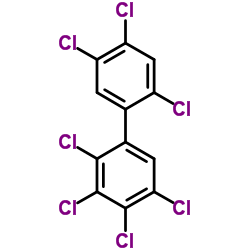
2,2',3,4,4',5,5'-PCB structure
|
Common Name | 2,2',3,4,4',5,5'-PCB | ||
|---|---|---|---|---|
| CAS Number | 35065-29-3 | Molecular Weight | 395.323 | |
| Density | 1.7±0.1 g/cm3 | Boiling Point | 424.3±40.0 °C at 760 mmHg | |
| Molecular Formula | C12H3Cl7 | Melting Point | 114℃ | |
| MSDS | Chinese USA | Flash Point | 210.9±24.7 °C | |
| Symbol |


GHS08, GHS09 |
Signal Word | Warning | |
|
Transcriptional profiling and biological pathway analysis of human equivalence PCB exposure in vitro: indicator of disease and disorder development in humans.
Environ. Res. 138 , 202-16, (2015) Our earlier gene-expression studies with a Slovak PCBs-exposed population have revealed possible disease and disorder development in accordance with epidemiological studies. The present investigation aimed to develop an in vitro model system that can provide ... |
|
|
Evaluation of estrogenic effects of polychlorinated biphenyls and organochlorinated pesticides using immature rat uterotrophic assay.
Hum. Exp. Toxicol. 32(5) , 476-82, (2013) In this study, we investigated the effects of polychlorinated biphenyls (PCBs) and organochlorinated pesticides on the serum levels of luteinising hormone (LH), follicle stimulating hormone (FSH) and weights and histomorphometry of uterine tissue in immature ... |
|
|
Food web-specific biomagnification of persistent organic pollutants.
Science 317 , 236-9, (2007) Substances that accumulate to hazardous levels in living organisms pose environmental and human-health risks, which governments seek to reduce or eliminate. Regulatory authorities identify bioaccumulative substances as hydrophobic, fat-soluble chemicals havin... |
|
|
Dopamine-dependent behavior in adult rats after perinatal exposure to purity-controlled polychlorinated biphenyl congeners (PCB52 and PCB180).
Toxicol. Lett. 224(1) , 32-9, (2014) Since knowledge about toxic effects of non-dioxinlike (NDL) PCBs is fragmentary, regulatory panels have concluded that risk assessment of these congeners is hampered or impossible. As the dopaminergic system is one of the main targets in PCB-related neurotoxi... |
|
|
Long-term trends of continental-scale PCB patterns studied using a global atmosphere-ocean general circulation model.
Environ. Sci. Pollut. Res. Int. 19(6) , 1971-80, (2012) Continental-scale distribution and inter-continental transport of four polychlorinated biphenyl (PCB) congeners (28, 101, 153, 180) from 1950 to 2010 were studied using the global multicompartment chemistry transport model MPI-MCTM. Following identical primar... |
|
|
Serum concentrations of indicator PCB congeners in the Czech adult population.
Chemosphere 72(8) , 1124-31, (2008) In 2006, levels of seven indicator polychlorinated biphenyl congeners (PCB28, 52, 101, 118, 138, 153, and 180) in blood serum of 202 blood donors residing for more than 2 years in five urban areas included in the Czech Human Biomonitoring project were measure... |
|
|
Biological monitoring of indoor-exposure to dioxin-like and non-dioxin-like polychlorinated biphenyls (PCB) in a public building.
Toxicol. Lett. 213(1) , 116-21, (2012) The release of PCBs from sealant material in public buildings and the resulting indoor air levels have raised growing concerns about possible human health effects connected with this exposure. Ambient monitoring of PCBs in a public building has revealed a con... |
|
|
Effects of non-dioxin-like polychlorinated biphenyl congeners (PCB 101, PCB 153 and PCB 180) alone or mixed on J774A.1 macrophage cell line: modification of apoptotic pathway.
Toxicol. Lett. 202(1) , 61-8, (2011) Non-dioxin-like polychlorinated biphenyls (PCBs) are stable and lipophilic chemicals that persist in the environment and tend to bioaccumulate in the food chains. In the present study, we have investigated the effect of PCBs 101, 153, and 180 on macrophage J7... |
|
|
Parental smoking and neonatal serum levels of polychlorinated biphenyls and hexachlorobenzene.
Pediatr. Res. 47(5) , 598-601, (2000) Polychlorinated biphenyls (PCB) and hexachlorobenzene (HCB) are ubiquitous compounds that have tumor-promoting properties if applied together with tobacco-specific carcinogens. It was the purpose of the present study to investigate whether parental smoking by... |
|
|
Postnatal exposure to PCB 153 and PCB 180, but not to PCB 52, produces changes in activity level and stimulus control in outbred male Wistar Kyoto rats.
Behav. Brain Funct. 7 , 18, (2011) Polychlorinated biphenyls (PCBs) are a class of organic compounds that bioaccumulate due to their chemical stability and lipophilic properties. Humans are prenatally exposed via trans-placental transfer, through breast milk as infants, and through fish, seafo... |