5-(3-(4-氟苯基)-1-苯基-1H-吡唑-4-基)咪唑啉-2,4-二酮
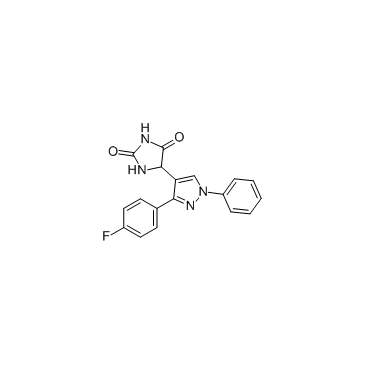
5-(3-(4-氟苯基)-1-苯基-1H-吡唑-4-基)咪唑啉-2,4-二酮结构式

|
常用名 | 5-(3-(4-氟苯基)-1-苯基-1H-吡唑-4-基)咪唑啉-2,4-二酮 | 英文名 | DPH |
|---|---|---|---|---|
| CAS号 | 484049-04-9 | 分子量 | 336.32000 | |
| 密度 | N/A | 沸点 | N/A | |
| 分子式 | C18H13FN4O2 | 熔点 | N/A | |
| MSDS | 美版 | 闪点 | N/A |
|
Regulation of SREBPs by Sphingomyelin in Adipocytes via a Caveolin and Ras-ERK-MAPK-CREB Signaling Pathway.
PLoS ONE 10 , e0133181, (2015) Sterol response element binding protein (SREBP) is a key transcription factor in insulin and glucose metabolism. We previously demonstrated that elevated levels of membrane sphingomyelin (SM) were related to peroxisome proliferator-activated receptor-γ (PPARγ... |
|
|
The direct anti-MRSA effect of emodin via damaging cell membrane.
Appl. Microbiol. Biotechnol. 99 , 7699-709, (2015) Methicillin-resistant Staphylococcus aureus (MRSA) has become an important bacterium for nosocomial infection. Only a few antibiotics can be effective against MRSA. Therefore, searching for new drugs against MRSA is important. Herein, anti-MRSA activities of ... |
|
|
Antioxidant comparative effects of two grape pomace Mexican extracts from vineyards on erythrocytes.
Food Chem. 194 , 1081-8, (2015) Maceration and Soxhlet methods were used to obtain methanol extracts from a Mexican grape (Ruby Cabernet) pomace and the biological activity and phenolic profiles were compared. The antioxidant capacity was used to evaluate the mechanism of action, using a ph... |
|
|
Folding and Intramembraneous BRICHOS Binding of the Prosurfactant Protein C Transmembrane Segment.
J. Biol. Chem. 290 , 17628-41, (2015) Surfactant protein C (SP-C) is a novel amyloid protein found in the lung tissue of patients suffering from interstitial lung disease (ILD) due to mutations in the gene of the precursor protein pro-SP-C. SP-C is a small α-helical hydrophobic protein with an un... |
|
|
Cholesterol under oxidative stress-How lipid membranes sense oxidation as cholesterol is being replaced by oxysterols.
Free Radic. Biol. Med. 84 , 30-41, (2015) The behavior of oxysterols in phospholipid membranes and their effects on membrane properties were investigated by means of dynamic light scattering, fluorescence spectroscopy, NMR, and extensive atomistic simulations. Two families of oxysterols were scrutini... |
|
|
New Insights on the Biophysical Interaction of Resveratrol with Biomembrane Models: Relevance for Its Biological Effects.
J. Phys. Chem. B 119 , 11664-72, (2015) Resveratrol has been widely studied because of its pleiotropic effects in cancer therapy, neuroprotection, and cardioprotection. It is believed that the interaction of resveratrol with biological membranes may play a key role in its therapeutic activity. The ... |
|
|
Curcumin loaded PLGA-poloxamer blend nanoparticles induce cell cycle arrest in mesothelioma cells.
Eur. J. Pharm. Biopharm. 93 , 37-45, (2015) The pharmacological potential of curcumin (CURC) is severely restricted because of its low water solubility/absorption, short half-life and poor bioavailability. To overcome these issues, CURC-loaded nanoparticles (NPs) were produced by a double emulsion tech... |
|
|
Octadecyl ferulate behavior in 1,2-Dioleoylphosphocholine liposomes.
Spectrochim. Acta. A. Mol. Biomol. Spectrosc. 153 , 333-43, (2015) Octadecyl ferulate was prepared using solid acid catalyst, monitored using Supercritical Fluid Chromatography and purified to a 42% yield. Differential scanning calorimetry measurements determined octadecyl ferulate to have melting/solidification phase transi... |
|
|
Molecular mechanism of action of chlorogenic acid on erythrocyte and lipid membranes.
Mol. Membr. Biol. 32 , 46-54, (2015) The high antioxidant capacity of chlorogenic acid (CGA) in respect to biological systems is commonly known, though the molecular mechanism underlying that activity is not known. The aim of the study was to determine that mechanism at the molecular and cell le... |
|
|
A polyspecific drug/proton antiporter mediates diphenhydramine and clonidine transport at the mouse blood-retinal barrier.
Br. J. Pharmacol. 172 , 4714-25, (2015) Transporters at the blood-retinal barrier (BRB), as at the blood-brain barrier (BBB), regulate the distribution of compounds into the neural parenchyma. However, the expression of BRB transporters and their quantitative impact in vivo are still poorly underst... |