LHRH (salmon) acetate salt
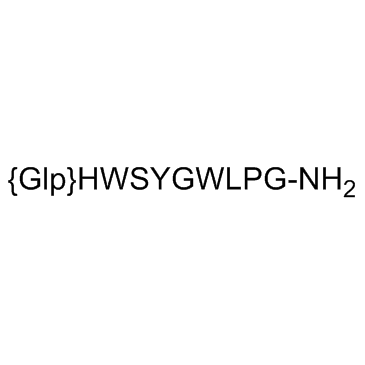
LHRH (salmon) acetate salt structure
|
Common Name | LHRH (salmon) acetate salt | ||
|---|---|---|---|---|
| CAS Number | 86073-88-3 | Molecular Weight | 1212.31000 | |
| Density | N/A | Boiling Point | N/A | |
| Molecular Formula | C60H73N15O13 | Melting Point | N/A | |
| MSDS | Chinese USA | Flash Point | N/A | |
| Symbol |

GHS08 |
Signal Word | Danger | |
Use of LHRH (salmon) acetate saltLuteinizing Hormone Releasing Hormone (LH-RH), salmon is the hypophysiotropic decapeptide synthesized in the hypothalamus that plays a crucial role in the control of reproductive functions. |
| Name | Luteinizing hormone releasing hormone salmon |
|---|---|
| Synonym | More Synonyms |
| Description | Luteinizing Hormone Releasing Hormone (LH-RH), salmon is the hypophysiotropic decapeptide synthesized in the hypothalamus that plays a crucial role in the control of reproductive functions. |
|---|---|
| Related Catalog | |
| In Vitro | Luteinizing hormone-releasing hormone (LHRH) is the key hormone in the control of reproductive functions.LHRH acts as an antimitogenic factor through the activation of the Gi-cAMP intracellular signaling pathway. LHRH might act as an inhibitory factor on both cell proliferation and metastatic behavior in melanoma cells[1]. The hypothalamic decapeptide luteinizing hormone-releasing hormone (LHRH) plays a central role in the control of reproduction by stimulating the release of pituitary luteinizing hormone (LH) and follicle-stimulating hormone (FSH), which in turn promote gonadal functions and regulate sex steroid secretion. The effects of LHRH are mediated by high-affinity G protein-coupled LHRH-receptor (LHRH-R) on pituitary gonadotropes. The responses to LHRH vary under different conditions and critically depend on the regimens of administration and doses delivered to gonadotrope cells[2]. |
| References |
| Molecular Formula | C60H73N15O13 |
|---|---|
| Molecular Weight | 1212.31000 |
| Exact Mass | 1211.55000 |
| PSA | 426.02000 |
| LogP | 2.37720 |
| InChIKey | NMJREATYWWNIKX-XJIZABAQSA-N |
| SMILES | CC(C)CC(NC(=O)C(Cc1c[nH]c2ccccc12)NC(=O)CNC(=O)C(Cc1ccc(O)cc1)NC(=O)C(CO)NC(=O)C(Cc1c[nH]c2ccccc12)NC(=O)C(Cc1cnc[nH]1)NC(=O)C1CCC(=O)N1)C(=O)N1CCCC1C(=O)NCC(N)=O |
| Storage condition | -20°C |
| Symbol |
GHS08 |
|---|---|
| Signal Word | Danger |
| Hazard Statements | H360 |
| Precautionary Statements | P201-P308 + P313 |
| Personal Protective Equipment | Eyeshields;full-face particle respirator type N100 (US);Gloves;respirator cartridge type N100 (US);type P1 (EN143) respirator filter;type P3 (EN 143) respirator cartridges |
| Hazard Codes | T: Toxic; |
| Risk Phrases | R60 |
| Safety Phrases | 53-22-36/37/39-45 |
| RIDADR | NONH for all modes of transport |
| WGK Germany | 3.0 |
|
Direct regulation of gonadotrophin-releasing hormone (GnRH) transcription by RF-amide-related peptide-3 and kisspeptin in a novel GnRH-secreting cell line, mHypoA-GnRH/GFP.
J. Neuroendocrinol. 26(12) , 888-97, (2014) RF-amide-related peptide-3 [RFRP-3; also often referred to as the mammalian orthologue of the avian gonadotrophin-inhibitory hormone (GnIH)] and kisspeptin have emerged as potent modulators of neuroen... |
|
|
Histidine(7.36(305)) in the conserved peptide receptor activation domain of the gonadotropin releasing hormone receptor couples peptide binding and receptor activation.
Mol. Cell. Endocrinol. 402 , 95-106, (2015) Transmembrane helix seven residues of G protein-coupled receptors (GPCRs) couple agonist binding to a conserved receptor activation mechanism. Amino-terminal residues of the GnRH peptide determine ago... |
|
|
Live birth rates after combined adjuvant therapy in IVF-ICSI cycles: a matched case-control study.
Reprod. Biomed. Online 30(4) , 340-8, (2015) The effectiveness of combined co-treatment with aspirin, doxycycline, prednisolone, with or without oestradiol patches, was investigated on live birth (LBR) rates after fresh and frozen embryo transfe... |
| pyr-his-trp-ser-tyr-gly-trp-leu-pro-gly-nh2 |
| Pyr-HWSYGWLPG-NH2 |
| Luteinizing Hormone Releasing Hormone (LH-RH), salmon |
The content on this webpage is sourced from various professional data sources. If you have any questions or concerns regarding the content, please feel free to contact service1@chemsrc.com.
- Shanghai Nianxing Industrial Co., Ltd
- China
- Product Name: LHRH (salmon) acetate salt
- Price: Check
- Purity: 98.0%
- Delivery: 10 Day
- Contact: Yang
- Email: sales@echemcloud.com
- GL Biochem (Shanghai) Ltd.
- China
- Product Name: Pyr-HWSYGWLPG-NH2
- Price: $Inquiry/1g
- Purity: 98.0%
- Delivery: Inquiry
- Contact: Jackie Yang
- Email: ymbetter@glbiochem.com
- Shanghai Jizhi Biochemical Technology Co., Ltd
- China
- Product Name: LHRH (salmon) acetate salt
- Price: ¥1078.0/5mg ¥378.0/1mg
- Purity: 97.0%
- Delivery: Inquiry
- Contact: Liu jia


- Email: 2130147988@qq.com
Get all suppliers and price by the below link:
LHRH (salmon) acetate salt suppliers
Reference only. check more LHRH (salmon) acetate salt price