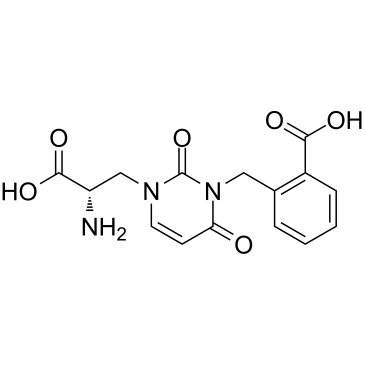
UBP 302

Modify Date: 2025-08-26 17:53:18

UBP 302 Structure
UBP 302 structure
Common Name UBP 302
CAS Number 745055-91-8 Molecular Weight 333.29600
Density N/A Boiling Point N/A
Molecular Formula C15H15N3O6 Melting Point N/A
MSDS Chinese USA Flash Point N/A
Symbol GHS07
GHS07
Signal Word Warning

 Use of UBP 302


UBP 302, the S enantiomer, is a potent and selective GluK1 (GluR5)-subunit containing kainate receptor antagonist (apparent Kd=402 nM), and displays very little affinity on GluK2 (GluR6) kainate receptors. Anxiolytic effects[1][2][3].

 Names

Name 2-[[3-[(2S)-2-amino-2-carboxyethyl]-2,6-dioxopyrimidin-1-yl]methyl]benzoic acid
Synonym More Synonyms

 UBP 302 Biological Activity

Description UBP 302, the S enantiomer, is a potent and selective GluK1 (GluR5)-subunit containing kainate receptor antagonist (apparent Kd=402 nM), and displays very little affinity on GluK2 (GluR6) kainate receptors. Anxiolytic effects[1][2][3].
Related Catalog
Target

Apparent Kd: 402 nM (GluK1)[2] IC50: 106 μM (AMPA receptors)[2]

References

[1]. More JC, et al. Characterisation of UBP296: a novel, potent and selective kainate receptor antagonist. Neuropharmacology. 2004 Jul;47(1):46-64.

[2]. Dolman NP, et al. Synthesis and pharmacology of willardiine derivatives acting as antagonists of kainate receptors. J Med Chem. 2005 Dec 1;48(24):7867-81.

[3]. Apland JP, et al. The limitations of diazepam as a treatment for nerve agent-induced seizures and neuropathology in rats: comparison with UBP302. J Pharmacol Exp Ther. 2014 Nov;351(2):359-72.

 Chemical & Physical Properties

Molecular Formula C15H15N3O6
Molecular Weight 333.29600
Exact Mass 333.09600
PSA 144.62000
InChIKey UUIYULWYHDSXHL-NSHDSACASA-N
SMILES NC(Cn1ccc(=O)n(Cc2ccccc2C(=O)O)c1=O)C(=O)O

 Safety Information

Symbol GHS07
GHS07
Signal Word Warning
Hazard Statements H302
RIDADR NONH for all modes of transport

 Articles3

More Articles
The limitations of diazepam as a treatment for nerve agent-induced seizures and neuropathology in rats: comparison with UBP302.

J. Pharmacol. Exp. Ther. 351(2) , 359-72, (2014)

Exposure to nerve agents induces prolonged status epilepticus (SE), causing brain damage or death. Diazepam (DZP) is the current US Food and Drug Administration-approved drug for the cessation of nerv...

High-Throughput Screen of GluK1 Receptor Identifies Selective Inhibitors with a Variety of Kinetic Profiles Using Fluorescence and Electrophysiology Assays.

J. Biomol. Screen. 20 , 708-19, (2015)

GluK1, a kainate subtype of ionotropic glutamate receptors, exhibits an expression pattern in the CNS consistent with involvement in pain processing and migraine. Antagonists of GluK1 have been shown ...

A rat model of nerve agent exposure applicable to the pediatric population: The anticonvulsant efficacies of atropine and GluK1 antagonists.

Toxicol. Appl. Pharmacol. 284 , 204-16, (2015)

Inhibition of acetylcholinesterase (AChE) after nerve agent exposure induces status epilepticus (SE), which causes brain damage or death. The development of countermeasures appropriate for the pediatr...

 Synonyms

Tocris-2079
UBC
(S)-1-(2-AMINO-2-CARBOXYETHYL)-3-(2-CARBOXYBENZYL)PYRIMIDINE-2,4-DIONE
UBP-302
2f35
The content on this webpage is sourced from various professional data sources. If you have any questions or concerns regarding the content, please feel free to contact service1@chemsrc.com.
Top Suppliers:I want be here


Get all suppliers and price by the below link:

UBP 302 suppliers


Price: ¥3100/1 mg

Reference only. check more UBP 302 price

Related Compounds: More...
UBP 296
745055-86-1
UBP 282
544697-47-4
UBP 310
902464-46-4
Imidazolium compounds, 1-(2-carboxyethyl)-4,5-dihydro-3-(hydroxyethyl)-2-norcoco alkyl, hydroxides, monosodium salts
94114-06-4
Imidazolium compounds, 1-(2-carboxyethyl)-4,5-dihydro-3-(hydroxyethyl)-2-norcoco alkyl, hydroxides, inner salts
94114-05-3
1-Propanaminium, 3,3'-iminobis[N-(carboxymethyl)-N,N-bis(2-hydroxyethyl)-, N-coco alkyl derivs., dihydroxides, bis(inner salts)
94095-50-8
methyl (1S,15S,18S,19S,20S)-18-hydroxy-1,3,11,12,14,15,16,17,18,19,20,21-dodecahydroyohimban-19-carboxylate,oxalic acid
94108-65-3
einecs 302-917-4
94135-49-6
6,13-dichloro-3-[4-[(4,6-dichloro-1,3,5-triazin-2-yl)amino]-2,3-disulfoanilino]-10-[4-[(4,6-dichloro-1,3,5-triazin-2-yl)amino]-2-sulfoanilino]-[1,4]benzoxazino[2,3-b]phenoxazine-4,11-disulfonic acid
94133-49-0
3,4-dichloro-N-(2-(4-(2-methoxyphenyl)piperazin-1-yl)ethyl)benzamide
1049469-21-7
2,3,4-trimethoxy-N-(2-(4-(2-methoxyphenyl)piperazin-1-yl)ethyl)benzamide
1049370-17-3
5-bromo-N-(2-(4-(2-methoxyphenyl)piperazin-1-yl)ethyl)furan-2-carboxamide
1049469-33-1
3,4-difluoro-N-(2-(4-(2-methoxyphenyl)piperazin-1-yl)ethyl)benzamide
1049469-54-6
N-(2-(4-(2-methoxyphenyl)piperazin-1-yl)ethyl)-2,4,6-trimethylbenzamide
1049469-64-8
2-(2,4-dichlorophenoxy)-N-(2-(4-(2-methoxyphenyl)piperazin-1-yl)ethyl)acetamide
1049413-98-0
4-(N,N-dimethylsulfamoyl)-N-(2-(4-(2-methoxyphenyl)piperazin-1-yl)ethyl)benzamide
1049469-74-0
N-(2-(4-(2-methoxyphenyl)piperazin-1-yl)ethyl)-2-(o-tolyloxy)acetamide
1049370-62-8
2-(2-fluorophenoxy)-N-(2-(4-(2-methoxyphenyl)piperazin-1-yl)ethyl)acetamide
1049370-67-3
2-(4-fluorophenoxy)-N-(2-(4-(2-methoxyphenyl)piperazin-1-yl)ethyl)acetamide
1049469-84-2