phyllomedusin
Modify Date: 2025-08-25 19:45:12
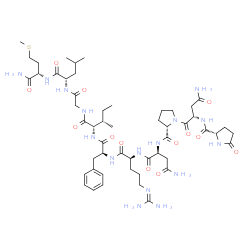
phyllomedusin structure
|
Common Name | phyllomedusin | ||
|---|---|---|---|---|
| CAS Number | 26145-48-2 | Molecular Weight | 1171.372 | |
| Density | 1.5±0.1 g/cm3 | Boiling Point | N/A | |
| Molecular Formula | C52H82N16O13S | Melting Point | N/A | |
| MSDS | N/A | Flash Point | N/A | |
Use of phyllomedusinPhyllomedusin, an tachykinin decapeptide, is a NK1 receptor agonist. Phyllomedusin has vasodilating activity and provokes the contraction of the pylorus[1][2][3]. |
| Name | phyllomedusin |
|---|
| Description | Phyllomedusin, an tachykinin decapeptide, is a NK1 receptor agonist. Phyllomedusin has vasodilating activity and provokes the contraction of the pylorus[1][2][3]. |
|---|---|
| Related Catalog | |
| Target |
NK1 |
| In Vitro | Phyllomedusin increases neuronal excitation with psychoactive and behavioral responses[4]. Phyllomedusin can cause smooth muscle contraction and vasodilatation[4]. |
| In Vivo | Phyllomedusin (30-300 μg/kg, i.p.) delays gastric emptying in conscious rats[2]. Phyllomedusin (0.1 and 5 μg/kg, i.v.) has stimulant activity on the stomach of the anaesthetized rat[3]. Animal Model: Conscious rats[2]. Dosage: 30, 100, 300 μg/kg Administration: Intraperitoneal injection (i.p.) Result: Caused 75% delay in gastric emptying in conscious rats. |
| References |
| Density | 1.5±0.1 g/cm3 |
|---|---|
| Molecular Formula | C52H82N16O13S |
| Molecular Weight | 1171.372 |
| Exact Mass | 1170.596802 |
| LogP | -1.52 |
| Index of Refraction | 1.668 |
| InChIKey | GGIXGYYACCFXOQ-GUXVTFBTSA-N |
| SMILES | CCC(C)C(NC(=O)C(Cc1ccccc1)NC(=O)C(CCCN=C(N)N)NC(=O)C(CC(N)=O)NC(=O)C1CCCN1C(=O)C(CC(N)=O)NC(=O)C1CCC(=O)N1)C(=O)NCC(=O)NC(CC(C)C)C(=O)NC(CCSC)C(N)=O |