L-Canavanine sulfate
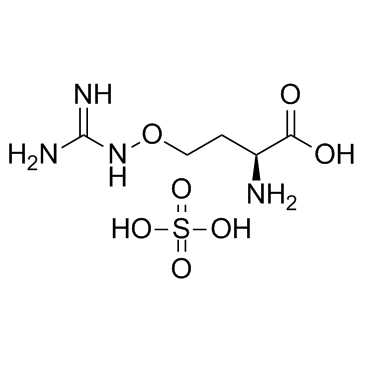
L-Canavanine sulfate structure
|
Common Name | L-Canavanine sulfate | ||
|---|---|---|---|---|
| CAS Number | 2219-31-0 | Molecular Weight | 274.252 | |
| Density | N/A | Boiling Point | 574ºC at 760mmHg | |
| Molecular Formula | C5H14N4O7S | Melting Point | 160-165 °C (dec.) | |
| MSDS | Chinese USA | Flash Point | 300.9ºC | |
| Symbol |

GHS07 |
Signal Word | Warning | |
Use of L-Canavanine sulfateL-Canavanine sulfate is a selective inhibitor of inducible NO synthase. |
| Name | L-canavanine sulfate |
|---|---|
| Synonym | More Synonyms |
| Description | L-Canavanine sulfate is a selective inhibitor of inducible NO synthase. |
|---|---|
| Related Catalog | |
| Target |
NO synthase[1] |
| In Vitro | L-Canavanine sulfate (L-CAV) causes only a limited degree of cytotoxicity in HeLa, Hep G2, and SK-HEP-1 cells when given alone in arginine-rich media with IC50 values ranging from 5 to 10 mM. In HaCaT keratinocyte cell line, IC50 of L-Canavanine sulfate exceeds the concentration of 10 mM, indicating low cytotoxicity in normal cells in vitro. In arginine-free media, IC50 of L-Canavanine sulfate in HeLa, Hep G2, and SK-HEP-1 cells are 0.21±0.04; 0.64±0.16; and 1.18±0.14 mM, respectively. L-Canavanine sulfate, which is hardly toxic alone, potentiates the cytotoxicity of vinblastine (VIN) and paclitaxel (PTX) in HeLa and hepatocellular carcinoma cells[2]. |
| In Vivo | Administration of L-Canavanine sulfate (100 mg/kg) produces a moderate increase in mean arterial pressure of 20 mm Hg, returns blood pressure to near basal levels and completely attenuates the lipopolysaccharide-induced hypotension. All, but one, endotoxaemic rats dosed with L-Canavanine sulfate (100 mg/kg) survive for 6 h post lipopolysaccharide, after which time the experiment is terminated (n=7)[1]. L-canavanine inhibits DNA synthesis by Li 210 cells in vivo and significantly increases the lifespan of animals bearing the Li 210 leukemia. An optimal dose of 18 g/kg produces a peak increase in lifespan of 44%. The therapeutic dose range is narrow, and a dose of 24 g/kg causes death due to drug toxicity[3]. |
| Cell Assay | A dose-dependent cytotoxicity is examined using the MTT assay. Into each well of 96-well plates, 2×10⁴ of cells are seeded, and after 24 h incubation, cells are incubated with test compounds (including L-Canavanine sulfate). After 24 h, 0.5 mg/mL of MTT is added to each well of HeLa, Caco-2, MIA PaCa-2, BxPC-3 and SK-HEP-1 cells, while MTT is added to Hep G2 after 48 h incubation with test compounds (including L-Canavanine sulfate). The cells are then incubated for 3 h so that the viable cells could produce formazan crystals; they are then dissolved in 100 μL DMSO. After incubation for 10 min in a shaker, the absorption of the formazan is measured at 570 nm using a reader[2]. |
| Animal Admin | Male rats weighing 295 to 305 g are used. After a period of stabilization, 6 mg lipopolysaccharide/kg is administered intravenously in 0.3 mL over 2 min, and cardiovascular parameters are monitored over 5 to 6 h. L-Canavanine sulfate is administered intravenously in a 0.2 mL volume bolus injection at 100 mg/kg[1]. Mice: L-Canavanine is dissolved in phosphate-buffered saline[1]. L-Canavanine (100 mg/mb) is infused at a rate of 0.1 mL/hr through a catheter implanted S.C. over the back. Groups of 5 mice are treated at each dose beveltogether with 6 to 8 control animals and are inspected twice per day for median time of death[1]. |
| References |
| Boiling Point | 574ºC at 760mmHg |
|---|---|
| Melting Point | 160-165 °C (dec.) |
| Molecular Formula | C5H14N4O7S |
| Molecular Weight | 274.252 |
| Flash Point | 300.9ºC |
| Exact Mass | 274.058319 |
| PSA | 217.43000 |
| LogP | 0.52230 |
| Appearance of Characters | powder | white |
| Vapour Pressure | 1.21E-08mmHg at 25°C |
| InChIKey | MVIPJKVMOKFIEV-DFWYDOINSA-N |
| SMILES | NC(N)=NOCCC(N)C(=O)O.O=S(=O)(O)O |
| Storage condition | 2-8°C |
| Water Solubility | H2O: 100 mg/mL |
| Symbol |
GHS07 |
|---|---|
| Signal Word | Warning |
| Hazard Statements | H302-H312-H332 |
| Precautionary Statements | P280 |
| Personal Protective Equipment | dust mask type N95 (US);Eyeshields;Gloves |
| Hazard Codes | Xn: Harmful; |
| Risk Phrases | R20/21/22 |
| Safety Phrases | S36 |
| RIDADR | 2811 |
| WGK Germany | 3 |
| HS Code | 2925290090 |
| HS Code | 2925290090 |
|---|---|
| Summary | 2925290090 other imines and their derivatives; salts thereof。Supervision conditions:None。VAT:17.0%。Tax rebate rate:9.0%。MFN tariff:6.5%。General tariff:30.0% |
|
Determination of L-canavanine and other free amino acids in Vicia disperma (Fabaceae) seeds by precolumn derivatization using diethyl ethoxymethylenemalonate and reversed-phase high-performance liquid chromatography.
Talanta 131 , 95-8, (2014) A method for determination of the non-protein amino acid l-α-amino-γ-(guanidinooxy)-n-butyric acid (L-canavanine) and other free amino acids in Vicia disperma is presented. Seed extracts were derivati... |
|
|
Quality control of a transcriptional regulator by SUMO-targeted degradation.
Mol. Cell. Endocrinol. 29 , 1694-706, (2009) Slx5 and Slx8 are heterodimeric RING domain-containing proteins that possess SUMO-targeted ubiquitin ligase (STUbL) activity in vitro. Slx5-Slx8 and its orthologs are proposed to target SUMO conjugate... |
|
|
Dissection of genetically complex traits with extremely large pools of yeast segregants.
Nanotechnology 464 , 1039-42, (2010) Most heritable traits, including many human diseases, are caused by multiple loci. Studies in both humans and model organisms, such as yeast, have failed to detect a large fraction of the loci that un... |
| CANAVANINE SULFATE,L |
| L-Canavanine sulphate |
| L-Canavanine Sulfate Hydrate |
| L-CANAVANINE SULFATE |
| O-Guanidino-L-homoserin,Sulfat |
| L-Homoserine, O-[(diaminomethylene)amino]-, sulfate (1:1) |
| O-[(Diaminomethylene)amino]-L-homoserine sulfate (1:1) |
| Canavanine sulfate |
| EINECS 218-728-4 |
| O-guanidino-L-homoserine,sulfate |
| L-Canavanine sulfate salt |
| L-HOMOSERINE, O-((AMINOIMINOMETHYL)AMINO)-, SULFATE (1:1) |
| MFCD00012618 |
| canavanine sulphate |
The content on this webpage is sourced from various professional data sources. If you have any questions or concerns regarding the content, please feel free to contact service1@chemsrc.com.
- Shanghai Nianxing Industrial Co., Ltd
- China
- Product Name: L-Canavanine sulfate
- Price: Check
- Purity: 98.0%
- Delivery: 10 Day
- Contact: Yang
- Email: sales@echemcloud.com
- Shanghai Jizhi Biochemical Technology Co., Ltd
- China
- Product Name: L-Canavanine sulfate
- Price: ¥888.0/20mg
- Purity: 98.0%
- Delivery: 3 Day
- Contact: Liu jia


- Email: 2130147988@qq.com
- DC Chemicals Limited
- China
- Product Name: AI3-52581
- Price: $Inquiry/100mg $Inquiry/250mg $Inquiry/500mg
- Purity: 98.0%
- Delivery: 3 Day
- Contact: Tony Cao
- Email: sales@dcchemicals.com
- Dayang Chem (Hangzhou) Co., Ltd.
- China
- Product Name: L-canavanine sulfate
- Price: $Inquiry/100g $Inquiry/1kg $Inquiry/100kg $Inquiry/1000kg
- Purity: 98.0%
- Delivery: Inquiry
- Contact: Ms Wang
- Email: enquiry@dycnchem.com
- Shanghai Amole Biotechnology Co., Ltd.
- China
- Product Name: L-Canavanine sulfate
- Price: ¥Inquiry/20mg ¥Inquiry/100mg ¥Inquiry/10mg ¥Inquiry/500mg
- Purity: 97.0%
- Delivery: Inquiry
- Contact: Xiyao Wang
- Email: 3623107365@qq.com
Get all suppliers and price by the below link:
L-Canavanine sulfate suppliers
Reference only. check more L-Canavanine sulfate price