L-Canavanine sulfate
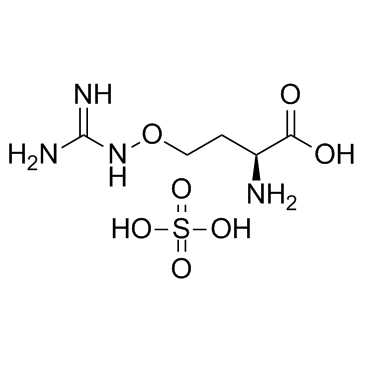
L-Canavanine sulfate structure
|
Common Name | L-Canavanine sulfate | ||
|---|---|---|---|---|
| CAS Number | 2219-31-0 | Molecular Weight | 274.252 | |
| Density | N/A | Boiling Point | 574ºC at 760mmHg | |
| Molecular Formula | C5H14N4O7S | Melting Point | 160-165 °C (dec.) | |
| MSDS | Chinese USA | Flash Point | 300.9ºC | |
| Symbol |

GHS07 |
Signal Word | Warning | |
Use of L-Canavanine sulfateL-Canavanine sulfate is a selective inhibitor of inducible NO synthase. |
This table lists Chinese names, IUPAC names and various aliases of this chemical substance.
| Name | L-canavanine sulfate |
|---|---|
| Synonym | More Synonyms |
This table contains bioactivity, target information and biological‑assay experimental data of this compound.
| Description | L-Canavanine sulfate is a selective inhibitor of inducible NO synthase. |
|---|---|
| Related Catalog | |
| Target |
NO synthase[1] |
| In Vitro | L-Canavanine sulfate (L-CAV) causes only a limited degree of cytotoxicity in HeLa, Hep G2, and SK-HEP-1 cells when given alone in arginine-rich media with IC50 values ranging from 5 to 10 mM. In HaCaT keratinocyte cell line, IC50 of L-Canavanine sulfate exceeds the concentration of 10 mM, indicating low cytotoxicity in normal cells in vitro. In arginine-free media, IC50 of L-Canavanine sulfate in HeLa, Hep G2, and SK-HEP-1 cells are 0.21±0.04; 0.64±0.16; and 1.18±0.14 mM, respectively. L-Canavanine sulfate, which is hardly toxic alone, potentiates the cytotoxicity of vinblastine (VIN) and paclitaxel (PTX) in HeLa and hepatocellular carcinoma cells[2]. |
| In Vivo | Administration of L-Canavanine sulfate (100 mg/kg) produces a moderate increase in mean arterial pressure of 20 mm Hg, returns blood pressure to near basal levels and completely attenuates the lipopolysaccharide-induced hypotension. All, but one, endotoxaemic rats dosed with L-Canavanine sulfate (100 mg/kg) survive for 6 h post lipopolysaccharide, after which time the experiment is terminated (n=7)[1]. L-canavanine inhibits DNA synthesis by Li 210 cells in vivo and significantly increases the lifespan of animals bearing the Li 210 leukemia. An optimal dose of 18 g/kg produces a peak increase in lifespan of 44%. The therapeutic dose range is narrow, and a dose of 24 g/kg causes death due to drug toxicity[3]. |
| Cell Assay | A dose-dependent cytotoxicity is examined using the MTT assay. Into each well of 96-well plates, 2×10⁴ of cells are seeded, and after 24 h incubation, cells are incubated with test compounds (including L-Canavanine sulfate). After 24 h, 0.5 mg/mL of MTT is added to each well of HeLa, Caco-2, MIA PaCa-2, BxPC-3 and SK-HEP-1 cells, while MTT is added to Hep G2 after 48 h incubation with test compounds (including L-Canavanine sulfate). The cells are then incubated for 3 h so that the viable cells could produce formazan crystals; they are then dissolved in 100 μL DMSO. After incubation for 10 min in a shaker, the absorption of the formazan is measured at 570 nm using a reader[2]. |
| Animal Admin | Male rats weighing 295 to 305 g are used. After a period of stabilization, 6 mg lipopolysaccharide/kg is administered intravenously in 0.3 mL over 2 min, and cardiovascular parameters are monitored over 5 to 6 h. L-Canavanine sulfate is administered intravenously in a 0.2 mL volume bolus injection at 100 mg/kg[1]. Mice: L-Canavanine is dissolved in phosphate-buffered saline[1]. L-Canavanine (100 mg/mb) is infused at a rate of 0.1 mL/hr through a catheter implanted S.C. over the back. Groups of 5 mice are treated at each dose beveltogether with 6 to 8 control animals and are inspected twice per day for median time of death[1]. |
| References |
This table shows physicochemical parameters including melting point, boiling point, density, solubility and optical rotation. Missing data is marked as N/A.
| Boiling Point | 574ºC at 760mmHg |
|---|---|
| Melting Point | 160-165 °C (dec.) |
| Molecular Formula | C5H14N4O7S |
| Molecular Weight | 274.252 |
| Flash Point | 300.9ºC |
| Exact Mass | 274.058319 |
| PSA | 217.43000 |
| LogP | 0.52230 |
| Appearance of Characters | powder | white |
| Vapour Pressure | 1.21E-08mmHg at 25°C |
| InChIKey | MVIPJKVMOKFIEV-DFWYDOINSA-N |
| SMILES | NC(N)=NOCCC(N)C(=O)O.O=S(=O)(O)O |
| Storage condition | 2-8°C |
| Water Solubility | H2O: 100 mg/mL |
This table provides MSDS information including hazard classification, first‑aid, fire‑fighting, spill handling, operation and storage instructions.
This table covers safety warnings, protective measures, incompatible substances and disposal guidelines for this compound.
| Symbol |
GHS07 |
|---|---|
| Signal Word | Warning |
| Hazard Statements | H302-H312-H332 |
| Precautionary Statements | P280 |
| Personal Protective Equipment | dust mask type N95 (US);Eyeshields;Gloves |
| Hazard Codes | Xn: Harmful; |
| Risk Phrases | R20/21/22 |
| Safety Phrases | S36 |
| RIDADR | 2811 |
| WGK Germany | 3 |
| HS Code | 2925290090 |
This table shows customs‑related data including HS‑code, tariff and regulatory conditions for import and export.
| HS Code | 2925290090 |
|---|---|
| Summary | 2925290090 other imines and their derivatives; salts thereof。Supervision conditions:None。VAT:17.0%。Tax rebate rate:9.0%。MFN tariff:6.5%。General tariff:30.0% |
This table lists relevant public references with title, journal and publication metadata for this compound.
|
Determination of L-canavanine and other free amino acids in Vicia disperma (Fabaceae) seeds by precolumn derivatization using diethyl ethoxymethylenemalonate and reversed-phase high-performance liquid chromatography.
Talanta 131 , 95-8, (2014) A method for determination of the non-protein amino acid l-α-amino-γ-(guanidinooxy)-n-butyric acid (L-canavanine) and other free amino acids in Vicia disperma is presented. Seed extracts were derivati... |
|
|
Quality control of a transcriptional regulator by SUMO-targeted degradation.
Mol. Cell. Endocrinol. 29 , 1694-706, (2009) Slx5 and Slx8 are heterodimeric RING domain-containing proteins that possess SUMO-targeted ubiquitin ligase (STUbL) activity in vitro. Slx5-Slx8 and its orthologs are proposed to target SUMO conjugate... |
|
|
Dissection of genetically complex traits with extremely large pools of yeast segregants.
Nanotechnology 464 , 1039-42, (2010) Most heritable traits, including many human diseases, are caused by multiple loci. Studies in both humans and model organisms, such as yeast, have failed to detect a large fraction of the loci that un... |
This table contains target information, in‑vitro & in‑vivo assay data for this compound.
|
Name: Small-molecule inhibitors of ST2 (IL1RL1)
Source: 20881
Target: interleukin-1 receptor-like 1 isoform [homo sapiens]
External Id: ST2_IL33_Inhibitors_Primary_Screening_77700
|
|
Name: Rescue cell viability in cybrid cells with a genetic mutation in complex 1 of the mit...
Source: ICCB-Longwood/NSRB Screening Facility, Harvard Medical School
Target: N/A
External Id: HMS1315
|
|
Name: qHTS assay for measurement of the activity of small molecule inhibitors on Zika virus...
Source: NCGC
Target: N/A
External Id: ZIK097
|
|
Name: 96-well format Chlamydomonas reinhardtii Algae Gravitaxis Assay to measure the differ...
Source: University of Pittsburgh Molecular Library Screening Center
Target: N/A
External Id: MH081217, Chlamydomonas reinhardtii Gravitaxis Assay to Identify Small Molecule Inhibitors of Cilia.
|
|
Name: Dicer-mediated maturation of pre-microRNA
Source: Center for Chemical Genomics, University of Michigan
Target: N/A
External Id: TargetID_659_CEMA
|
|
Name: High-throughput screen for inhibitors of the GIV GBA-motif interaction with Galpha-i ...
Source: ICCB-Longwood/NSRB Screening Facility, Harvard Medical School
External Id: HMS1303
|
|
Name: qHTS assay to identify small molecule antagonists of the estrogen related receptor (E...
Source: 824
Target: N/A
External Id: ERR513
|
|
Name: qHTS assay to identify small molecule antagonists of the estrogen related receptor (E...
Source: 824
External Id: ERR845
|
|
Name: qHTS assay to identify small molecule antagonists of the estrogen related receptor si...
Source: 824
Target: N/A
External Id: PGC981
|
|
Name: Discovery of Small Molecules to Inhibit Human Cytomegalovirus Nuclear Egress
Source: ICCB-Longwood/NSRB Screening Facility, Harvard Medical School
Target: HCMV UL50
External Id: HMS1262
|
This table collects all English aliases, systematic names and CAS‑related synonyms of the compound.
| CANAVANINE SULFATE,L |
| L-Canavanine sulphate |
| L-Canavanine Sulfate Hydrate |
| L-CANAVANINE SULFATE |
| O-Guanidino-L-homoserin,Sulfat |
| L-Homoserine, O-[(diaminomethylene)amino]-, sulfate (1:1) |
| O-[(Diaminomethylene)amino]-L-homoserine sulfate (1:1) |
| Canavanine sulfate |
| EINECS 218-728-4 |
| O-guanidino-L-homoserine,sulfate |
| L-Canavanine sulfate salt |
| L-HOMOSERINE, O-((AMINOIMINOMETHYL)AMINO)-, SULFATE (1:1) |
| MFCD00012618 |
| canavanine sulphate |
This section contains frequently‑asked‑questions about this compound, including basic parameters, properties, storage conditions and corresponding answers.
| Q: What are the uses of L-canavanine sulfate? |
| A: Main uses of L-canavanine sulfate: L-Canavanine sulfate is a selective inhibitor of inducible NO synthase. |
| Q: What is the melting point of L-canavanine sulfate? |
| A: Melting point of L-canavanine sulfate is 160-165 °C (dec.). |
| Q: What is the SMILES notation of L-canavanine sulfate? |
| A: SMILES notation of L-canavanine sulfate is NC(N)=NOCCC(N)C(=O)O.O=S(=O)(O)O. |
| Q: What is the boiling point of L-canavanine sulfate? |
| A: Boiling point of L-canavanine sulfate is 574ºC at 760mmHg. |
| Q: What is the CAS number of L-canavanine sulfate? |
| A: CAS number of L-canavanine sulfate is 2219-31-0. |
| Q: What English synonyms does L-canavanine sulfate have? |
| A: English synonyms of L-canavanine sulfate: CANAVANINE SULFATE,L, L-Canavanine sulphate, L-Canavanine Sulfate Hydrate, L-CANAVANINE SULFATE, O-Guanidino-L-homoserin,Sulfat, L-Homoserine, O-[(diaminomethylene)amino]-, sulfate (1:1), O-[(Diaminomethylene)amino]-L-homoserine sulfate (1:1), Canavanine sulfate, EINECS 218-728-4, O-guanidino-L-homoserine,sulfate, L-Canavanine sulfate salt, L-HOMOSERINE, O-((AMINOIMINOMETHYL)AMINO)-, SULFATE (1:1), MFCD00012618, canavanine sulphate. |
| Q: What is the physical appearance of L-canavanine sulfate? |
| A: L-canavanine sulfate appears as powder | white. |
| Q: What is the polar surface area (PSA) of L-canavanine sulfate? |
| A: Polar surface area (PSA) of L-canavanine sulfate is 217.43000. |
| Q: What is the safety information for L-canavanine sulfate? |
| A: Safety information for L-canavanine sulfate: S36. |
| Q: What is the molecular formula of L-canavanine sulfate? |
| A: Molecular formula of L-canavanine sulfate is C5H14N4O7S. |
This table lists manufacturers and suppliers of this compound, including vendor names and product supply reference information.
| Shanghai Nianxing Industrial Co., Ltd |
| Dayang Chem (Hangzhou) Co., Ltd. |