KZR-616 maleate
Modify Date: 2025-09-08 19:36:00
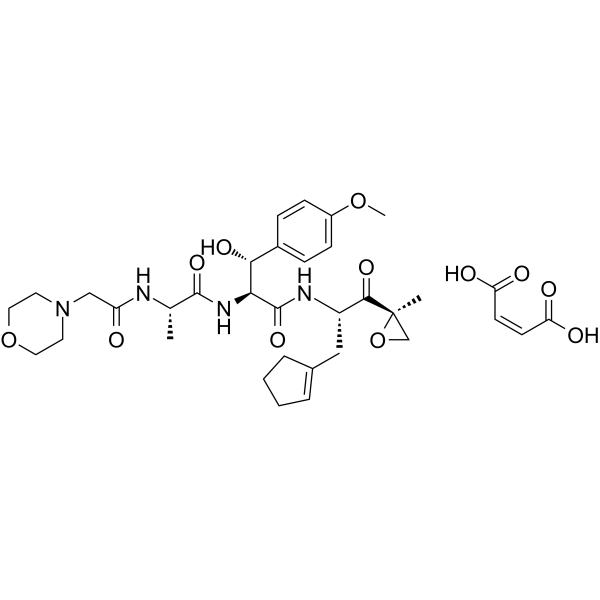
KZR-616 maleate structure
|
Common Name | KZR-616 maleate | ||
|---|---|---|---|---|
| CAS Number | 2170983-62-5 | Molecular Weight | 702.75 | |
| Density | N/A | Boiling Point | N/A | |
| Molecular Formula | C34H46N4O12 | Melting Point | N/A | |
| MSDS | N/A | Flash Point | N/A | |
Use of KZR-616 maleateKZR-616 maleate, a first-in-class immunoproteasome inhibitor, selectively targets the LMP7 (IC50: 39/57 nM=hLMP7/mLMP7) and LMP2 (IC50: 131/179 nM=hLMP7/mLMP7) subunits of the immunoproteasome. KZR-616 maleate has the potential for the research of multiple autoimmune diseases[1][2]. |
| Name | KZR-616 maleate |
|---|
| Description | KZR-616 maleate, a first-in-class immunoproteasome inhibitor, selectively targets the LMP7 (IC50: 39/57 nM=hLMP7/mLMP7) and LMP2 (IC50: 131/179 nM=hLMP7/mLMP7) subunits of the immunoproteasome. KZR-616 maleate has the potential for the research of multiple autoimmune diseases[1][2]. |
|---|---|
| Related Catalog | |
| In Vitro | KZR-616 maleate also inhibits MECL-1 subunit (IC50=623 nM) and constitutive proteasome β5 subunit (IC50=688 nM). KZR-616 maintains LMP7 and LMP2 selective inhibition in MOLT-4 cells. KZR-616 (250 nM) shows a comparable cytokine inhibition profile peripheral blood mononuclear cells (PBMC)[1]. KZR-616 maleate is an immunoproteasome-selective inhibitor identified based on the optimization of ONX-0914 (HY-13207) and PR-924 (HY-123587)[3]. |
| In Vivo | KZR-616 maleate (5 mg/kg; i.v.; dosing was repeated on days 6, 8, 11, and 13) shows efficacy in the anticollagen antibody induced arthritis (CAIA) model[1]. Animal Model: 7-8 week old female BALB/c mice (CAIA model)[1] Dosage: I.v.; Dosing was repeated on days 6, 8, 11, and 13 until for 15 day Administration: 5 mg/kg Result: Showed efficacy in the anticollagen antibody induced arthritis (CAIA) model. |
| References |
| Molecular Formula | C34H46N4O12 |
|---|---|
| Molecular Weight | 702.75 |
| InChIKey | HVKAUVYFVFFXLW-MTOCQVLVSA-N |
| SMILES | COc1ccc(C(O)C(NC(=O)C(C)NC(=O)CN2CCOCC2)C(=O)NC(CC2=CCCC2)C(=O)C2(C)CO2)cc1.O=C(O)C=CC(=O)O |