Nelonicline citrate
Modify Date: 2025-08-27 08:26:00
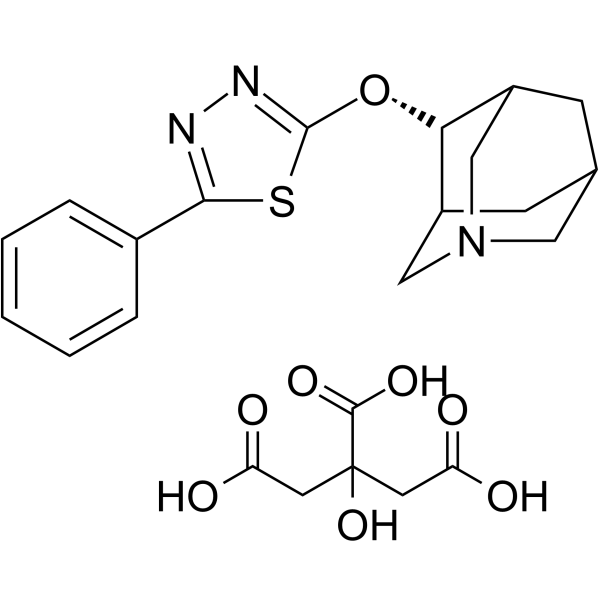
Nelonicline citrate structure
|
Common Name | Nelonicline citrate | ||
|---|---|---|---|---|
| CAS Number | 1026136-84-4 | Molecular Weight | 505.54 | |
| Density | N/A | Boiling Point | N/A | |
| Molecular Formula | C23H27N3O8S | Melting Point | N/A | |
| MSDS | N/A | Flash Point | N/A | |
Use of Nelonicline citrateNelonicline (ABT-126) citrate is an orally active and selective α7 nicotinic receptor agonist with high affinity to α7 nAChRs in human brain (Ki=12.3 nM). Nelonicline citrate is used for the research of shizophrenia and Alzheimer's disease[1][2][3]. |
| Name | Nelonicline citrate |
|---|
| Description | Nelonicline (ABT-126) citrate is an orally active and selective α7 nicotinic receptor agonist with high affinity to α7 nAChRs in human brain (Ki=12.3 nM). Nelonicline citrate is used for the research of shizophrenia and Alzheimer's disease[1][2][3]. |
|---|---|
| Related Catalog | |
| In Vitro | Nelonicline citrate is an agonist that binds with high affinity to α7 nAChRs in human brain (Ki= 12.3 nM) and activates currents in Xenopus oocytes expressing recombinant human α7 nAChRs (EC50=2 μM; intrinsic activity of 74% relative to acetylcholine). Nelonicline citrate does bind to α3β4* nAChRs in human IMR-32 neuroblastoma cells (Ki=60 nM), but has only 12% efficacy at 100,000 nM in a calcium flux assay in these cell. Like some other α7 nAChR agonists, Nelonicline citrate is also a 5-HT3 receptor antagonist, but it has >10-fold lower affinity for this receptor than for α7 nAChRs (Ki of 140 nM)[1]. |
| References |
| Molecular Formula | C23H27N3O8S |
|---|---|
| Molecular Weight | 505.54 |
| InChIKey | JIGJENFBLHIYGW-SUZIKMBOSA-N |
| SMILES | O=C(O)CC(O)(CC(=O)O)C(=O)O.c1ccc(-c2nnc(OC3C4CC5CC3CN(C5)C4)s2)cc1 |