Bimatoprost

Bimatoprost structure
|
Common Name | Bimatoprost | ||
|---|---|---|---|---|
| CAS Number | 155206-00-1 | Molecular Weight | 415.566 | |
| Density | 1.1±0.1 g/cm3 | Boiling Point | 629.8±55.0 °C at 760 mmHg | |
| Molecular Formula | C25H37NO4 | Melting Point | 66-68°C | |
| MSDS | USA | Flash Point | 334.7±31.5 °C | |
Use of BimatoprostBimatoprost is a prostaglandin analog used topically (as eye drops) to control the progression of glaucoma and in the management of ocular hypertension.Target: Prostaglandin ReceptorBimatoprost is a prostaglandin analog/prodrug used topically (as eye drops) to control the progression of glaucoma and in the management of ocular hypertension. It reduces intraocular pressure (IOP) by increasing the outflow of aqueous fluid from the eyes. In December 2008, the indication to lengthen eyelashes was approved by the U.S. Food and Drug Administration (FDA); the cosmetic formulation of bimatoprost is sold as Latisse. In 2008-2011, at least three case series suggested that bimatoprost has the ability to reduce adipose (fat) tissue.Bimatoprost activates prostamide alpha F2 receptors found in the hair follicle to stimulate its growth rate. Research led by Professor Randall and the University of Bradford found that it may also offer a treatment for scalp hair regrowth in trials conducted on samples taken from men undergoing hair transplants. According to Allergan's package labeling, users of its Latisse cosmetic product didn't develop darker irises in clinical studies; however, "patients should be advised about the potential for increased brown iris pigmentation which is likely to be permanent." |
This table lists Chinese names, IUPAC names and various aliases of this chemical substance.
| Name | bimatoprost |
|---|---|
| Synonym | More Synonyms |
This table contains bioactivity, target information and biological‑assay experimental data of this compound.
| Description | Bimatoprost is a prostaglandin analog used topically (as eye drops) to control the progression of glaucoma and in the management of ocular hypertension.Target: Prostaglandin ReceptorBimatoprost is a prostaglandin analog/prodrug used topically (as eye drops) to control the progression of glaucoma and in the management of ocular hypertension. It reduces intraocular pressure (IOP) by increasing the outflow of aqueous fluid from the eyes. In December 2008, the indication to lengthen eyelashes was approved by the U.S. Food and Drug Administration (FDA); the cosmetic formulation of bimatoprost is sold as Latisse. In 2008-2011, at least three case series suggested that bimatoprost has the ability to reduce adipose (fat) tissue.Bimatoprost activates prostamide alpha F2 receptors found in the hair follicle to stimulate its growth rate. Research led by Professor Randall and the University of Bradford found that it may also offer a treatment for scalp hair regrowth in trials conducted on samples taken from men undergoing hair transplants. According to Allergan's package labeling, users of its Latisse cosmetic product didn't develop darker irises in clinical studies; however, "patients should be advised about the potential for increased brown iris pigmentation which is likely to be permanent." |
|---|---|
| Related Catalog | |
| References |
This table shows physicochemical parameters including melting point, boiling point, density, solubility and optical rotation. Missing data is marked as N/A.
| Density | 1.1±0.1 g/cm3 |
|---|---|
| Boiling Point | 629.8±55.0 °C at 760 mmHg |
| Melting Point | 66-68°C |
| Molecular Formula | C25H37NO4 |
| Molecular Weight | 415.566 |
| Flash Point | 334.7±31.5 °C |
| Exact Mass | 415.272247 |
| PSA | 89.79000 |
| LogP | 1.98 |
| Vapour Pressure | 0.0±1.9 mmHg at 25°C |
| Index of Refraction | 1.591 |
| InChIKey | AQOKCDNYWBIDND-UDIRQSBCSA-N |
| SMILES | CCNC(=O)CCCC=CCC1C(O)CC(O)C1C=CC(O)CCc1ccccc1 |
| Storage condition | −20°C |
This table provides MSDS information including hazard classification, first‑aid, fire‑fighting, spill handling, operation and storage instructions.
This table covers safety warnings, protective measures, incompatible substances and disposal guidelines for this compound.
| Personal Protective Equipment | Eyeshields;Gloves;type N95 (US);type P1 (EN143) respirator filter |
|---|---|
| Hazard Codes | Xi |
| RIDADR | NONH for all modes of transport |
| WGK Germany | 3 |
This table presents publicly reported synthetic routes, reaction conditions, reactants and product information of the compound.
This table lists upstream starting materials and downstream derivative products related to this chemical.
| Precursor 8 | |
|---|---|
| DownStream 0 | |
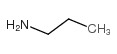 CAS#:107-10-8
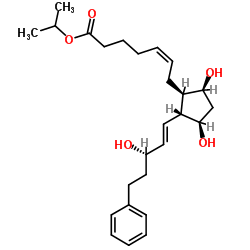 CAS#:130209-76-6
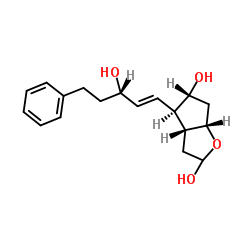 CAS#:856240-62-5
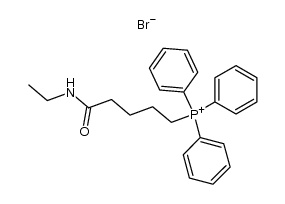 CAS#:1201226-16-5
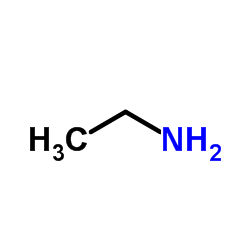 CAS#:75-04-7
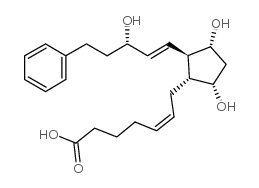 CAS#:38344-08-0
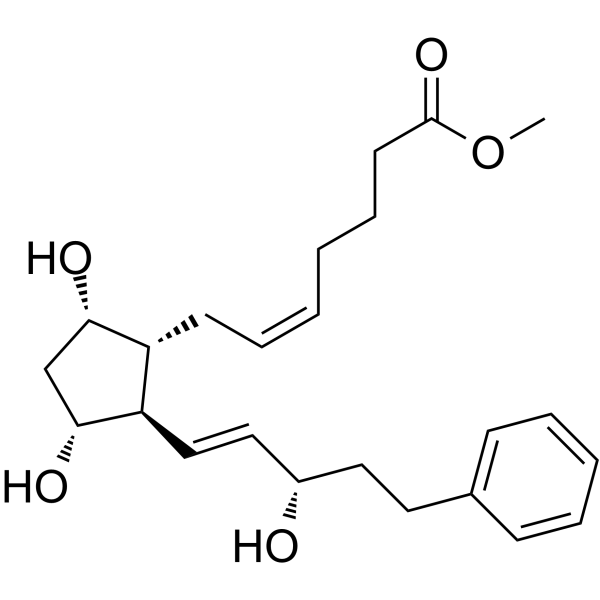 CAS#:38315-47-8
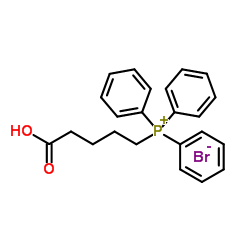 CAS#:17814-85-6
This table lists relevant public references with title, journal and publication metadata for this compound.
|
A retrospective review and observational study of outcomes and safety of bimatoprost ophthalmic solution 0.03% for treating eyelash hypotrichosis.
Dermatol. Surg. 40(10) , 1118-24, (2014) The efficacy and safety of bimatoprost ophthalmic solution 0.03% for treating hypotrichosis were shown in a randomized controlled trial and in an open-label study. To date, no data on real-world exper... |
|
|
Conjunctiva-associated lymphoid tissue (CALT) reactions to antiglaucoma prostaglandins with or without BAK-preservative in rabbit acute toxicity study.
PLoS ONE 7 , e33913, (2012) Conjunctiva-associated lymphoid tissue (CALT) is closely associated with ocular surface immunity. This study investigated the effects of antiglaucoma prostaglandin analogs with or without benzalkonium... |
|
|
Expression profile of inflammatory cytokines in aqueous from glaucomatous eyes.
Mol. Vis. 18 , 431-8, (2012) To determine the proinflammatory cytokine profile of aqueous humor from glaucomatous eyes.Aqueous humor samples were prospectively collected from 38 eyes (26 primary open angle glaucoma [POAG] and 12 ... |
This table contains target information, in‑vitro & in‑vivo assay data for this compound.
|
Name: Drug Induced Liver Injury Prediction System (DILIps) training set; hepatic side effec...
Source: ChEMBL
Target: Hepatotoxicity
External Id: CHEMBL1909317
|
|
Name: Drug Induced Liver Injury Prediction System (DILIps) training set; hepatic side effec...
Source: ChEMBL
Target: Hepatotoxicity
External Id: CHEMBL1909316
|
|
Name: Drug Induced Liver Injury Prediction System (DILIps) training set; hepatic side effec...
Source: ChEMBL
Target: Hepatotoxicity
External Id: CHEMBL1909319
|
|
Name: Compound was evaluated for inhibition of rat Gabra1 in an in vitro assay with cellula...
Source: ChEMBL
Target: Gamma-aminobutyric acid receptor subunit alpha-1
External Id: CHEMBL5291801
|
|
Name: Discontinuous Radiometric Assay from US Patent US9271961: "Bifunctional AKR1C3 inhibi...
Source: BindingDB
Target: N/A
External Id: BindingDB_7810_1
|
|
Name: Drug Induced Liver Injury Prediction System (DILIps) training set; hepatic side effec...
Source: ChEMBL
Target: Hepatotoxicity
External Id: CHEMBL1909318
|
|
Name: Agonist activity at human GABRA1 in an in vitro cell-based assay measured by fluoresc...
Source: ChEMBL
Target: Gamma-aminobutyric acid receptor subunit gamma-2
External Id: CHEMBL5291796
|
|
Name: USP8 deubiquitinase inhibition: Primary qHTS
Source: 24642
Target: ubiquitin specific peptidase 8
External Id: USP8 FAST DUB HTS Primary
|
|
Name: Drug Induced Liver Injury Prediction System (DILIps) training set; hepatic side effec...
Source: ChEMBL
Target: Hepatotoxicity
External Id: CHEMBL1909320
|
|
Name: Binding affinity towards rat Gabra1 in an in vitro assay with cellular components mea...
Source: ChEMBL
Target: Gamma-aminobutyric acid receptor subunit alpha-1
External Id: CHEMBL5291798
|
This table collects all English aliases, systematic names and CAS‑related synonyms of the compound.
| (5Z)-7-{(1R,2R,3R,5S)-3,5-Dihydroxy-2-[(1E,3S)-3-hydroxy-5-phenyl-1-penten-1-yl]cyclopentyl}-N-ethyl-5-heptenamide |
| BiMatoprost HOUSE STANDARD |
| BiMapnost |
| (5Z)-7-{(1R,2R,3R,5S)-3,5-Dihydroxy-2-[(1E,3S)-3-hydroxy-5-phenylpent-1-en-1-yl]cyclopentyl}-N-ethylhept-5-enamide |
| Prostamide |
| 17-Phenyl-tri-norprostaglandin F2α-ethyl amide |
| MFCD03411999 |
| Lumigan |
| Bimatoprost |
This section contains frequently‑asked‑questions about this compound, including basic parameters, properties, storage conditions and corresponding answers.
| Q: What is the molecular formula of bimatoprost? |
| A: Molecular formula of bimatoprost is C25H37NO4. |
| Q: What is the boiling point of bimatoprost? |
| A: Boiling point of bimatoprost is 629.8±55.0 °C at 760 mmHg. |
| Q: What is the SMILES notation of bimatoprost? |
| A: SMILES notation of bimatoprost is CCNC(=O)CCCC=CCC1C(O)CC(O)C1C=CC(O)CCc1ccccc1. |
| Q: What English synonyms does bimatoprost have? |
| A: English synonyms of bimatoprost: (5Z)-7-{(1R,2R,3R,5S)-3,5-Dihydroxy-2-[(1E,3S)-3-hydroxy-5-phenyl-1-penten-1-yl]cyclopentyl}-N-ethyl-5-heptenamide, BiMatoprost HOUSE STANDARD, BiMapnost, (5Z)-7-{(1R,2R,3R,5S)-3,5-Dihydroxy-2-[(1E,3S)-3-hydroxy-5-phenylpent-1-en-1-yl]cyclopentyl}-N-ethylhept-5-enamide, Prostamide, 17-Phenyl-tri-norprostaglandin F2α-ethyl amide, MFCD03411999, Lumigan, Bimatoprost. |
| Q: What is the CAS number of bimatoprost? |
| A: CAS number of bimatoprost is 155206-00-1. |
| Q: What is the polar surface area (PSA) of bimatoprost? |
| A: Polar surface area (PSA) of bimatoprost is 89.79000. |
| Q: What is the LogP of bimatoprost? |
| A: LogP of bimatoprost is 1.98. |
| Q: What is the molecular weight of bimatoprost? |
| A: Molecular weight of bimatoprost is 415.566. |
| Q: What is the English name of bimatoprost? |
| A: The English name of bimatoprost is bimatoprost. |
| Q: What are the storage conditions for bimatoprost? |
| A: Storage conditions for bimatoprost: −20°C. |
This table lists manufacturers and suppliers of this compound, including vendor names and product supply reference information.
| Shanghai Nianxing Industrial Co., Ltd |
| Dayang Chem (Hangzhou) Co., Ltd. |
| Henan Tianfu Chemical Co., Ltd. |