Angiotensin II acetate salt
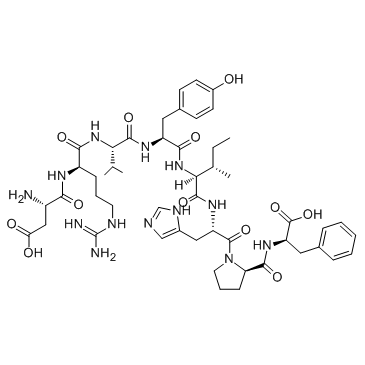
Angiotensin II acetate salt structure
|
Common Name | Angiotensin II acetate salt | ||
|---|---|---|---|---|
| CAS Number | 4474-91-3 | Molecular Weight | 1046.179 | |
| Density | 1.4±0.1 g/cm3 | Boiling Point | 809.08°C (rough estimate) | |
| Molecular Formula | C50H71N13O12 | Melting Point | N/A | |
| MSDS | USA | Flash Point | N/A | |
Use of Angiotensin II acetate saltAngiotensin II human is a vasoconstrictor that acts on the AT1 and the AT2 receptor. |
This table lists Chinese names, IUPAC names and various aliases of this chemical substance.
| Name | Angiotensin Ⅱ, human |
|---|---|
| Synonym | More Synonyms |
This table contains bioactivity, target information and biological‑assay experimental data of this compound.
| Description | Angiotensin II human is a vasoconstrictor that acts on the AT1 and the AT2 receptor. |
|---|---|
| Related Catalog | |
| Target |
Angiotensin receptor (AT receptor)[1] |
| In Vitro | Most of the known actions of Angiotensin II (Ang II) are mediated by AT1 receptors, the AT2 receptor contributes to the regulation of blood pressure and renal function[1]. Angiotensin II raises blood pressure (BP) by a number of actions, the most important ones being vasoconstriction, sympathetic nervous stimulation, increased aldosterone biosynthesis and renal actions. Other Angiotensin II actions include induction of growth, cell migration, and mitosis of vascular smooth muscle cells, increased synthesis of collagen type I and III in fibroblasts, leading to thickening of the vascular wall and myocardium, and fibrosis. These actions are mediated by type 1 Ang II receptors (AT1)[2]. At the cellular level, responsiveness to Angiotensin II is conferred by the expression of the two classes of angiotensin receptors (AT1 and AT2). The effects of Angiotensin II to increase blood pressure are mediated by AT1 receptors[3]. |
| In Vivo | To distinguish the AT1 receptor population that is critical for the pathogenesis of hypertension, osmotic minipumps are implanted s.c. into each animal to infuse Angiotensin II (1,000 ng/kg/min) continuously for 4 weeks. Angiotensin II causes hypertension by activating AT1 receptors in the kidney promoting sodium reabsorption[3]. |
| Animal Admin | Mice[3] (129×C57BL/6) F1 mice lacking AT1A receptors for Angiotensin II are used. The mice are fed 10 gm/day gelled 0.25% NaCl diet that contains all nutrients and water. After 1 week of baseline collections, the animals are implanted with osmotic minipumps infusing Angiotensin II and are returned to the metabolic cage for 5 more days. Urinary sodium content is determined by using an IL943 Automatic Flame photometer. After 28 days of Angiotensin II infusion, hearts are harvested, weighed, fixed in formalin, sectioned, and stained with Masson trichrome. All of the tissues are examined by a pathologist (P.R.) without knowledge of genotypes. |
| References |
This table shows physicochemical parameters including melting point, boiling point, density, solubility and optical rotation. Missing data is marked as N/A.
| Density | 1.4±0.1 g/cm3 |
|---|---|
| Boiling Point | 809.08°C (rough estimate) |
| Molecular Formula | C50H71N13O12 |
| Molecular Weight | 1046.179 |
| Exact Mass | 1045.534546 |
| PSA | 406.34000 |
| LogP | 2.34 |
| Index of Refraction | 1.664 |
| InChIKey | CZGUSIXMZVURDU-JZXHSEFVSA-N |
| SMILES | CCC(C)C(NC(=O)C(Cc1ccc(O)cc1)NC(=O)C(NC(=O)C(CCCN=C(N)N)NC(=O)C(N)CC(=O)O)C(C)C)C(=O)NC(Cc1cnc[nH]1)C(=O)N1CCCC1C(=O)NC(Cc1ccccc1)C(=O)O |
| Storage condition | -20°C |
This table summarizes toxicological test data, acute & chronic toxicity and ecological hazard parameters for this chemical.
CHEMICAL IDENTIFICATION
HEALTH HAZARD DATAACUTE TOXICITY DATA
|
This table covers safety warnings, protective measures, incompatible substances and disposal guidelines for this compound.
| Personal Protective Equipment | Eyeshields;Gloves;type N95 (US);type P1 (EN143) respirator filter |
|---|---|
| RIDADR | NONH for all modes of transport |
| WGK Germany | 3 |
| RTECS | BW2165000 |
This table presents publicly reported synthetic routes, reaction conditions, reactants and product information of the compound.
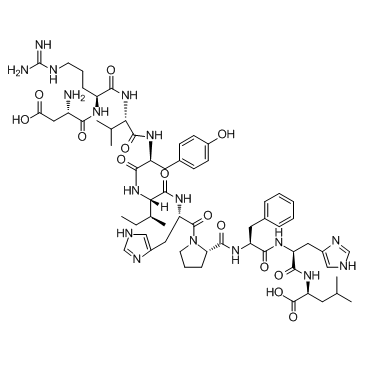
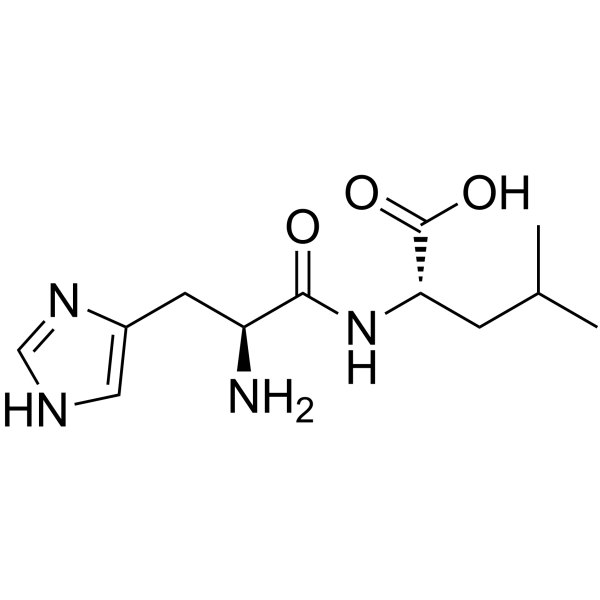

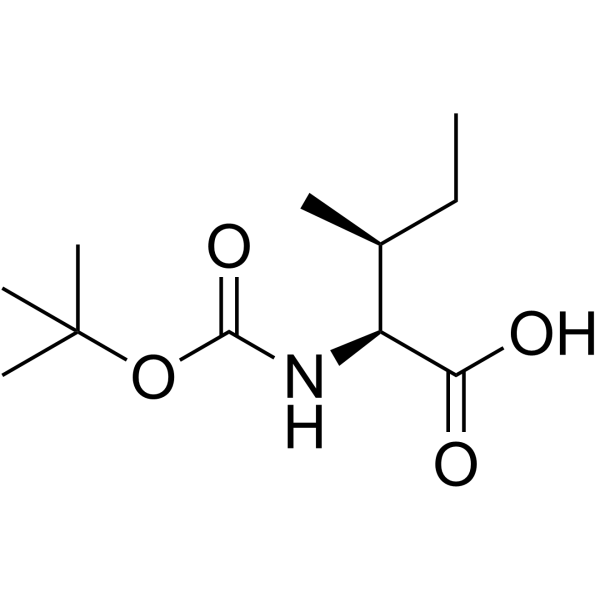

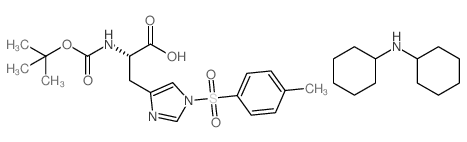
This table lists upstream starting materials and downstream derivative products related to this chemical.
| Precursor 5 | |
|---|---|
| DownStream 2 | |
 CAS#:63-91-2
 CAS#:51833-78-4
This table lists relevant public references with title, journal and publication metadata for this compound.
|
Trimethylamine-N-oxide: a carnitine-derived metabolite that prolongs the hypertensive effect of angiotensin II in rats.
Can. J. Cardiol. 30(12) , 1700-5, (2014) Recent evidence suggests that an elevated plasma trimethylamine N-oxide (TMAO) level is associated with an increased risk of adverse cardiovascular events in humans; however, the mechanism is not clea... |
|
|
IGF-1 deficiency impairs cerebral myogenic autoregulation in hypertensive mice.
J. Cereb. Blood Flow Metab. 34(12) , 1887-97, (2014) Aging impairs autoregulatory protection in the brain, exacerbating hypertension-induced cerebromicrovascular injury, neuroinflammation, and development of vascular cognitive impairment. Despite the im... |
|
|
Effects of a domain-selective ACE inhibitor in a mouse model of chronic angiotensin II-dependent hypertension.
Clin. Sci. 127(1) , 57-63, (2014) The somatic isozyme of ACE (angiotensin I-converting enzyme) comprises two distinct zinc-dependent catalytic domains with different substrate specificities for angiotensin I (cleaved selectively by th... |
This table contains target information, in‑vitro & in‑vivo assay data for this compound.
This table collects all English aliases, systematic names and CAS‑related synonyms of the compound.
| α-Aspartylarginylvalyltyrosylisoleucylhistidylprolylphenylalanine |
| α-aspartyl-N-(diaminomethylidene)ornithylvalyltyrosylisoleucylhistidylprolylphenylalanine |
| α-Aspartyl-N-(diaminomethylene)ornithylvalyltyrosylisoleucylhistidylprolylphenylalanine |
| Angiotensin II |
| ASP-ARG-VAL-TYR-ILE-HIS-PRO-PHE |
| Angiotensin II human |
This section contains frequently‑asked‑questions about this compound, including basic parameters, properties, storage conditions and corresponding answers.
| Q: What is the boiling point of Angiotensin Ⅱ, human? |
| A: Boiling point of Angiotensin Ⅱ, human is 809.08°C (rough estimate). |
| Q: What is the LogP of Angiotensin Ⅱ, human? |
| A: LogP of Angiotensin Ⅱ, human is 2.34. |
| Q: What is the CAS number of Angiotensin Ⅱ, human? |
| A: CAS number of Angiotensin Ⅱ, human is 4474-91-3. |
| Q: What is the molecular formula of Angiotensin Ⅱ, human? |
| A: Molecular formula of Angiotensin Ⅱ, human is C50H71N13O12. |
| Q: What is the molecular weight of Angiotensin Ⅱ, human? |
| A: Molecular weight of Angiotensin Ⅱ, human is 1046.179. |
| Q: What are the upstream materials of Angiotensin Ⅱ, human? |
| A: Related upstream materials(CAS) of Angiotensin Ⅱ, human: 484-42-4;15761-39-4;13139-16-7;13734-34-4;65057-34-3. |
| Q: What is the English name of Angiotensin Ⅱ, human? |
| A: The English name of Angiotensin Ⅱ, human is Angiotensin Ⅱ, human. |
| Q: What are the storage conditions for Angiotensin Ⅱ, human? |
| A: Storage conditions for Angiotensin Ⅱ, human: -20°C. |
| Q: What English synonyms does Angiotensin Ⅱ, human have? |
| A: English synonyms of Angiotensin Ⅱ, human: α-Aspartylarginylvalyltyrosylisoleucylhistidylprolylphenylalanine, α-aspartyl-N-(diaminomethylidene)ornithylvalyltyrosylisoleucylhistidylprolylphenylalanine, α-Aspartyl-N-(diaminomethylene)ornithylvalyltyrosylisoleucylhistidylprolylphenylalanine, Angiotensin II, ASP-ARG-VAL-TYR-ILE-HIS-PRO-PHE, Angiotensin II human. |
| Q: What are the downstream products of Angiotensin Ⅱ, human? |
| A: Related downstream products(CAS) of Angiotensin Ⅱ, human: 63-91-2;51833-78-4. |
This table lists manufacturers and suppliers of this compound, including vendor names and product supply reference information.
| Shanghai Nianxing Industrial Co., Ltd |
| Henan Tianfu Chemical Co., Ltd. |