Nuciferine
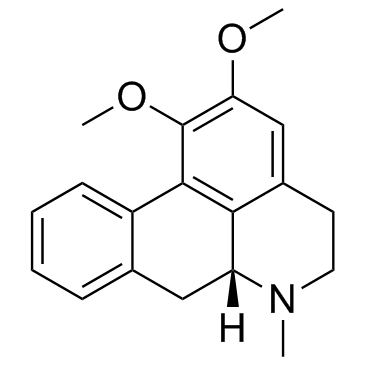
Nuciferine structure
|
Common Name | Nuciferine | ||
|---|---|---|---|---|
| CAS Number | 475-83-2 | Molecular Weight | 295.375 | |
| Density | 1.1±0.1 g/cm3 | Boiling Point | 430.7±45.0 °C at 760 mmHg | |
| Molecular Formula | C19H21NO2 | Melting Point | 165.5°C | |
| MSDS | N/A | Flash Point | 151.9±17.3 °C | |
Use of NuciferineNuciferine is an antagonist at 5-HT2A (IC50=478 nM), 5-HT2C (IC50=131 nM), and 5-HT2B (IC50=1 μM), an inverse agonist at 5-HT7 (IC50=150 nM), a partial agonist at D2 (EC50=64 nM), D5 (EC50=2.6 μM) and 5-HT6 (EC50=700 nM), an agonist at 5-HT1A (EC50=3.2 μM) and D4 (EC50=2 μM) receptor. |
This table lists Chinese names, IUPAC names and various aliases of this chemical substance.
| Name | Nuciferine |
|---|---|
| Synonym | More Synonyms |
This table contains bioactivity, target information and biological‑assay experimental data of this compound.
| Description | Nuciferine is an antagonist at 5-HT2A (IC50=478 nM), 5-HT2C (IC50=131 nM), and 5-HT2B (IC50=1 μM), an inverse agonist at 5-HT7 (IC50=150 nM), a partial agonist at D2 (EC50=64 nM), D5 (EC50=2.6 μM) and 5-HT6 (EC50=700 nM), an agonist at 5-HT1A (EC50=3.2 μM) and D4 (EC50=2 μM) receptor. |
|---|---|
| Related Catalog | |
| Target |
IC50: 131 nM (5-HT2C receptor), 150 nM (5-HT7 receptor), 478 nM (5-HT2A receptor), 1 μM (5-HT2B receptor)[1] EC50: 64 nM (D2 receptor), 2.6 μM (D5 receptor), 700 nM (5-HT6 receptor),3.2 μM (5-HT1A receptor), 2 μM (D4 receptor)[1] |
| In Vitro | Nuciferine is a partial agonist at DD2 receptor with an activity (Emax=67% of dopamine) similar to aripiprazole (Emax=50% of dopamine). In line with its partial agonist activity, Nuciferine inhibited dopamine-induced activation of Gi with a potency similar to clozapine (Nuciferine KB=62 nM; Clozapine KB=20 nM) as determined via Schild regression analysis[1]. The natural product Nuciferine acts as an effective inhibitor of adult worm motility. Nuciferine is effective at inhibiting both basal and 5-HT evoked motility of adult schistosomes. Nuciferine inhibits Sm.5HTRL and schistosomule with 0.24±0.04 and 0.62±0.22 μM, respectively[2]. |
| In Vivo | In rodent models relevant to antipsychotic drug action, Nuciferine blocks head-twitch responses and discriminative stimulus effects of a 5-HT2A agonist, substituted for clozapine discriminative stimulus, enhanced amphetamine induced locomotor activity, inhibited phencyclidine (PCP)-induced locomotor activity, and rescued PCP-induced disruption of prepulse inhibition without induction of catalepsy. In the presence of 1 or 3 mg/kg Nuciferine, cumulative PCP doses produce similar substitution to PCP alone. In the clozapine-trained animals, a dose-dependent substitution for 1.25 mg/kg clozapine is seen at 10 mg/kg Nuciferine (80.63% drug lever responding), with an ED50 value of 5.42 mg/kg (95% CI 3.09-9.48 mg/kg) while the lower doses tested (0.1 mg/kg-3 mg/kg) fails to produce substitution for clozapine’s discriminative cue. In addition to a high percentage of responding on the clozapine-appropriate lever, 10 mg/kg Nuciferine also produces significant rate suppression as compared to vehicle control points (p<0.001)[1]. |
| Kinase Assay | For affinity determination, Nuciferine is subjected to primary radioligand binding assays tested at a single 10 μM concentration to displace 50% of the radioligand at a given receptor target. If a more than 50% of the radioligand is displaced, Nuciferine is selected for a secondary binding assay tested at 11 concentrations in triplicate in competition with the radioligand to generate an IC50 and Ki. Binding assays are performed in 96-well plates with 125 μL per well in appropriate binding buffer using radioligand at or near the Kd. Plates are incubated at room temperature in the dark for 90 min. Reactions are stopped by vacuum filtrations onto 0.3% polyethyleneimine soaked 96-well filter mats using a 96-well Filtermate harvester, followed by at least three washes of cold wash buffer. Scintillation cocktail is melted onto dried filters and radioactivity is counted using a Wallac Trilux Microbeta[1]. |
| Cell Assay | Cells are plated into 48-well plates one day before uptake is performed. Cells are washed with 0.5 mL uptake buffer (4 mM Tris, 6.25 mM HEPES, 120 mM NaCl, 5 mM KCl, 1.2 mM CaCl2, 1.2 mM MgSO4, 5.6 mM D-glucose, 1.7 mM ascorbic acid, and 1 μM pargyline, pH 7.4). Cells are incubated with 225 μL uptake buffer with or without the indicated concentration of Nuciferine for 15 minutes. After incubation, 25 μL uptake buffer containing 3H-DA and DA is added for a final concentration of 20 nM 3H-DA and 1 μM DA. Cells are incubated at 37°C for 20 minutes or for the time indicated. Nonspecific uptake is determined in the presence of 10 μM nomifensine. Uptake is terminated by aspirating uptake buffer and washing each well twice with 0.5 mL ice-cold uptake buffer. Cells are lysed in 0.1 N NaOH and transferred to vials containing 3 mL scintillation cocktail. Radioactivity is quantitated using a Beckman LS6500 counter. Data are analyzed in Graph Pad Prism 5.0[1]. |
| Animal Admin | Mice[1] Adult male NIH Swiss mice weighing approximately 25 g are used. Mice are injected with either Nuciferine (1, 3, or 10 mg/kg, i.p.) or vehicle, n=4 mice/condition. Fifteen minutes later, mice are injected with 1 mg/kg DOI (i.p.) and immediately placed in an observation chamber (new cage without bedding). Head-twitches (operationally defined as a rapid rotational jerk of the head that can be distinguished from species-appropriate grooming or scratching behaviors) are counted for 20 minutes in 5 minute bins. For the time-course study, mice are pretreated with 3.0 mg/kg Nuciferine (i.p.) at 60, 45, 30, 15, or 0 minutes (co-injection) prior to the 1.0 mg/kg DOI (i.p.) injection, and head-twitches are counted as described above. In one experiment, mice (n=4 per condition) are pretreated with an injection (s.c.) of 3.0 mg/kg Nuciferine or vehicle 15 minutes prior to 1.0 mg/kg DOI injection (i.p.) and head-twitches are counted as described above. All experiments are performed by 3 observers, with 2 observers blinded to the experimental conditions which are evenly distributed. Power analyses are performed with the resulting data. The two highest doses of Nuciferine tested (10 and 3 mg/kg), had 0.96 and 0.88 power to detect significance (α=0.05). As these experiments are performed blinded and in distinct mice, further replication is not performed. |
| References |
This table shows physicochemical parameters including melting point, boiling point, density, solubility and optical rotation. Missing data is marked as N/A.
| Density | 1.1±0.1 g/cm3 |
|---|---|
| Boiling Point | 430.7±45.0 °C at 760 mmHg |
| Melting Point | 165.5°C |
| Molecular Formula | C19H21NO2 |
| Molecular Weight | 295.375 |
| Flash Point | 151.9±17.3 °C |
| Exact Mass | 295.157227 |
| LogP | 4.12 |
| Vapour Pressure | 0.0±1.0 mmHg at 25°C |
| Index of Refraction | 1.597 |
| InChIKey | ORJVQPIHKOARKV-OAHLLOKOSA-N |
| SMILES | COc1cc2c3c(c1OC)-c1ccccc1CC3N(C)CC2 |
This table contains target information, in‑vitro & in‑vivo assay data for this compound.
This table collects all English aliases, systematic names and CAS‑related synonyms of the compound.
| (-)-Nucipherine |
| (R)-1,2-Dimethoxyaporphine |
| nuciferin |
| (R)-nuciferine |
| 5,6,6a,7-tetrahydro-1,2-dimethoxy-6-methyl-g)quinolin(r)-4h-dibenzo(d |
| (6aR)-1,2-Dimethoxy-6-methyl-5,6,6a,7-tetrahydro-4H-dibenzo[de,g]quinoline |
| l-nuciferine |
| 1,2-dimethoxy-6a-beta-aporphin |
| l-5,6-dimethoxyaporphine |
This section contains frequently‑asked‑questions about this compound, including basic parameters, properties, storage conditions and corresponding answers.
| Q: What is the LogP of Nuciferine? |
| A: LogP of Nuciferine is 4.12. |
| Q: What English synonyms does Nuciferine have? |
| A: English synonyms of Nuciferine: (-)-Nucipherine, (R)-1,2-Dimethoxyaporphine, nuciferin, (R)-nuciferine, 5,6,6a,7-tetrahydro-1,2-dimethoxy-6-methyl-g)quinolin(r)-4h-dibenzo(d, (6aR)-1,2-Dimethoxy-6-methyl-5,6,6a,7-tetrahydro-4H-dibenzo[de,g]quinoline, l-nuciferine, 1,2-dimethoxy-6a-beta-aporphin, l-5,6-dimethoxyaporphine. |
| Q: What is the boiling point of Nuciferine? |
| A: Boiling point of Nuciferine is 430.7±45.0 °C at 760 mmHg. |
| Q: What is the molecular formula of Nuciferine? |
| A: Molecular formula of Nuciferine is C19H21NO2. |
| Q: What is the CAS number of Nuciferine? |
| A: CAS number of Nuciferine is 475-83-2. |
| Q: What is the molecular weight of Nuciferine? |
| A: Molecular weight of Nuciferine is 295.375. |
| Q: What is the InChIKey of Nuciferine? |
| A: InChIKey of Nuciferine is ORJVQPIHKOARKV-OAHLLOKOSA-N. |
| Q: What is the safety information for Nuciferine? |
| A: Safety information for Nuciferine: 24/25. |
| Q: What are the uses of Nuciferine? |
| A: Main uses of Nuciferine: Nuciferine is an antagonist at 5-HT2A (IC50=478 nM), 5-HT2C (IC50=131 nM), and 5-HT2B (IC50=1 μM), an inverse agonist at 5-HT7 (IC50=150 nM), a partial agonist at D2 (EC50=64 nM), D5 (EC50=2.6 μM) and 5-HT6 (EC50=700 nM), an agonist at 5-HT1A (EC50=3.2 μM) and D4 (EC50=2 μM) receptor. |
| Q: What is the English name of Nuciferine? |
| A: The English name of Nuciferine is Nuciferine. |
This table lists manufacturers and suppliers of this compound, including vendor names and product supply reference information.
| Shanghai Nianxing Industrial Co., Ltd |
| BioBioPha |
| naturewill |
| Henan Tianfu Chemical Co., Ltd. |