Reserpine
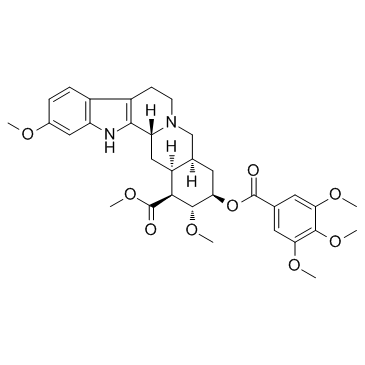
Reserpine structure
|
Common Name | Reserpine | ||
|---|---|---|---|---|
| CAS Number | 50-55-5 | Molecular Weight | 608.679 | |
| Density | 1.3±0.1 g/cm3 | Boiling Point | 700.1±60.0 °C at 760 mmHg | |
| Molecular Formula | C33H40N2O9 | Melting Point | 265ºC (dec.) | |
| MSDS | Chinese USA | Flash Point | 377.2±32.9 °C | |
| Symbol |

GHS07 |
Signal Word | Warning | |
Use of ReserpineReserpine is an inhibitor of the vesicular monoamine transporter 2 (VMAT2). |
This table lists Chinese names, IUPAC names and various aliases of this chemical substance.
| Name | reserpine |
|---|---|
| Synonym | More Synonyms |
This table contains bioactivity, target information and biological‑assay experimental data of this compound.
| Description | Reserpine is an inhibitor of the vesicular monoamine transporter 2 (VMAT2). |
|---|---|
| Related Catalog | |
| Target |
VMAT2[1] |
| In Vitro | Reserpine is an inhibitor of the vesicular monoamine transporter 2 (VMAT2). Reserpine displays a significant effect on the density of dopamine D1 receptors (F2,12=8.81, p<0.01) in the rat striatum. The affinity (Kd) for the dopamine D1 and D2 receptors during withdrawal from acute and chronic administration of reserpine is not change[1]. IC50 values of 43.9 and 54.9 μM are obtained after 1 day of treatment with Reserpine in JB6 P+ and HepG2-C8 cells, respectively. Reserpine induces luciferase activity in a dose-dependent manner at concentrations ranging from 5 to 50 μM, and no significant induction is observed at concentrations lower than 5 μM. Results demonstrate that Reserpine (2.5 to 10 μM) also increases the protein expression of Nrf2, HO-1, and NQO1. Reserpine at concentrations of 2.5 to 10 μM decreases the mRNA expression of DNMT1, DNMT3a, and DNMT3b in a concentration-dependent manner in JB6 P+ cells after 7 days of treatment. Reserpine at 10 μM generates a significant difference for DNMT3a expression (p<0.05)[2]. |
| In Vivo | Withdrawal (48 h) from chronic (14-day) but not acute Reserpine administration in a dose of 0.2 mg/kg i.p. produces a significant reduction of the immobility time (F2,18=3.68, p<0.05), but increases the climbing time (F2,18=4.48, p<0.02), and does not change the swimming time (F2,18=1.78; NS) in the forced swim test (FST) in rats[1]. Reserpine at a dose of 5 mg/kg body weight produces significant increase in the urinary excretion profile of vanillylmandelic acid (VMA) compare to control animals. The amount of 5-hydroxyindoleacetic acid (5-HIAA) excreted in animals treated with Reserpine is found to be more than in the control. Dose dependent hypotension is observed with Reserpine. Reserpine at doses of 0.5, 1, 5, 10 and 15 μg/kg produce significant (p<0.01) reduction in blood pressure compare to control[3]. |
| Kinase Assay | After incubation for 24 h, JB6 P+ cells (1×10⁵ cells/10-cm dish) are treated with various concentrations of Reserpine. Whole cell lysates are prepared from the treated cells using radioimmunoprecipitation assay buffer supplemented with a protease inhibitor cocktail, and a BCA kit is used to determine protein concentrations[2]. |
| Cell Assay | JB6 P+ cells are seeded in 96-well plates containing Minimum essential media (MEM) at a density of 1×10⁴ cells/mL (100 μL/well) for 1, 3, and 5 days, and HepG2-C8 cells are seeded in plates containing DMEM. After incubation for 24 h, the cells are treated with either DMSO or various concentrations of Reserpine. For JB6 P+ cells, the medium is changed every 2 days for the 3-day and 5-day treatments. Cell viability is assessed using a MTS assay kit according to the manufacturer’s instructions. The absorbance of the formazan product is read at 490 nm, and the cell viability is calculated and compared with the DMSO control group[2]. |
| Animal Admin | Albino rats of either sex weighing between 100 to 150 g are used in the study. They are acclimatized to the laboratory conditions for at least 10 days prior to the experiment and provided with standard diet and water ad libitum with 12 h light and dark cycle. Animals are divided into different groups of six each and are housed individually in metabolic cages. Group 1: Control animals treated with DMSO intraperitoneally at a dose of 0.1 mL/100 g body weight. Group 2: Animals administered intraperitoneally with Reserpine at a dose of 5 mg/kg body weight. The 24 h urine samples from the point of drug administration are collected for each animal[3]. |
| References |
This table shows physicochemical parameters including melting point, boiling point, density, solubility and optical rotation. Missing data is marked as N/A.
| Density | 1.3±0.1 g/cm3 |
|---|---|
| Boiling Point | 700.1±60.0 °C at 760 mmHg |
| Melting Point | 265ºC (dec.) |
| Molecular Formula | C33H40N2O9 |
| Molecular Weight | 608.679 |
| Flash Point | 377.2±32.9 °C |
| Exact Mass | 608.273376 |
| PSA | 117.78000 |
| LogP | 4.05 |
| Vapour Pressure | 0.0±2.2 mmHg at 25°C |
| Index of Refraction | 1.620 |
| InChIKey | QEVHRUUCFGRFIF-MDEJGZGSSA-N |
| SMILES | COC(=O)C1C2CC3c4[nH]c5cc(OC)ccc5c4CCN3CC2CC(OC(=O)c2cc(OC)c(OC)c(OC)c2)C1OC |
This table provides MSDS information including hazard classification, first‑aid, fire‑fighting, spill handling, operation and storage instructions.
This table summarizes toxicological test data, acute & chronic toxicity and ecological hazard parameters for this chemical.
CHEMICAL IDENTIFICATION
HEALTH HAZARD DATAACUTE TOXICITY DATA
MUTATION DATA
|
This table covers safety warnings, protective measures, incompatible substances and disposal guidelines for this compound.
| Symbol |
GHS07 |
|---|---|
| Signal Word | Warning |
| Hazard Statements | H302 |
| Precautionary Statements | P301 + P312 + P330 |
| Personal Protective Equipment | Eyeshields;Faceshields;full-face respirator (US);Gloves;multi-purpose combination respirator cartridge (US);type ABEK (EN14387) respirator filter |
| Hazard Codes | Xi:Irritant |
| Risk Phrases | R10;R36;R67 |
| Safety Phrases | S26 |
| RIDADR | UN 1219 |
| WGK Germany | 3 |
| RTECS | ZG0350000 |
| Packaging Group | II |
| Hazard Class | 6.1 |
| HS Code | 3003909090 |
This table lists upstream starting materials and downstream derivative products related to this chemical.
| Precursor 0 | |
|---|---|
| DownStream 1 | |
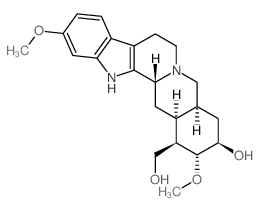 CAS#:482-98-4
This table shows customs‑related data including HS‑code, tariff and regulatory conditions for import and export.
| HS Code | 3003909090 |
|---|
This table lists relevant public references with title, journal and publication metadata for this compound.
|
Mechanisms involved in quinolone resistance in Mycoplasma mycoides subsp. capri.
Vet. J. 204 , 327-32, (2015) Mycoplasma mycoides subsp. capri is a causative agent of contagious agalactia in goats. In this study, M. mycoides subsp. capri mutants were selected for resistance to fluoroquinolones (norfloxacin, e... |
|
|
Multiple mutations and increased RNA expression in tetracycline-resistant Streptococcus pneumoniae as determined by genome-wide DNA and mRNA sequencing.
J. Antimicrob. Chemother. 70 , 1946-59, (2015) The objective of this study was to characterize chromosomal mutations associated with resistance to tetracycline in Streptococcus pneumoniae.Chronological appearance of mutations in two S. pneumoniae ... |
|
|
Deficiency of the novel exopolyphosphatase Rv1026/PPX2 leads to metabolic downshift and altered cell wall permeability in Mycobacterium tuberculosis.
MBio 6 , e02428, (2015) Mycobacterium tuberculosis can persist for decades in the human host. Stringent response pathways involving inorganic polyphosphate [poly(P)], which is synthesized and hydrolyzed by polyphosphate kina... |
This table contains target information, in‑vitro & in‑vivo assay data for this compound.
This table collects all English aliases, systematic names and CAS‑related synonyms of the compound.
| methyl (1S,2R,3R,4aS,13bR,14aS)-2,11-dimethoxy-3-{[(3,4,5-trimethoxyphenyl)carbonyl]oxy}-1,2,3,4,4a,5,7,8,13,13b,14,14a-dodecahydroindolo[2',3':3,4]pyrido[1,2-b]isoquinoline-1-carboxylate |
| methyl (1R,15S,17R,18R,19S,20S)-6,18-dimethoxy-17-(3,4,5-trimethoxybenzoyl)oxy-1,3,11,12,14,15,16,17,18,19,20,21-dodecahydroyohimban-19-carboxylate |
| MFCD00005091 |
| Hiserpia |
| Methyl 18b-Hydroxy-11,17a-dimethoxy-3b,20a-yohimban-16b-carboxylate 3,4,5-Trimethoxybenzoate (Ester) |
| Serpipur |
| EINECS 200-047-9 |
| Raunervil |
| Serpanray |
| Methyl (3β,16β,17α,18β,20α)-11,17-dimethoxy-18-[(3,4,5-trimethoxybenzoyl)oxy]yohimban-16-carboxylate |
| Methyl-(1S,2R,3R,4aS,13bR,14aS)-2,11-dimethoxy-3-{[(3,4,5-trimethoxyphenyl)carbonyl]oxy}-1,2,3,4,4a,5,7,8,13,13b,14,14a-dodecahydroindolo[2',3':3,4]pyrido[1,2-b]isochinolin-1-carboxylat |
| methyl reserpate 3,4,5-trimethoxybenzoic acid ester |
| Raupasil |
| SERPASIL |
| Rausedil |
| rivasin |
| reserpine |
| [3H]-Reserpine |
| Serpivite |
| (-)-reserpine |
| Reserpine Base |
| serpentina |
| Serp-AFD |
| Serpalan |
| Apoplon |
This section contains frequently‑asked‑questions about this compound, including basic parameters, properties, storage conditions and corresponding answers.
| Q: What is the polar surface area (PSA) of reserpine? |
| A: Polar surface area (PSA) of reserpine is 117.78000. |
| Q: What is the English name of reserpine? |
| A: The English name of reserpine is reserpine. |
| Q: What is the melting point of reserpine? |
| A: Melting point of reserpine is 265ºC (dec.). |
| Q: What are the uses of reserpine? |
| A: Main uses of reserpine: Reserpine is an inhibitor of the vesicular monoamine transporter 2 (VMAT2). |
| Q: What is the molecular formula of reserpine? |
| A: Molecular formula of reserpine is C33H40N2O9. |
| Q: What is the CAS number of reserpine? |
| A: CAS number of reserpine is 50-55-5. |
| Q: What are the downstream products of reserpine? |
| A: Related downstream products(CAS) of reserpine: 482-98-4. |
| Q: What is the boiling point of reserpine? |
| A: Boiling point of reserpine is 700.1±60.0 °C at 760 mmHg. |
| Q: What is the InChIKey of reserpine? |
| A: InChIKey of reserpine is QEVHRUUCFGRFIF-MDEJGZGSSA-N. |
| Q: What is the LogP of reserpine? |
| A: LogP of reserpine is 4.05. |
This table lists manufacturers and suppliers of this compound, including vendor names and product supply reference information.
| Shanghai Nianxing Industrial Co., Ltd |
| BioBioPha |
| Henan Tianfu Chemical Co., Ltd. |