Fluorescamine
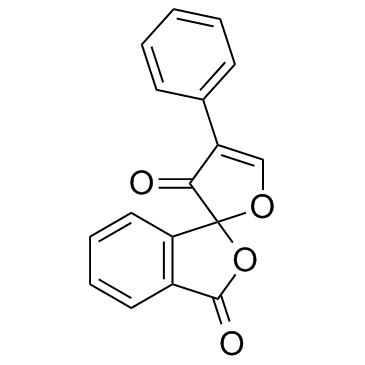
Fluorescamine structure
|
Common Name | Fluorescamine | ||
|---|---|---|---|---|
| CAS Number | 38183-12-9 | Molecular Weight | 278.259 | |
| Density | 1.4±0.1 g/cm3 | Boiling Point | 550.3±50.0 °C at 760 mmHg | |
| Molecular Formula | C17H10O4 | Melting Point | 153-157 °C(lit.) | |
| MSDS | Chinese USA | Flash Point | 248.5±30.2 °C | |
|
Regulation of SREBPs by Sphingomyelin in Adipocytes via a Caveolin and Ras-ERK-MAPK-CREB Signaling Pathway.
PLoS ONE 10 , e0133181, (2015) Sterol response element binding protein (SREBP) is a key transcription factor in insulin and glucose metabolism. We previously demonstrated that elevated levels of membrane sphingomyelin (SM) were related to peroxisome proliferator-activated receptor-γ (PPARγ... |
|
|
Expression of aryl hydrocarbon receptor 1 (AHR1), AHR1 nuclear translocator 1 (ARNT1) and CYP1 family monooxygenase mRNAs and their activity in chicken ovarian follicles following in vitro exposure to 2,3,7,8-tetrachlorodibenzo-p-dioxin (TCDD).
Toxicol. Lett. 237 , 100-11, (2015) The aim of this in vitro study was to determine the effect of TCDD and luteinizing hormone (LH) on mRNA expression of aryl hydrocarbon receptor 1 (AHR1), AHR1 nuclear translocator 1 (ARNT1), and the CYP1 family monooxygenases (CYP1A4, CYP1A5, CYP1B1), and to ... |
|
|
Potentiating effect of graphene nanomaterials on aromatic environmental pollutant-induced cytochrome P450 1A expression in the topminnow fish hepatoma cell line PLHC-1.
Environ. Toxicol. 30 , 1192-204, (2015) Graphene and its derivatives are an emerging class of carbon nanomaterial with great potential for a broad range of industrial and consumer applications. However, their increasing production and use is expected to result in release of nano-sized graphene plat... |
|
|
Biodegradable polyester-based microcarriers with modified surface tailored for tissue engineering.
J. Biomed. Mater. Res. A 103(3) , 939-48, (2015) Microcarriers have been proposed in tissue engineering, namely for bone, cartilage, skin, vascular, and central nervous system. Although polyester-based microcarriers have been already used for this purpose, their surface properties should be improved to prov... |
|
|
Design and solid phase synthesis of new DOTA conjugated (+)-biotin dimers planned to develop molecular weight-tuned avidin oligomers.
Org. Biomol. Chem. 13(13) , 3988-4001, (2015) Chemical modifications of the biotin carrier in pretargeted avidin–biotin radionuclide therapy may be of paramount importance for tuning the amount of the radioactivity delivered to cancer cells by labelled biotins. We report here the synthesis of a collectio... |
|
|
Protease-degradable electrospun fibrous hydrogels.
Nat. Commun. 6 , 6639, (2015) Electrospun nanofibres are promising in biomedical applications to replicate features of the natural extracellular matrix (ECM). However, nearly all electrospun scaffolds are either non-degradable or degrade hydrolytically, whereas natural ECM degrades proteo... |
|
|
Bio-inspired oligovitronectin-grafted surface for enhanced self-renewal and long-term maintenance of human pluripotent stem cells under feeder-free conditions.
Biomaterials 50 , 127-39, (2015) Current protocols for human pluripotent stem cell (hPSC) expansion require feeder cells or matrices from animal sources that have been the major obstacle to obtain clinical grade hPSCs due to safety issues, difficulty in quality control, and high expense. Thu... |
|
|
Tumor-targeted delivery of paclitaxel using low density lipoprotein-mimetic solid lipid nanoparticles.
Mol. Pharm. 12(4) , 1230-41, (2015) Water-insoluble anticancer drugs, including paclitaxel, present severe clinical side effects when administered to patients, primarily associated with the toxicity of reagents used to solubilize the drugs. In efforts to develop alternative formulations of wate... |
|
|
Regulation of tissue ingrowth into proteolytically degradable hydrogels.
Acta Biomater. 24 , 44-52, (2015) Regulation of the rate of cell ingrowth into and within a matrix is desirable for efficient tissue regeneration. Polyethylene glycol hydrogels crosslinked with matrix metalloproteinase (MMP) susceptible peptide sequences permit cell-controlled invasion. In th... |
|
|
Differential regulation of the calpain-calpastatin complex by the L-domain of calpastatin.
Biochim. Biophys. Acta 1843(11) , 2583-91, (2014) Here we demonstrate that the presence of the L-domain in calpastatins induces biphasic interaction with calpain. Competition experiments revealed that the L-domain is involved in positioning the first inhibitory unit in close and correct proximity to the calp... |