BETA-CHLORNALTREXAMINE 2HCL
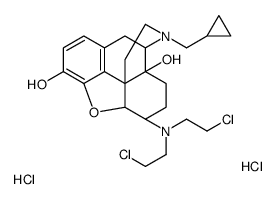
BETA-CHLORNALTREXAMINE 2HCL structure
|
Common Name | BETA-CHLORNALTREXAMINE 2HCL | ||
|---|---|---|---|---|
| CAS Number | 67025-98-3 | Molecular Weight | 540.35000 | |
| Density | N/A | Boiling Point | N/A | |
| Molecular Formula | C24H34Cl4N2O3 | Melting Point | N/A | |
| MSDS | USA | Flash Point | N/A | |
|
Methocinnamox is a potent, long-lasting, and selective antagonist of morphine-mediated antinociception in the mouse: comparison with clocinnamox, beta-funaltrexamine, and beta-chlornaltrexamine.
J. Pharmacol. Exp. Ther. 294 , 933, (2000) The irreversible mu-opioid antagonists beta-funaltrexamine (beta-FNA) and beta-chlornaltrexamine (beta-CNA) are important pharmacological tools but have a kappa-agonist activity and, in the latter case, low selectivity. This work examines whether clocinnamox ... |
|
|
Relationship between kappa 1 opioid receptor binding and inhibition of adenylyl cyclase in guinea pig brain membranes.
Biochem. Pharmacol. 45(1) , 207-16, (1993) Previously, we showed that kappa-selective ligands inhibit adenylyl cyclase in guinea pig cerebellar membranes. The present studies explore the relationship between kappa 1 binding sites (as determined with [3H]U-69,593 binding) and kappa 1-inhibition of aden... |
|
|
Single nucleotide polymorphisms in the human mu opioid receptor gene alter basal G protein coupling and calmodulin binding.
J. Biol. Chem. 276(37) , 34624-30, (2001) The mu opioid receptor (MOR) plays a central role in mediating acute and chronic effects of narcotic drugs. Three rare single nucleotide polymorphisms in the hMOR gene have been identified that cause amino acid substitutions in the third intracellular (i3) lo... |
|
|
Tyr-MIF-1 and hemorphin can act as opiate agonists as well as antagonists in the guinea pig ileum.
Life Sci. 51(11) , 869-85, (1992) The brain peptide Tyr-MIF-1 (Tyr-Pro-Leu-Gly-NH2) was tested for its effects on electrically stimulated contractions in the guinea pig ileum assay. Tyr-MIF-1 acted as an opiate agonist in reducing these contractions. Its IC50 was about 9 microM, and its effec... |
|
|
Nitrous oxide-antinociception is mediated by opioid receptors and nitric oxide in the periaqueductal gray region of the midbrain.
Eur. Neuropsychopharmacol. 18(3) , 194-9, (2008) Previous studies have shown that nitrous oxide (N(2)O)-induced antinociception is sensitive to antagonism by blockade of opioid receptors and also by inhibition of nitric oxide (NO) production. The present study was conducted to determine whether these occur ... |
|
|
Buprenorphine is a weak partial agonist that inhibits opioid receptor desensitization.
J. Neurosci. 29(22) , 7341-8, (2009) Buprenorphine is a weak partial agonist at mu-opioid receptors that is used for treatment of pain and addiction. Intracellular and whole-cell recordings were made from locus ceruleus neurons in rat brain slices to characterize the actions of buprenorphine. Ac... |
|
|
Thermodynamic parameters for [D-Pen2,5]enkephalin at delta-opioid receptors in the mouse isolated vas deferens.
Eur. J. Pharmacol. 244(3) , 231-8, (1993) Dissociation constants (KA) for [D-Pen2,5]enkephalin (DPDPE) inhibition of the electrically evoked twitch of the mouse isolated vas deferens preparation (MVD) were calculated at five temperatures (25, 30, 34, 37 and 40 degrees C). These values were determined... |
|
|
Calmodulin regulation of basal and agonist-stimulated G protein coupling by the mu-opioid receptor (OP(3)) in morphine-pretreated cell.
J. Neurochem. 75(2) , 763-71, (2000) Calmodulin (CaM) has been shown to suppress basal G protein coupling and attenuate agonist-stimulated G protein coupling of the mu-opioid receptor (OP(3)) through direct interaction with the third intracellular (i3) loop of the receptor. Here we have investig... |
|
|
Pharmacological studies on the "orphan" opioid receptor in central and peripheral sites.
Can. J. Physiol. Pharmacol. 76(3) , 304-13, (1998) We have exploited the availability of the "orphan" opioid receptor (referred to here as ORL1) in its "natural state" to investigate the effect of nociceptin (orphanin FQ), the endogenous agonist for the ORL1 receptor in the brain, vas deferens, and myenteric ... |
|
|
Protection by U-50,488H against beta-chlornaltrexamine antagonism of nitrous oxide antinociception in mice.
Brain Res. 549(1) , 162-4, (1991) Nitrous oxide antinociception in the abdominal constriction test was significantly reduced in mice pretreated intracerebroventricularly (i.c.v.) with beta-chlornaltrexamine (beta-CNA). However, this antagonism was reversed when the beta-CNA was co-administere... |