2-Phenylglycine
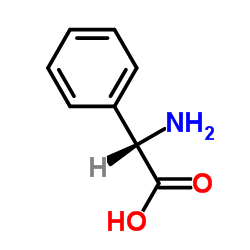
2-Phenylglycine structure
|
Common Name | 2-Phenylglycine | ||
|---|---|---|---|---|
| CAS Number | 2835-06-5 | Molecular Weight | 151.163 | |
| Density | 1.2±0.1 g/cm3 | Boiling Point | 288.7±28.0 °C at 760 mmHg | |
| Molecular Formula | C8H9NO2 | Melting Point | 121-127ºC | |
| MSDS | Chinese USA | Flash Point | 128.4±24.0 °C | |
|
Ion-pairing reversed-phase liquid chromatography fractionation in combination with isotope labeling reversed-phase liquid chromatography–mass spectrometry for comprehensive metabolome profiling
J. Chromatogr. A. 1218(23) , 3689-94, (2011) We report a novel two-dimensional (2D) separation strategy aimed at improving the detectability of liquid chromatography mass spectrometry (LC–MS) for metabolome analysis. It is based on the use of ion-pairing (IP) reversed-phase (RP) LC as the first dimensio... |
|
|
Two plate-based colorimetric assays for screening α-amino acid ester hydrolase with high synthesis/hydrolysis ratio.
Enzyme Microb. Technol. 51(2) , 107-12, (2012) α-Amino acid ester hydrolases (AEHs) are enzymes of interest to the semi-synthesis of β-lactam antibiotics with α-amino, such as cephalexin and cefaclor. An undesired side reaction, the hydrolysis of α-amino acid ester, had hindered applications in antibiotic... |
|
|
Discovery of novel DNA gyrase inhibitors by high-throughput virtual screening.
Antimicrob. Agents Chemother. 51 , 3688-98, (2007) The bacterial type II topoisomerases DNA gyrase and topoisomerase IV are validated targets for clinically useful quinolone antimicrobial drugs. A significant limitation to widely utilized quinolone inhibitors is the emergence of drug-resistant bacteria due to... |
|
|
Mutation-specific potency and efficacy of cystic fibrosis transmembrane conductance regulator chloride channel potentiators.
J. Pharmacol. Exp. Ther. 330(3) , 783-91, (2009) Cystic fibrosis (CF) is caused by mutations in the cystic fibrosis transmembrane conductance regulator (CFTR) Cl(-) channel. The mutations G551D and G1349D, which affect the nucleotide-binding domains (NBDs) of CFTR protein, reduce channel activity. This defe... |
|
|
Design and synthesis of a hybrid potentiator-corrector agonist of the cystic fibrosis mutant protein DeltaF508-CFTR.
Bioorg. Med. Chem. Lett. 20(1) , 87-91, (2010) A developing therapy of cystic fibrosis caused by the DeltaF508 mutation in CFTR employs correction of defective CFTR chloride channel gating by a 'potentiator' and of defective CFTR protein folding by a 'corrector'. Based on SAR data for phenylglycine-type p... |
|
|
Selective and orally bioavailable phenylglycine tissue factor/factor VIIa inhibitors.
Bioorg. Med. Chem. Lett. 15(23) , 5344-52, (2005) We describe the structure-based design and synthesis of highly potent, orally bioavailable tissue factor/factor VIIa inhibitors which interfere with the coagulation cascade by selective inhibition of the extrinsic pathway. |
|
|
Isolation and characterization of a benzoylformate decarboxylase and a NAD+/NADP+-dependent benzaldehyde dehydrogenase involved in D-phenylglycine metabolism in Pseudomonas stutzeri ST-201.
Biochim. Biophys. Acta 1770(11) , 1585-92, (2007) Following induction with D-phenylglycine both d-phenylglycine aminotransferase activity and benzoylformate decarboxylase activity were observed in cultures of Pseudomonas stutzeri ST-201. Induction with benzoylformate, on the other hand, induced only benzoylf... |
|
|
Structural scaffold of 18-crown-6 tetracarboxylic acid for optical resolution of chiral amino acid: X-ray crystal analyses and energy calculations of complexes of D- and L-isomers of tyrosine, isoleucine, methionine and phenylglycine.
Org. Biomol. Chem. 2(23) , 3470-5, (2004) To clarify the structural scaffold of (+)-18-crown-6 tetracarboxylic acid ((+)-18C6H4) for the optical resolution of a chiral amino acid, the crystal structures of its equimolar complexes with L- and D-isomers of tyrosine (Tyr), isoleucine (Ile), methionine (... |
|
|
Conformational study of jet-cooled L-phenylglycine.
J. Chem. Phys. 128(18) , 184313, (2008) We investigated the conformational structures of L-phenylglycine in the gas phase by photoionization and double resonance spectroscopy techniques as well as high-level ab initio calculations. The UV-UV and IR-UV double resonance spectroscopy suggested that th... |
|
|
Predominant (S)-enantioselective inclusion of aryl methyl sulfoxides by (S)-isoleucyl-(S)-phenylglycines.
J. Org. Chem. 75(3) , 660-5, (2010) In terms of chiral recognition for racemic aryl methyl sulfoxides in the solid state, three kinds of crystalline (S)-alkylglycyl-(S)-phenylglycines were examined as potential dipeptides host molecules. When (S)-alanyl-(S)-phenylglycines [(S,S)-Ala-Phg] crysta... |