Fotemustine
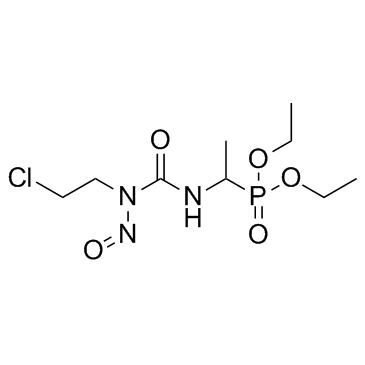
Fotemustine structure
|
Common Name | Fotemustine | ||
|---|---|---|---|---|
| CAS Number | 92118-27-9 | Molecular Weight | 315.691 | |
| Density | 1.4±0.1 g/cm3 | Boiling Point | 188 °C(lit.) | |
| Molecular Formula | C9H19ClN3O5P | Melting Point | 85ºC | |
| MSDS | Chinese USA | Flash Point | 104 °F | |
| Symbol |

GHS08 |
Signal Word | Warning | |
Use of FotemustineFotemustine is a DNA-alkylating agent, with antitumor activity. |
| Name | Diethyl (1-(3-(2-chloroethyl)-3-nitrosoureido)ethyl)phosphonate |
|---|---|
| Synonym | More Synonyms |
| Description | Fotemustine is a DNA-alkylating agent, with antitumor activity. |
|---|---|
| Related Catalog | |
| Target |
DNA Alkylator[1] |
| In Vitro | Fotemustine is a DNA-alkylating agent. Fotemustine (800 μM) decreases GSH and intracellular GSSG levels but increases the extracellular GSSG-levels rapidly in isolated rat hepatocytes[1]. Fotemustine shows inhibitory effect on several tumor cell lines, with IC50s ranging form 0.05 to 0.18 mM[2]. |
| Cell Assay | Cell proliferation assays are performed using MTT. Briefly, cell suspensions containing 2 × 10⁴ viable cells/mL are plated into 96-well dishes and allowed to attach for 48 h at 371C in a 5% CO2 atmosphere. The culture medium is then removed and the cells are incubated for two doubling times at 37°C in the culture medium containing fotemustine (10-3 to 10 mM). When tested, amifostine or WR-1065 (10-4 to 10 mM) is added before Fotemustine for 15 min. Control cultures are exposed to saline for 15 min and then allowed to grow for the same duration in complete culture medium[2]. |
| References |
| Density | 1.4±0.1 g/cm3 |
|---|---|
| Boiling Point | 188 °C(lit.) |
| Melting Point | 85ºC |
| Molecular Formula | C9H19ClN3O5P |
| Molecular Weight | 315.691 |
| Flash Point | 104 °F |
| Exact Mass | 315.075073 |
| PSA | 107.11000 |
| LogP | 1.26 |
| Index of Refraction | 1.524 |
| InChIKey | YAKWPXVTIGTRJH-UHFFFAOYSA-N |
| SMILES | CCOP(=O)(OCC)C(C)NC(=O)N(CCCl)N=O |
| Storage condition | 2-8°C |
CHEMICAL IDENTIFICATION
HEALTH HAZARD DATAACUTE TOXICITY DATA
MUTATION DATA
|
| Symbol |
GHS08 |
|---|---|
| Signal Word | Warning |
| Hazard Statements | H351 |
| Precautionary Statements | P281 |
| Hazard Codes | Xi |
| Risk Phrases | R10:Flammable. R36/37:Irritating to eyes and respiratory system . R43:May cause sensitization by skin contact. |
| Safety Phrases | S16-S26-S36 |
| RIDADR | UN 3336 3/PG 2 |
| WGK Germany | 3 |
| Packaging Group | III |
| Hazard Class | 6.1(b) |
|
Multiple bone metastases from glioblastoma multiforme without local brain relapse: a case report and review of the literature.
Tumori 99(5) , e237-40, (2013) Extracranial metastases from glioblastoma multiforme (GBM) are a very rare event, even if an increasing incidence has been documented. We report the case of a young woman with primary GBM who develope... |
|
|
Phase III randomized study of fotemustine and dacarbazine versus dacarbazine with or without interferon-α in advanced malignant melanoma.
J. Transl. Med. 11 , 38, (2013) The effect of the addition of fotemustine and/or interferon (IFN) to standard therapy with dacarbazine alone in patients with advanced malignant melanoma was investigated in a multicenter, randomized ... |
|
|
Good clinical activity and favorable toxicity profile of once weekly bortezomib, fotemustine, and dexamethasone (B-MuD) for the treatment of relapsed multiple myeloma.
Am. J. Hematol. 88(2) , 102-6, (2013) Since multiple myeloma (MM) is still not-curable, the management of relapse remains challenging. Given the known efficacy of alkylating agents in MM, we conducted a phase I/II study to test a new thre... |
| Phosphonic acid, P-[1-[[[(2-chloroethyl)nitrosoamino]carbonyl]amino]ethyl]-, diethyl ester |
| MFCD00866278 |
| Diethyl (1-{[(2-chloroethyl)(nitroso)carbamoyl]amino}ethyl)phosphonate |
| 1-(2-chloroethyl)-3-(1-diethoxyphosphorylethyl)-1-nitrosourea |
| Fotemustine |