Enalaprilat Dihydrate
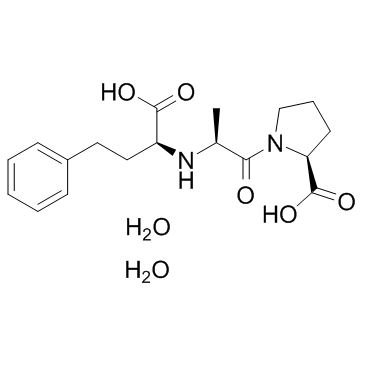
Enalaprilat Dihydrate structure
|
Common Name | Enalaprilat Dihydrate | ||
|---|---|---|---|---|
| CAS Number | 84680-54-6 | Molecular Weight | 384.424 | |
| Density | N/A | Boiling Point | 563.5ºC at 760 mmHg | |
| Molecular Formula | C18H28N2O7 | Melting Point | 211-215°C | |
| MSDS | Chinese USA | Flash Point | 294.6ºC | |
Use of Enalaprilat DihydrateEnalaprilat is an angiotensin-converting enzyme (ACE) inhibitor with IC50 of 1.94 nM.Target: ACEEnalaprilat has high affinity for human endothelial ACE with IC50 of 1.94 nM in vitro binding assay by displacing a saturating concentration of [125I]351A, a radiolabeled lisinopril analogue from ACE binding sites, and shows bradykinin/angiotensin I selectivity ratio of 1.00 calculated from double displacement experiments [1]. Enalaprilat attenuates the IGF-I induced neonatal rat cardiac fibroblast growth (30% reduction) in a concentration-dependent fashion, with IC50 of 90 mM [2].Administration of Enalaprilat induces a significant reduction of MAP at 70 minutes compared with the placebo group during haemorrhagic shock in rats, and results in a 50% reduction of CO, a general tendency of EB extravasation which is significant in the kidney and lungs, and a significant increase in ileal EB extravasation (53%) [3]. |
| Name | enalaprilat dihydrate |
|---|---|
| Synonym | More Synonyms |
| Description | Enalaprilat is an angiotensin-converting enzyme (ACE) inhibitor with IC50 of 1.94 nM.Target: ACEEnalaprilat has high affinity for human endothelial ACE with IC50 of 1.94 nM in vitro binding assay by displacing a saturating concentration of [125I]351A, a radiolabeled lisinopril analogue from ACE binding sites, and shows bradykinin/angiotensin I selectivity ratio of 1.00 calculated from double displacement experiments [1]. Enalaprilat attenuates the IGF-I induced neonatal rat cardiac fibroblast growth (30% reduction) in a concentration-dependent fashion, with IC50 of 90 mM [2].Administration of Enalaprilat induces a significant reduction of MAP at 70 minutes compared with the placebo group during haemorrhagic shock in rats, and results in a 50% reduction of CO, a general tendency of EB extravasation which is significant in the kidney and lungs, and a significant increase in ileal EB extravasation (53%) [3]. |
|---|---|
| Related Catalog | |
| References |
| Boiling Point | 563.5ºC at 760 mmHg |
|---|---|
| Melting Point | 211-215°C |
| Molecular Formula | C18H28N2O7 |
| Molecular Weight | 384.424 |
| Flash Point | 294.6ºC |
| Exact Mass | 384.189636 |
| PSA | 125.40000 |
| LogP | 1.32630 |
| Index of Refraction | 1.579 |
| InChIKey | MZYVOFLIPYDBGD-MLZQUWKJSA-N |
| SMILES | CC(NC(CCc1ccccc1)C(=O)O)C(=O)N1CCCC1C(=O)O.O.O |
| Storage condition | -20°C Freezer |
| Personal Protective Equipment | Eyeshields;Gloves;type N95 (US);type P1 (EN143) respirator filter |
|---|---|
| Hazard Codes | Xi |
| Risk Phrases | R20/21/22:Harmful by inhalation, in contact with skin and if swallowed . R36/37/38:Irritating to eyes, respiratory system and skin . |
| Safety Phrases | S22-S26-S36/37/39 |
| RIDADR | NONH for all modes of transport |
| RTECS | TW3590600 |
|
Evaluation of a rapid method for the therapeutic drug monitoring of aliskiren, enalapril and its active metabolite in plasma and urine by UHPLC-MS/MS.
J. Chromatogr. B. Analyt. Technol. Biomed. Life Sci. 980 , 79-87, (2015) Given the increasing popularity of aliskiren, particularly in combination with angiotensin converting enzyme inhibitor (e.g. enalapril), it is important to determine whether its use in combination wit... |
|
|
Role of multidrug resistance-associated protein 4 in the basolateral efflux of hepatically derived enalaprilat.
Drug Metab. Dispos. 42(9) , 1567-74, (2014) Hepatic uptake and efflux transporters govern the systemic and hepatic exposure of many drugs and metabolites. Enalapril is a pharmacologically inactive prodrug of enalaprilat. Following oral administ... |
|
|
Enalaprilat.
Dimens. Crit. Care Nurs. 19(2) , 22, (2000)
|
| MFCD00941393 |
| ENALAPRILAT DIHYDRATE |
| 2-[N-(1-Carboxy-3-phenylpropyl)alanyl]-1-pyrrolidinecarboxylic acid dihydrate |
| EINECS 278-459-3 |
| 1-Pyrrolidinecarboxylic acid, 2-[2-[(1-carboxy-3-phenylpropyl)amino]-1-oxopropyl]-, hydrate (1:2) |