Diafenthiuron
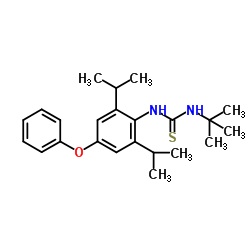
Diafenthiuron structure
|
Common Name | Diafenthiuron | ||
|---|---|---|---|---|
| CAS Number | 80060-09-9 | Molecular Weight | 384.578 | |
| Density | 1.1±0.1 g/cm3 | Boiling Point | 448.8±55.0 °C at 760 mmHg | |
| Molecular Formula | C23H32N2OS | Melting Point | 144.6-147.7°C | |
| MSDS | Chinese USA | Flash Point | 225.2±31.5 °C | |
| Symbol |

GHS07 |
Signal Word | Warning | |
Use of DiafenthiuronDiafenthiuron is a thiourea compound commonly used pesticide. Diafenthiuron inhibits mitochondrial functioning in insect pests[1]. |
| Name | diafenthiuron |
|---|---|
| Synonym | More Synonyms |
| Description | Diafenthiuron is a thiourea compound commonly used pesticide. Diafenthiuron inhibits mitochondrial functioning in insect pests[1]. |
|---|---|
| Related Catalog | |
| References |
| Density | 1.1±0.1 g/cm3 |
|---|---|
| Boiling Point | 448.8±55.0 °C at 760 mmHg |
| Melting Point | 144.6-147.7°C |
| Molecular Formula | C23H32N2OS |
| Molecular Weight | 384.578 |
| Flash Point | 225.2±31.5 °C |
| Exact Mass | 384.223541 |
| PSA | 65.38000 |
| LogP | 6.00 |
| Vapour Pressure | 0.0±1.1 mmHg at 25°C |
| Index of Refraction | 1.582 |
| InChIKey | WOWBFOBYOAGEEA-UHFFFAOYSA-N |
| SMILES | CC(C)c1cc(Oc2ccccc2)cc(C(C)C)c1NC(=S)NC(C)(C)C |
CHEMICAL IDENTIFICATION
HEALTH HAZARD DATAACUTE TOXICITY DATA
|
| Symbol |
GHS07 |
|---|---|
| Signal Word | Warning |
| Hazard Statements | H332 |
| Personal Protective Equipment | dust mask type N95 (US);Eyeshields;Faceshields;Gloves |
| Hazard Codes | Xn:Harmful |
| Risk Phrases | R20 |
| Safety Phrases | S22 |
| RIDADR | UN 2811 |
| RTECS | XN9100000 |
| Packaging Group | II |
| Hazard Class | 6.1(a) |
| HS Code | 2930909053 |
|
~%
Diafenthiuron CAS#:80060-09-9 |
| Literature: US4962126 A1, ; |

| Precursor 1 | |
|---|---|
| DownStream 0 | |
| HS Code | 2930909053 |
|---|---|
| Summary | 2930909053 s-(4-phenoxybutyl) dimethylcarbamothioate。supervision conditions:s(import or export registration certificate for pesticides)。VAT:17.0%。tax rebate rate:9.0%。MFN tarrif:6.5%。general tariff:30.0% |
|
Multi-residue method for determination of 238 pesticides in Chinese cabbage and cucumber by liquid chromatography-tandem mass spectrometry: comparison of different purification procedures.
J. Agric. Food Chem. 62(47) , 11449-56, (2014) This paper describes the comparison of five sample cleanup procedures for the determination of 238 pesticides via triple quadrupole liquid chromatography-tandem mass spectrometry (LC-MS/MS, with only ... |
|
|
Diafenthiuron residue and decline in pakchoi and soil under field application.
Ecotoxicol. Environ. Saf. 79 , 75-9, (2012) A simple analytical method based on QuEChERs was established for diafenthiuron residues in packhoi and soil. The residue levels and diaaipation rates of diafenthiuron in packhoi and soil were detected... |
|
|
Field efficacy and baseline toxicities of pyriproxifen, acetamiprid, and diafenthiuron against Bemisia tabaci Gennadius (Homoptera: Aleyrodidae) in Burkina Faso (West Africa).
J. Environ. Sci. Health B 38(6) , 757-69, (2003) Bioassays were conducted in 2001 and 2002 to estimate toxicities and dose-response relationships of 24 Bemisica tabaci Gennadius populations to pyriproxifen, acemitaprid, and diafenthiuron. LC50s rang... |
| Thiourea, N-[2,6-bis(1-methylethyl)-4-phenoxyphenyl]-N'-(1,1-dimethylethyl)- |
| Diafenthiuron |
| 1-tert-Butyl-3-(2,6-diisopropyl-4-phenoxyphenyl)thiourea |
| N-tert-butyl-N’-[2,6-di(propan-2-yl)-4-phenoxyphenyl]carbonothioic diamide |
| PoLO |
| 1-(2,6-Diisopropyl-4-phenoxyphenyl)-3-(2-methyl-2-propanyl)thiourea |
| 1-tert-butyl-3-[4-phenoxy-2,6-di(propan-2-yl)phenyl]thiourea |
| Pegasus |
| N-[2,6-bis(1-methylethyl)-4-phenoxyphenyl]-N’-(1,1-dimethylethyl)thiourea |
| N-[2,6-Bis(1-methylethyl)-4-phenoxyphenyl]-N'-(1,1-dimethylethyl)thiourea |
| MFCD01311814 |
| 1-tert-Butyl-3-(2,6-diisopropyl-4-phenoxyphenyl)thioharnstoff |