2-Iminobiotin hydrobromide
Modify Date: 2025-08-26 20:58:22
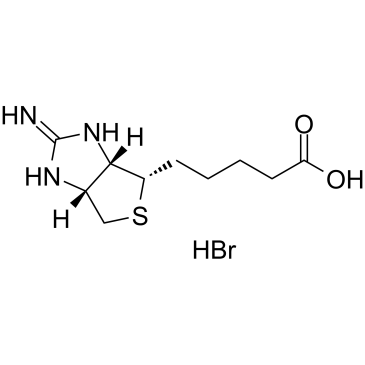
2-Iminobiotin hydrobromide structure
|
Common Name | 2-Iminobiotin hydrobromide | ||
|---|---|---|---|---|
| CAS Number | 76985-52-9 | Molecular Weight | 324.24 | |
| Density | N/A | Boiling Point | N/A | |
| Molecular Formula | C10H18BrN3O2S | Melting Point | N/A | |
| MSDS | N/A | Flash Point | N/A | |
Use of 2-Iminobiotin hydrobromide2-Iminobiotin hydrobromide (Guanidinobiotin hydrobromide) is a biotin (vitamin H or B7) analog. 2-Iminobiotin hydrobromide is a reversible nitric oxide synthases inhibitor with Kis of 21.8 and 37.5 μM for murine iNOS and rat n-cNOS, respectively[1]. 2-Iminobiotin hydrobromide superimposes on hypothermia protects human neuronal cells from hypoxia-induced cell damage[2]. |
| Name | 2-Iminobiotin hydrobromide |
|---|
| Description | 2-Iminobiotin hydrobromide (Guanidinobiotin hydrobromide) is a biotin (vitamin H or B7) analog. 2-Iminobiotin hydrobromide is a reversible nitric oxide synthases inhibitor with Kis of 21.8 and 37.5 μM for murine iNOS and rat n-cNOS, respectively[1]. 2-Iminobiotin hydrobromide superimposes on hypothermia protects human neuronal cells from hypoxia-induced cell damage[2]. |
|---|---|
| Related Catalog | |
| Target |
NO synthases[1] |
| In Vitro | Application of low concentrations of 2-Iminobiotin (2-IB; 10 ng/mL and 30 ng/mL) superimposed on hypothermia abrogates the hypoxia-induced lactate dehydrogenase (LDH) increase, resulting in LDH levels that were not different from the normoxia control[1]. |
| References |
| Molecular Formula | C10H18BrN3O2S |
|---|---|
| Molecular Weight | 324.24 |
| InChIKey | JKIJLCYOCQWMQL-UFLZEWODSA-N |
| SMILES | Br.NC1=NC2C(CSC2CCCCC(=O)O)N1 |