GRP (porcine)
Modify Date: 2025-09-18 18:35:18
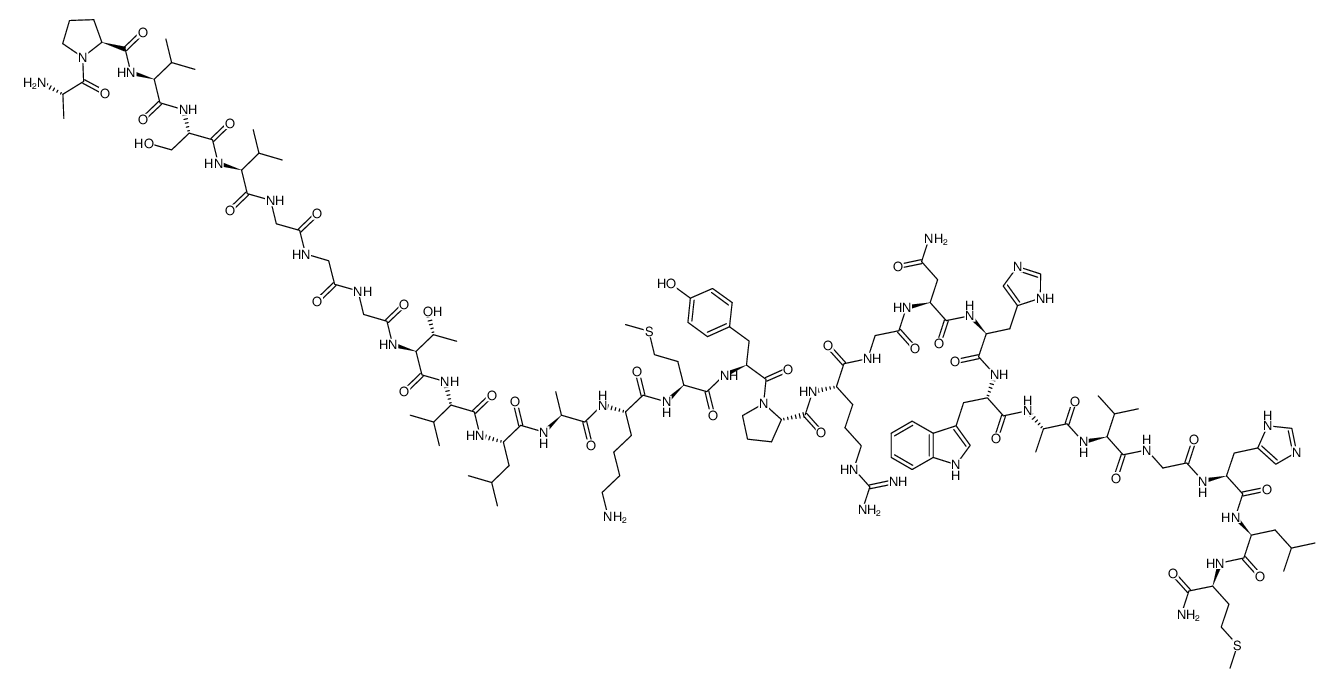
GRP (porcine) structure
|
Common Name | GRP (porcine) | ||
|---|---|---|---|---|
| CAS Number | 74815-57-9 | Molecular Weight | 2805.29 | |
| Density | N/A | Boiling Point | N/A | |
| Molecular Formula | C126H198N38O31S2 | Melting Point | N/A | |
| MSDS | N/A | Flash Point | N/A | |
Use of GRP (porcine)GRP (porcine) (Porcine gastrin-releasing peptide 27) is the putative mammalian analog of Bombesin (HY-P0195). GRP (porcine) activates the release of a number of gastroenteropancreatic (GEP) peptides into the peripheral circulation. GRP (porcine) stimulates gastrin release and exocrine pancreatic secretion. GRP (porcine) is a useful marker of neuroendocrine differentiation in many tumors[1][2]. |
| Name | gastrin releasing peptide, porcine |
|---|---|
| Synonym | More Synonyms |
| Description | GRP (porcine) (Porcine gastrin-releasing peptide 27) is the putative mammalian analog of Bombesin (HY-P0195). GRP (porcine) activates the release of a number of gastroenteropancreatic (GEP) peptides into the peripheral circulation. GRP (porcine) stimulates gastrin release and exocrine pancreatic secretion. GRP (porcine) is a useful marker of neuroendocrine differentiation in many tumors[1][2]. |
|---|---|
| Related Catalog | |
| References |
| Molecular Formula | C126H198N38O31S2 |
|---|---|
| Molecular Weight | 2805.29 |
| Exact Mass | 2803.45000 |
| PSA | 1123.58000 |
| LogP | 3.34950 |
| InChIKey | GLCDCQPXUJKYKQ-GZDVRPNBSA-N |
| SMILES | CSCCC(NC(=O)C(CC(C)C)NC(=O)C(Cc1cnc[nH]1)NC(=O)CNC(=O)C(NC(=O)C(C)NC(=O)C(Cc1c[nH]c2ccccc12)NC(=O)C(Cc1cnc[nH]1)NC(=O)C(CC(N)=O)NC(=O)CNC(=O)C(CCCNC(=N)N)NC(=O)C1CCCN1C(=O)C(Cc1ccc(O)cc1)NC(=O)C(CCSC)NC(=O)C(CCCCN)NC(=O)C(C)NC(=O)C(CC(C)C)NC(=O)C(NC(=O)C(NC(=O)CNC(=O)CNC(=O)CNC(=O)C(NC(=O)C(CO)NC(=O)C(NC(=O)C1CCCN1C(=O)C(C)N)C(C)C)C(C)C)C(C)O)C(C)C)C(C)C)C(N)=O |
| APVSVGGGTVLAKMYPRGNHWAVGHLM-NH2 |