SKF 83822 hydrobromide
Modify Date: 2025-09-11 11:40:40
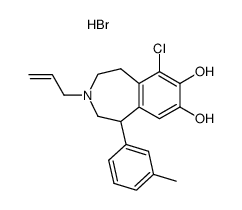
SKF 83822 hydrobromide structure
|
Common Name | SKF 83822 hydrobromide | ||
|---|---|---|---|---|
| CAS Number | 74115-10-9 | Molecular Weight | 424.76 | |
| Density | N/A | Boiling Point | N/A | |
| Molecular Formula | C20H23BrClNO2 | Melting Point | N/A | |
| MSDS | Chinese USA | Flash Point | N/A | |
| Symbol |


GHS06, GHS09 |
Signal Word | Danger | |
Use of SKF 83822 hydrobromideSKF83822 hydrobromide is a potent dopamine D1 receptor agonist. SKF83822 hydrobromide activates Gs/olf/adenylyl cyclase (AC)-coupled D1 receptors, but not phospholipase C (PLC)-coupled D1-like receptors[1]. |
| Name | 3-allyl-6-chloro-1-(m-tolyl)-2,3,4,5-tetrahydro-1H-benzo[d]azepine-7,8-diol hydrobromide |
|---|
| Description | SKF83822 hydrobromide is a potent dopamine D1 receptor agonist. SKF83822 hydrobromide activates Gs/olf/adenylyl cyclase (AC)-coupled D1 receptors, but not phospholipase C (PLC)-coupled D1-like receptors[1]. |
|---|---|
| Related Catalog | |
| Target |
D1 Receptor |
| In Vitro | SKF83822 (1 μM) increases DARPP-32 phosphorylation in Neostriatal slices. Treatment with SKF83822 for 5 min stimulates DARPP-32 Thr34 phosphorylation maximally at a concentration of 100 μM with a half maximal effect at ∼1 μM. SKF83822 (1 μM) does not affect the phosphorylation of DARPP-32 at Thr75, Ser97 or Ser130[1]. Western Blot Analysis[1] Cell Line: Neostriatal slices Concentration: 1 μM Incubation Time: 0, 0.5, 2, 5, and 10 minutes Result: Treatment with 1 μM increased the level of phospho-Thr34 DARPP-32, maximally by ∼6-fold within 2 min of incubation. |
| In Vivo | SKF83822 activates dopamine D1 receptors coupled to Gαs/olf and downstream cyclase activity. SKF83822 produces a locomotor response in both rodent and non-human primate models without affecting stereotypy, intense grooming, or dyskinesia. An acute injection of SKF83822 (0.4 mg/kg; i.p.) induced a greater than threefold increase in locomotor activity relative to the baseline period for each genotype[1]. Animal Model: Gαq knockout mice[1] Dosage: 0.4 mg/kg Administration: Result: There was a significant increase in locomotor activity in each genotype. |
| References |
| Molecular Formula | C20H23BrClNO2 |
|---|---|
| Molecular Weight | 424.76 |
| Exact Mass | 423.06000 |
| PSA | 43.70000 |
| LogP | 5.13160 |
| InChIKey | CFWPKYBBXBANLU-UHFFFAOYSA-N |
| SMILES | Br.C=CCN1CCc2c(cc(O)c(O)c2Cl)C(c2cccc(C)c2)C1 |
| Symbol |
GHS06, GHS09 |
|---|---|
| Signal Word | Danger |
| Hazard Statements | H301-H400 |
| Precautionary Statements | P273-P301 + P310 |
| RIDADR | UN2811 - class 6.1 - PG 3 - EHS - Toxic solids, organic, n.o.s., HI: all |