6,7-Isoquinolinediol,1,2,3,4-tetrahydro-1-methyl-, hydrobromide (1:1)
Modify Date: 2025-08-25 16:09:06
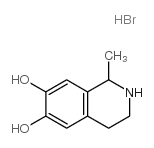
6,7-Isoquinolinediol,1,2,3,4-tetrahydro-1-methyl-, hydrobromide (1:1) structure
|
Common Name | 6,7-Isoquinolinediol,1,2,3,4-tetrahydro-1-methyl-, hydrobromide (1:1) | ||
|---|---|---|---|---|
| CAS Number | 59709-57-8 | Molecular Weight | 260.12800 | |
| Density | N/A | Boiling Point | 362.6ºC at 760 mmHg | |
| Molecular Formula | C10H14BrNO2 | Melting Point | 186-187ºC(lit.) | |
| MSDS | Chinese USA | Flash Point | 175.4ºC | |
| Symbol |

GHS07 |
Signal Word | Warning | |
| Name | 6,7-dihydroxy-1-methyl-1,2,3,4-tetrahydroisoquinoline hydrobromide |
|---|---|
| Synonym | More Synonyms |
| Boiling Point | 362.6ºC at 760 mmHg |
|---|---|
| Melting Point | 186-187ºC(lit.) |
| Molecular Formula | C10H14BrNO2 |
| Molecular Weight | 260.12800 |
| Flash Point | 175.4ºC |
| Exact Mass | 259.02100 |
| PSA | 52.49000 |
| LogP | 2.59140 |
| Appearance of Characters | white to brown |
| Storage condition | Hygroscopic, -20?C Freezer, Under Inert Atmosphere |
| Stability | Store in freezer at -20°C |
| Water Solubility | H2O: soluble5mg/mL (warmed; clear solution) |
| Symbol |
GHS07 |
|---|---|
| Signal Word | Warning |
| Hazard Statements | H315-H319-H335 |
| Precautionary Statements | P261-P305 + P351 + P338 |
| Hazard Codes | Xn |
| Risk Phrases | R34 |
| Safety Phrases | S25-S36/37/39-S45 |
| RIDADR | NONH for all modes of transport |
| WGK Germany | 3 |
| HS Code | 2933499090 |
|
~99%
6,7-Isoquinolin... CAS#:59709-57-8 |
| Literature: Dalence-Guzman, Maria F.; Berglund, Magnus; Skogvall, Staffan; Sterner, Olov Bioorganic and Medicinal Chemistry, 2008 , vol. 16, # 5 p. 2499 - 2512 |
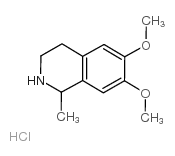
| Precursor 1 | |
|---|---|
| DownStream 2 | |
 CAS#:621-84-1
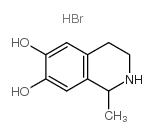 CAS#:38221-21-5
| HS Code | 2933499090 |
|---|---|
| Summary | 2933499090. other compounds containing in the structure a quinoline or isoquinoline ring-system (whether or not hydrogenated), not further fused. VAT:17.0%. Tax rebate rate:13.0%. . MFN tariff:6.5%. General tariff:20.0% |
|
A trivalent approach for determining in vitro toxicology: Examination of oxime K027.
J. Appl. Toxicol. 35(2) , 219-27, (2014) Unforeseen toxic effects contribute to compound attrition during preclinical evaluation and clinical trials. Consequently, there is a need to correlate in vitro toxicity to in vivo and clinical outcom... |
| 1-methyl-1,2,3,4-tetrahydroisoquinoline-6,7-diol,hydrobromide |
| MFCD00012741 |
The content on this webpage is sourced from various professional data sources. If you have any questions or concerns regarding the content, please feel free to contact service1@chemsrc.com.
- Shanghai Nianxing Industrial Co., Ltd
- China
- Product Name: 6,7-Isoquinolinediol,1,2,3,4-tetrahydro-1-methyl-, hydrobromide (1:1)
- Price: Check
- Purity: 98.0%
- Delivery: 10 Day
- Contact: Yang
- Email: sales@echemcloud.com
- Shanghai Jizhi Biochemical Technology Co., Ltd
- China
- Product Name: 6,7-Isoquinolinediol,1,2,3,4-tetrahydro-1-methyl-, hydrobromide (1:1)
- Price: ¥1318.0/10mg
- Purity: 98.0%
- Delivery: 3 Day
- Contact: Liu jia


- Email: 2130147988@qq.com
- Dayang Chem (Hangzhou) Co., Ltd.
- China
- Product Name: 6,7-Isoquinolinediol,1,2,3,4-tetrahydro-1-methyl-, hydrobromide (1:1)
- Price: $Inquiry/100g $Inquiry/1kg $Inquiry/100kg $Inquiry/1000kg
- Purity: 98.0%
- Delivery: Inquiry
- Contact: Ms Wang
- Email: enquiry@dycnchem.com
Get all suppliers and price by the below link:
6,7-Isoquinolinediol,1,2,3,4-tetrahydro-1-methyl-, hydrobromide (1:1) suppliers
6,7-Isoquinolinediol,1,2,3,4-tetrahydro-1-methyl-, hydrobromide (1:1) price