Tetrabenazine
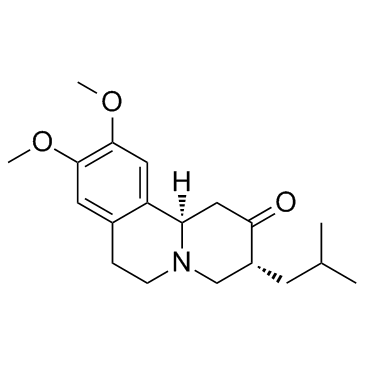
Tetrabenazine structure
|
Common Name | Tetrabenazine | ||
|---|---|---|---|---|
| CAS Number | 58-46-8 | Molecular Weight | 317.423 | |
| Density | 1.1±0.1 g/cm3 | Boiling Point | 448.9±45.0 °C at 760 mmHg | |
| Molecular Formula | C19H27NO3 | Melting Point | 128-130ºC | |
| MSDS | Chinese USA | Flash Point | 225.3±28.7 °C | |
| Symbol |

GHS07 |
Signal Word | Warning | |
Use of TetrabenazineTetrabenazine is a VMAT-inhibitor used for treatment of hyperkinetic movement disorder.Target: Otherstetrabenazine (TBZ), a monoamine-depleting and a dopamine-receptor-blocking drug. TBZ is an effective and safe drug for the treatment of a variety of hyperkinetic movement disorders. In contrast to typical neuroleptics, TBZ has not been demonstrated to cause tardive dyskinesia [1, 2]. Twenty patients with tardive dyskinesia (mean duration = 43.7 months) were videotaped before and after tetrabenazine treatment. One patient did not tolerate tetrabenazine owing to sedation. The remaining 19 were rated after a mean of 20.3 weeks at a mean tetrabenazine dose of 57.9 mg/day. There were significant improvements in mean scores on both the patient AIMS self-rating and the AIMS motor subset evaluated by the blind videotape raters. All 19 patients continued to take tetrabenazine after the study [3]. |
| Name | 9,10-dimethoxy-3-isobutyl-1,3,4,6,7,11b-hexahydro-2H-pyrido[2,1-a]isoquinolin-2-one |
|---|---|
| Synonym | More Synonyms |
| Description | Tetrabenazine is a VMAT-inhibitor used for treatment of hyperkinetic movement disorder.Target: Otherstetrabenazine (TBZ), a monoamine-depleting and a dopamine-receptor-blocking drug. TBZ is an effective and safe drug for the treatment of a variety of hyperkinetic movement disorders. In contrast to typical neuroleptics, TBZ has not been demonstrated to cause tardive dyskinesia [1, 2]. Twenty patients with tardive dyskinesia (mean duration = 43.7 months) were videotaped before and after tetrabenazine treatment. One patient did not tolerate tetrabenazine owing to sedation. The remaining 19 were rated after a mean of 20.3 weeks at a mean tetrabenazine dose of 57.9 mg/day. There were significant improvements in mean scores on both the patient AIMS self-rating and the AIMS motor subset evaluated by the blind videotape raters. All 19 patients continued to take tetrabenazine after the study [3]. |
|---|---|
| Related Catalog | |
| References |
| Density | 1.1±0.1 g/cm3 |
|---|---|
| Boiling Point | 448.9±45.0 °C at 760 mmHg |
| Melting Point | 128-130ºC |
| Molecular Formula | C19H27NO3 |
| Molecular Weight | 317.423 |
| Flash Point | 225.3±28.7 °C |
| Exact Mass | 317.199097 |
| PSA | 38.77000 |
| LogP | 3.48 |
| Vapour Pressure | 0.0±1.1 mmHg at 25°C |
| Index of Refraction | 1.554 |
CHEMICAL IDENTIFICATION
HEALTH HAZARD DATAACUTE TOXICITY DATA
|
| Symbol |
GHS07 |
|---|---|
| Signal Word | Warning |
| Hazard Statements | H302 |
| Personal Protective Equipment | dust mask type N95 (US);Eyeshields;Gloves |
| Hazard Codes | Xn: Harmful; |
| Risk Phrases | R22 |
| RIDADR | UN 3249 |
| RTECS | DK2275000 |
| Packaging Group | III |
| Hazard Class | 6.1(b) |
| HS Code | 2933990090 |
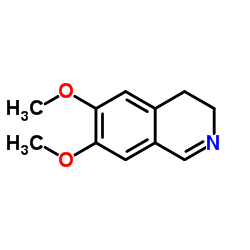 CAS#:3382-18-1
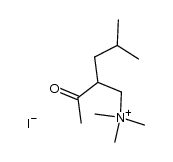 CAS#:1069-62-1
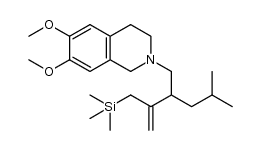 CAS#:1346909-10-1
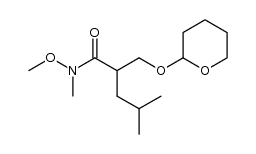 CAS#:1346909-38-3
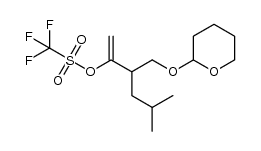 CAS#:1346909-40-7
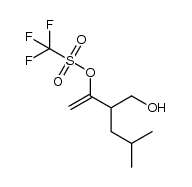 CAS#:1346909-31-6
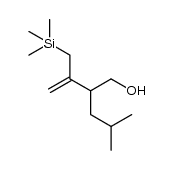 CAS#:1346909-44-1
| HS Code | 2933990090 |
|---|---|
| Summary | 2933990090. heterocyclic compounds with nitrogen hetero-atom(s) only. VAT:17.0%. Tax rebate rate:13.0%. . MFN tariff:6.5%. General tariff:20.0% |
|
The VMAT-2 inhibitor tetrabenazine alters effort-related decision making as measured by the T-maze barrier choice task: reversal with the adenosine A2A antagonist MSX-3 and the catecholamine uptake blocker bupropion.
Psychopharmacol. Ser. 232(7) , 1313-23, (2015) Depressed people show effort-related motivational symptoms, such as anergia, retardation, lassitude, and fatigue. Animal tests can model these motivational symptoms, and the present studies characteri... |
|
|
Effect of NMDAR antagonists in the tetrabenazine test for antidepressants: comparison with the tail suspension test.
Acta Neuropsychiatr. 27 , 228-34, (2015) The N-methyl-d-aspartate receptor (NMDAR) antagonist ketamine, produces rapid and enduring antidepressant effect in patients with treatment-resistant depression. Similar dramatic effects have not been... |
|
|
"Mixed" anionic and non-ionic micellar liquid chromatography for high-speed radiometabolite analysis of positron emission tomography radioligands.
J. Chromatogr. A. 1281 , 54-9, (2013) A mixed micellar liquid chromatographic (LC) method, the mobile phase consisting of anionic and non-ionic surfactants, has been developed for the high-speed direct radiometabolite analysis of positron... |
| 2H-Benzo(a)quinolizin-2-one, 1,3,4,6,7,11b-hexahydro-9,10-dimethoxy-3-(2-methylpropyl)- |
| 2H-Benzo[a]quinolizin-2-one, 1,3,4,6,7,11b-hexahydro-9,10-dimethoxy-3-(2-methylpropyl)- |
| 2-Oxo-3-isobutyl-9,10-dimethoxy-1,2,3,4,6,7-hexahydro-11bH-benzo[a]quinolizine |
| 9,10-Dimethoxy-3-(2-methylpropyl)-1,3,4,6,7,11b-hexahydro-2H-pyrido[2,1-a]isochinolin-2-on |
| tetrabenazine |
| Ro 1-9569 |
| Rubigen |
| 3-Isobutyl-9,10-dimethoxy-1,3,4,6,7,11b-hexahydro-2H-pyrido[2,1-a]isoquinolin-2-one |
| Tetrabenazine,(3R,11bR)-rel-1,3,4,6,7,11b-hexahydro-9,10-dimethoxy-3-(2-methylpropyl)-2H-benzo[a]quinolizin-2-one |
| 9,10-dimethoxy-3-isobutyl-1,3,4,6,7,11b-hexahydro-2H-pyrido[2,1-a]isoquinolin-2-one |
| Nitoman |
The content on this webpage is sourced from various professional data sources. If you have any questions or concerns regarding the content, please feel free to contact service1@chemsrc.com.
- Shanghai Nianxing Industrial Co., Ltd
- China
- Product Name: Tetrabenazine
- Price: Check
- Purity: 99.0%
- Delivery: 10 Day
- Contact: Yang
- Email: sales@echemcloud.com
- Shanghai Jizhi Biochemical Technology Co., Ltd
- China
- Product Name: Tetrabenazine
- Price: ¥1008.0/200mg ¥3708.0/1g
- Purity: 99.0%
- Delivery: Inquiry
- Contact: Liu jia


- Email: 2130147988@qq.com
- ShangHai DC Chemicals Co.,Ltd
- China
- Product Name: Tetrabenazine
- Price: ¥Inquiry/1g
- Purity: 98.9%
- Delivery: 1 Day
- Contact: Tony Lai
- Email: order@dcchemicals.com
- DC Chemicals Limited
- China
- Product Name: Tetrabenazine
- Price: $200.0/100mg $350.0/250mg $650.0/1g
- Purity: 98.0%
- Delivery: 3 Day
- Contact: Tony Cao
- Email: sales@dcchemicals.com
- Dayang Chem (Hangzhou) Co., Ltd.
- China
- Product Name: Tetrabenazine
- Price: $Inquiry/100g $Inquiry/1kg $Inquiry/100kg $Inquiry/1000kg
- Purity: 98.0%
- Delivery: Inquiry
- Contact: Ms Wang
- Email: enquiry@dycnchem.com
- Shanghai Amole Biotechnology Co., Ltd.
- China
- Product Name: Tetrabenazine
- Price: ¥Inquiry/100mg ¥Inquiry/1g ¥Inquiry/250mg ¥Inquiry/5g
- Purity: 98.0%
- Delivery: Inquiry
- Contact: Xiyao Wang
- Email: 3623107365@qq.com
- Henan Tianfu Chemical Co., Ltd.
- China
- Product Name: Tetrabenazine
- Price: $Inquiry/1kg $Inquiry/25kg $Inquiry/1000kg $Inquiry/10ton
- Purity: 99.0%
- Delivery: Inquiry
- Contact: Anson
- Email: info@tianfuchem.com
Get all suppliers and price by the below link:
Reference only. check more Tetrabenazine price