Hexadecanedioic acid
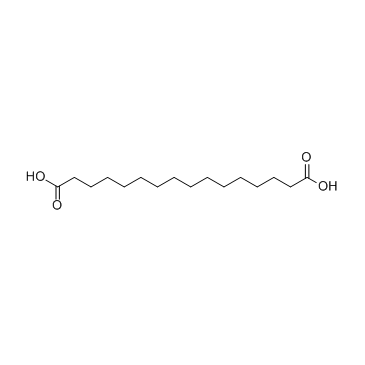
Hexadecanedioic acid structure
|
Common Name | Hexadecanedioic acid | ||
|---|---|---|---|---|
| CAS Number | 505-54-4 | Molecular Weight | 286.407 | |
| Density | 1.0±0.1 g/cm3 | Boiling Point | 457.5±18.0 °C at 760 mmHg | |
| Molecular Formula | C16H30O4 | Melting Point | 120-123 °C(lit.) | |
| MSDS | Chinese USA | Flash Point | 244.6±17.7 °C | |
Use of Hexadecanedioic acidHexadecanedioic acid is covalently linked to Sepharose 4B, shows better performance in terms of specificity than dye-based resins and could be used for depletion of SA from plasma samples. |
| Name | Hexadecanedioic Acid |
|---|---|
| Synonym | More Synonyms |
| Description | Hexadecanedioic acid is covalently linked to Sepharose 4B, shows better performance in terms of specificity than dye-based resins and could be used for depletion of SA from plasma samples. |
|---|---|
| Related Catalog | |
| Target |
Human Endogenous Metabolite |
| References |
| Density | 1.0±0.1 g/cm3 |
|---|---|
| Boiling Point | 457.5±18.0 °C at 760 mmHg |
| Melting Point | 120-123 °C(lit.) |
| Molecular Formula | C16H30O4 |
| Molecular Weight | 286.407 |
| Flash Point | 244.6±17.7 °C |
| Exact Mass | 286.214417 |
| PSA | 74.60000 |
| LogP | 5.05 |
| Vapour Pressure | 0.0±2.4 mmHg at 25°C |
| Index of Refraction | 1.475 |
| InChIKey | QQHJDPROMQRDLA-UHFFFAOYSA-N |
| SMILES | O=C(O)CCCCCCCCCCCCCCC(=O)O |
| Storage condition | 2-8°C |
| Stability | Stable. Incompatible with bases, oxidizing agents, reducing agents. Combustible. |
| HS Code | 2917190090 |
|---|---|
| Summary | 2917190090 acyclic polycarboxylic acids, their anhydrides, halides, peroxides, peroxyacids and their derivatives VAT:17.0% Tax rebate rate:9.0% Supervision conditions:none MFN tariff:6.5% General tariff:30.0% |
|
Feasibility of detecting prostate cancer by ultraperformance liquid chromatography-mass spectrometry serum metabolomics.
J. Proteome Res. 13(7) , 3444-54, (2014) Prostate cancer (PCa) is the second leading cause of cancer-related mortality in men. The prevalent diagnosis method is based on the serum prostate-specific antigen (PSA) screening test, which suffers... |
|
|
Alkylthioacetic acids (3-thia fatty acids) as non-beta-oxidizable fatty acid analogues: a new group of hypolipidemic drugs. III. Dissociation of cholesterol- and triglyceride-lowering effects and the induction of peroxisomal beta-oxidation.
J. Lipid Res. 30(11) , 1711-8, (1989) Previous work in this laboratory indicated that sulfur-substituted fatty acid analogues, 1.10-bis(carboxymethylthio)decane and alkylthioacetic acid, both non-beta-oxidizable compounds, and the beta-ox... |
|
|
Subcellular localization of hexadecanedioic acid activation in human liver.
J. Lipid Res. 15(6) , 551-6, (1974) The activation of hexadecanedioic acid has been studied in subcellular fractions of human liver. The activation capacity in a total homogenate of human liver was found to be 0.5 micro mole/min/g wet w... |
| hexadecandioic acid |
| Hexadecanedioic acid |
| EINECS 208-013-5 |
| MFCD00002746 |
| 1,14-Tetradecanedicarboxylic Acid |
| Thapsic Acid |
The content on this webpage is sourced from various professional data sources. If you have any questions or concerns regarding the content, please feel free to contact service1@chemsrc.com.
- Shanghai Nianxing Industrial Co., Ltd
- China
- Product Name: Hexadecanedioic acid
- Price: Check
- Purity: 98.0%
- Delivery: 10 Day
- Contact: Yang
- Email: sales@echemcloud.com
- Shanghai Jizhi Biochemical Technology Co., Ltd
- China
- Product Name: Hexadecanedioic acid
- Price: ¥328.0/1g ¥138.0/250mg
- Purity: 98.0%
- Delivery: 2 Day
- Contact: Liu jia


- Email: 2130147988@qq.com
- Chengdu Pukang Biotechnology Co., Ltd.
- China
- Product Name: Hexadecanedioic acid
- Price: ¥Inquiry/10g
- Purity: 95.0%
- Delivery: Inquiry
- Contact: Lihua Yang
- Email: sales@pu-kang.com
- Dayang Chem (Hangzhou) Co., Ltd.
- China
- Product Name: Hexadecanedioic acid
- Price: $Inquiry/100g $Inquiry/1kg $Inquiry/100kg $Inquiry/1000kg
- Purity: 98.0%
- Delivery: Inquiry
- Contact: Ms Wang
- Email: enquiry@dycnchem.com
- Zhongshan Xingrui Chemical Co. , Ltd.
- China
- Product Name: Hexadecanedioic acid
- Price: ¥Inquiry/25kg
- Purity: 99.0%
- Delivery: Inquiry
- Contact: Wang Jie
- Email: 3096638339@qq.com
Get all suppliers and price by the below link:
Hexadecanedioic acid suppliers
Reference only. check more Hexadecanedioic acid price