RX 67668
Modify Date: 2025-12-01 13:27:14
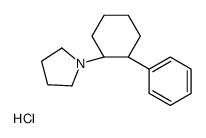
RX 67668 structure
|
Common Name | RX 67668 | ||
|---|---|---|---|---|
| CAS Number | 40709-76-0 | Molecular Weight | 265.82100 | |
| Density | N/A | Boiling Point | N/A | |
| Molecular Formula | C16H24ClN | Melting Point | N/A | |
| MSDS | N/A | Flash Point | N/A | |
Use of RX 67668RX 67668 is a potent cholinesterase inhibitor with an IC50 of 5 μM for both acetylcholinesterase (AChE) and butyrylcholinesterase. RX 67668 can reverse the neuromuscular blockade induced by D-tubocurarine. RX 67668 is a muscle relaxant used to relieve skeletal muscle fatigue[1][2]. |
| Name | 1-[(1R,2R)-2-phenylcyclohexyl]pyrrolidine,hydrochloride |
|---|
| Description | RX 67668 is a potent cholinesterase inhibitor with an IC50 of 5 μM for both acetylcholinesterase (AChE) and butyrylcholinesterase. RX 67668 can reverse the neuromuscular blockade induced by D-tubocurarine. RX 67668 is a muscle relaxant used to relieve skeletal muscle fatigue[1][2]. |
|---|---|
| Related Catalog | |
| Target |
IC50: 5 μM (acetylcholinesterase) and 5 μM (butyrylcholinesterase)[1] |
| In Vivo | RX 67668 (1-4 mg/kg; i.p.) reduces by half the dose of methacholine necessary to produce red tears, whilst RX 67668 (7-2 mg/kg s.c.) is necessary to reduce the pupil diameter of the mouse to 50% of the control value[1]. Rat anterior tibialis preparation of the cat tibialis preparation demonstrates that RX 67668 (0.3-1.0 mg/kg; i.v.) is effective in reversing tubocurarine-induced muscle blockade[1]. |
| References |
| Molecular Formula | C16H24ClN |
|---|---|
| Molecular Weight | 265.82100 |
| Exact Mass | 265.16000 |
| PSA | 3.24000 |
| LogP | 4.54850 |
| InChIKey | PFJUKRASTDOAQF-QNBGGDODSA-N |
| SMILES | Cl.c1ccc(C2CCCCC2N2CCCC2)cc1 |