N-Acetylcysteine amide
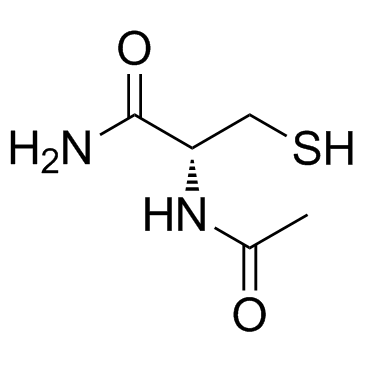
N-Acetylcysteine amide structure
|
Common Name | N-Acetylcysteine amide | ||
|---|---|---|---|---|
| CAS Number | 38520-57-9 | Molecular Weight | 162.21000 | |
| Density | N/A | Boiling Point | N/A | |
| Molecular Formula | C5H10N2O2S | Melting Point | N/A | |
| MSDS | Chinese USA | Flash Point | N/A | |
| Symbol |

GHS07 |
Signal Word | Warning | |
Use of N-Acetylcysteine amideN-Acetylcysteine amide is a cell membranes and blood brain barrier permeant thiol antioxidant and neuroprotective agent. |
| Name | (2R)-2-acetamido-3-sulfanylpropanamide |
|---|---|
| Synonym | More Synonyms |
| Description | N-Acetylcysteine amide is a cell membranes and blood brain barrier permeant thiol antioxidant and neuroprotective agent. |
|---|---|
| Related Catalog | |
| In Vitro | N-Acetylcysteine amide shows no obvious effect on the viability of H9c2 cells treated with doxorubicin (DOX) at < 1 mM, but causes significant cytotoxicity at 10-20 mM. N-Acetylcysteine amide (750 μM) reduces the ROS levle and lipid peroxidation induced by DOX, and restores GSH/GSSG ratio and activities of antioxidant enzymes, such as catalase (CAT), gluthathione peroxidase (GPx), gluthathione reductase (GR)[1]. N-Acetylcysteine amide (1 mM) protects the human brain microvascular endothelial (HBMVEC) from methamphetamine (METH)- induced cell death[3]. |
| In Vivo | N-Acetylcysteine amide has increased CNS bioavailability. N-Acetylcysteine amide (150 mg/kg, i.p.) improves cortical sparing and functional outcome, reduces oxidative stress, improves mitochondrial bioenergetics, and maintains mitochondrial glutathione content following traumatic brain injury (TBI) in rats[2]. |
| Cell Assay | To choose a sublethal concentration of N-Acetylcysteine amide and N-acetylcysteine for the study on their ability to protect cells from doxorubicin (DOX)-induced toxicity, H9c2 cells are exposed with N-Acetylcysteine amide or N-acetylcysteine at 0.25 mM, 0.50 mM, 0.75 mM, 1 mM, 2 mM, 5 mM, 10 mM, and 20 mM for 24 h. Untreated cells are used as the control for each experiment[1]. |
| Animal Admin | Rats[2] In order to assess mitochondrial respiration and glutathione content following traumatic brain injury (TBI), rats are randomly divided into three groups (n = 5 animals/group). (I.) N-Acetylcysteine amide group receives multiple bolus IP injections of N-Acetylcysteine amide (150 mg/kg) immediately after 5 minutes and then every 6 hours up to 24 hrs post-injury. (II.) Vehicle group receives equivalent v/v saline at 5 minutes and every 6 hours (6, 12, 18, 24 hrs) up to 24 hrs post-injury. (III.) Sham injured group animals do not receive any drug treatment. At 25 hrs post-injury, all animals are euthanized and mitochondria are isolated from the ipsilateral cortical hemisphere (6 mm punch) to carry out measurements of mitochondrial respiration and glutathione content[2]. |
| References |
| Molecular Formula | C5H10N2O2S |
|---|---|
| Molecular Weight | 162.21000 |
| Exact Mass | 162.04600 |
| PSA | 115.47000 |
| LogP | 0.89620 |
| Storage condition | -20℃ |
| HS Code | 2930909090 |
|---|---|
| Summary | 2930909090. other organo-sulphur compounds. VAT:17.0%. Tax rebate rate:13.0%. . MFN tariff:6.5%. General tariff:30.0% |
|
Gambogic acid sensitizes resistant breast cancer cells to doxorubicin through inhibiting P-glycoprotein and suppressing survivin expression.
Chem. Biol. Interact. 235 , 76-84, (2015) The development of resistance to chemotherapeutic agents remains a major challenge to breast cancer chemotherapy. Overexpression of drug efflux transporters like P-glycoprotein (P-gp) and resistance t... |
|
|
Atmospheric gas plasma-induced ROS production activates TNF-ASK1 pathway for the induction of melanoma cancer cell apoptosis.
Mol. Biol. Cell 25(9) , 1523-31, (2014) Atmospheric gas plasmas (AGPs) are able to selectively induce apoptosis in cancer cells, offering a promising alternative to conventional therapies that have unwanted side effects such as drug resista... |
|
|
Mutations in the mitochondrial methionyl-tRNA synthetase cause a neurodegenerative phenotype in flies and a recessive ataxia (ARSAL) in humans.
PLoS Biol. 10 , e1001288, (2012) An increasing number of genes required for mitochondrial biogenesis, dynamics, or function have been found to be mutated in metabolic disorders and neurological diseases such as Leigh Syndrome. In a f... |
| Nac amide |
| acetylcysteinamide |
| Acetylcysteine amide |
| (R)- 2-(Acetylamino)-3-mercapto-Propanamide AD4 N-Acetyl-L-cysteinamide NACA acetylcysteinamide |
| N-Acetyl-L-cysteine amide |
| N-Acetylcysteine amide |
| NACA |
| N-Acetyl-L-cysteinamide |
The content on this webpage is sourced from various professional data sources. If you have any questions or concerns regarding the content, please feel free to contact service1@chemsrc.com.
- Shanghai Nianxing Industrial Co., Ltd
- China
- Product Name: N-Acetylcysteineamide
- Price: Check
- Purity: 98.0%
- Delivery: 10 Day
- Contact: Yang
- Email: sales@echemcloud.com
- DC Chemicals Limited
- China
- Product Name: Nac amide
- Price: $Inquiry/100mg $Inquiry/250mg $Inquiry/500mg
- Purity: 98.0%
- Delivery: 3 Day
- Contact: Tony Cao
- Email: sales@dcchemicals.com
- Nanjing Peptide Biotech Ltd
- China
- Product Name: N-Acetyl-L-cysteine amide
- Price: ¥Inquiry/10g ¥Inquiry/100g ¥Inquiry/1kg ¥Inquiry/10kg
- Purity: 98.0%
- Delivery: 7 Day
- Contact: jom


- Email: chenglong.fan@njpeptide.com
- Shanghai Amole Biotechnology Co., Ltd.
- China
- Product Name: N-Acetylcysteine amide
- Price: ¥Inquiry/100mg ¥Inquiry/1g ¥Inquiry/250mg ¥Inquiry/25mg
- Purity: 98.0%
- Delivery: Inquiry
- Contact: Xiyao Wang
- Email: 3623107365@qq.com
Get all suppliers and price by the below link:
N-Acetylcysteine amide suppliers
Reference only. check more N-Acetylcysteine amide price