MAO-B-IN-22
Modify Date: 2025-08-27 11:05:12
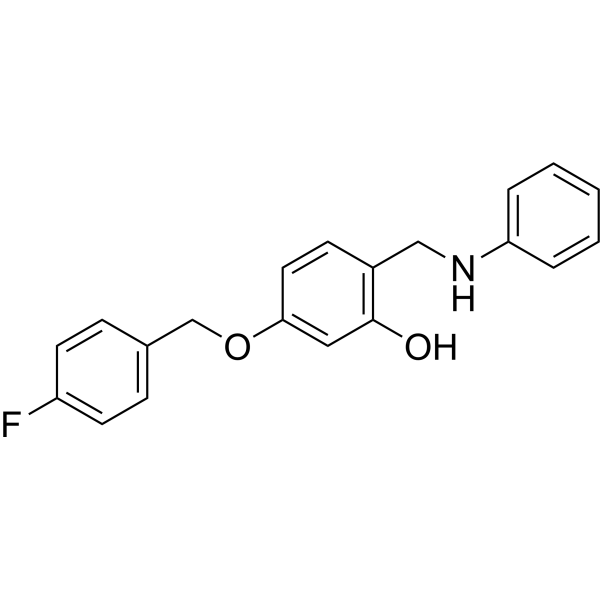
MAO-B-IN-22 structure
|
Common Name | MAO-B-IN-22 | ||
|---|---|---|---|---|
| CAS Number | 2902600-76-2 | Molecular Weight | 323.36 | |
| Density | N/A | Boiling Point | N/A | |
| Molecular Formula | C20H18FNO2 | Melting Point | N/A | |
| MSDS | N/A | Flash Point | N/A | |
Use of MAO-B-IN-22MAO-B-IN-22 (compound 6h) is a potent MAO-B inhibitor with an IC50 of 0.014 μM. MAO-B-IN-22 has high antioxidant activity, good metal chelating ability, proper BBB permeability and significant neuroprotective effect[1]. |
| Name | MAO-B-IN-22 |
|---|
| Description | MAO-B-IN-22 (compound 6h) is a potent MAO-B inhibitor with an IC50 of 0.014 μM. MAO-B-IN-22 has high antioxidant activity, good metal chelating ability, proper BBB permeability and significant neuroprotective effect[1]. |
|---|---|
| Related Catalog | |
| In Vitro | MAO-B-IN-22 (compound 6h) (2.5-50 μM, 24 h) 可以剂量依赖性的保护过氧化氢诱导的氧化损伤,提高细胞活力[1]。 MAO-B-IN-22 (compound 6h) (0.5-10 μM, 24 h) 可以剂量依赖性的降低 LPS 诱导的 NO 产生,具有抗神经炎症活性[1]。 Cell Viability Assay[1] Cell Line: PC-12 cells Concentration: 2.5 μM, 10.0 μM, 50.0 μM Incubation Time: 24 h Result: Increased cell viability to 59.8%, 69.6% and 77.2% of the control value at doses of 2.5 μM, 10.0 μM and 50.0 μM, respectively. Western Blot Analysis[1] Cell Line: BV-2 cells Concentration: 0.5 μM, 2.5 μM, 10.0 μM Incubation Time: 24 h Result: Significantly reduced LPS-induced NO production by 13.5%, 28.0% and 76.1% at concentrations of 0.5 μM, 2.5 μM and 10.0 μM, respectively. Inhibited the release of ROS induced by lipopolysaccharide, and the inhibitory rates were 21.2% and 99.0% at the concentration of 2.5 μM and 10.0 μM , respectively. Significantly inhibited the phosphorylation of IκBα to p-IκBα, and inhibited the translocation of p65 from the cytoplasm to the nucleus. |
| In Vivo | MAO-B-IN-22 (compound 6h)(53.5 mg/kg, oral gavage, once a day for 3 weeks) 可以通过抑制 MAO-B 增加多巴胺能神经递质水平和减少 ROS 引起的氧化损伤水平来减轻小鼠的运动损伤,可以减轻 MPTP 治疗小鼠的运动障碍,并可能改善体内 PD 的症状[1]。 Animal Model: C57BL/6C mice[1] Dosage: 53.5 mg/kg Administration: oral gavage, once a day for 3 weeks Result: Significantly improved traction test scores and reduced BWT times, T-turns and T-totals. Restored DA levels and reduce MDA levels. |
| References |
| Molecular Formula | C20H18FNO2 |
|---|---|
| Molecular Weight | 323.36 |