(+)-Catechin hydrate
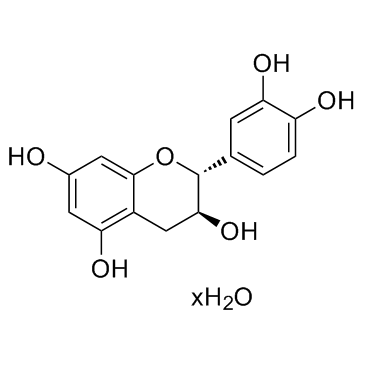
(+)-Catechin hydrate structure
|
Common Name | (+)-Catechin hydrate | ||
|---|---|---|---|---|
| CAS Number | 225937-10-0 | Molecular Weight | 308.283 | |
| Density | N/A | Boiling Point | 630.4ºC at760mmHg | |
| Molecular Formula | C15H14O6.xH2O | Melting Point | 175-177ºC | |
| MSDS | Chinese USA | Flash Point | 335ºC | |
| Symbol |

GHS07 |
Signal Word | Warning | |
Use of (+)-Catechin hydrate(+)-Catechin hydrate inhibits cyclooxygenase-1 (COX-1) with an IC50 of 1.4 μM. |
| Name | (+)-catechin hydrate |
|---|---|
| Synonym | More Synonyms |
| Description | (+)-Catechin hydrate inhibits cyclooxygenase-1 (COX-1) with an IC50 of 1.4 μM. |
|---|---|
| Related Catalog | |
| Target |
COX-1:1.4 μM (IC50) |
| In Vitro | (+)-Catechin exhibits >95% inhibitory activity at 70 μg/mL against cyclooxygenase-1 (COX-1) with an IC50 of 1.4 μM[1]. A dose-dependent reduction in color is observed after 24 hours of treatment with (+)-Catechin, and 54.76% of the cells are dead at the highest concentration of (+)-Catechin tested (160 μg/mL) whereas the IC50 of (+)-Catechin is achieved at 127.62 μg/mL (+)-Catechin. A dose- and time-dependent increase in the induction of apoptosis is observed when MCF-7 cells are treated with (+)-Catechin. When compare to the control cells at 24 hours, 40.7 and 41.16% of the cells treated with 150 μg/mL and 300 μg/mL (+)-Catechin, respectively, undergo apoptosis. The expression levels of Caspase-3, -8, and -9 and p53 in MCF-7 cells treated with 150 μg/mL (+)-Catechin for 24 h increase by 5.81, 1.42, 3.29, and 2.68 fold, respectively, as compare to the levels in untreated control cells[2]. |
| In Vivo | Animals treated with (+)-Catechin at the lowest tested dose, i.e., 50 mg/kg, p.o. have spent comparatively more time in exploring the novel object in the choice trial, however, the difference is not statistically significant. (+)-Catechin prevents the time-induced episodic memory deficits in a dose-dependent manner, the most effective being 200 mg/kg, p.o.. Treatment with (+)-Catechin prevents the rise in MPO level compare to DOX alone treatment group (21.98±9.44 and 36.76±4.39% in the hippocampus and the frontal cortex respectively)[3]. |
| Cell Assay | The Cell viability assay is performed to assess the toxicity of different concentrations of (+)-Catechin on MCF-7 cells. Briefly, MCF-7 cells (2×10⁴ cells/well) are plated in 96-well plates and treated with 0 μg/mL (+)-Catechin and 160 μg/mL (+)-Catechin for 24 hours. Then, 40 μL of the Cell Titer Blue solution is directly added to the wells and incubated at 37°C for 6 hours. The fluorescence is recorded with a 560 nm/590 nm (excitation/emission) filter set using a microplate fluorescence reader, and the IC50 is calculated. Quadruplet samples are run for each concentration of (+)-Catechin in three independent experiments[2]. |
| Animal Admin | Rats[3] Twelve weeks old, healthy male rats weighing 200 to 230 g are used in this study. Rats are divided into four experimental groups (n=9 each) for one vehicle and three groups of (+)-Catechin (three doses). The doses of (+)-Catechin are prepared at 50, 100, 200 mg/kg and administered orally for 7 days prior to and during the experimental trials. Episodic memory, the conscious memory of the past experiences is evaluated in this study[3]. |
| References |
| Boiling Point | 630.4ºC at760mmHg |
|---|---|
| Melting Point | 175-177ºC |
| Molecular Formula | C15H14O6.xH2O |
| Molecular Weight | 308.283 |
| Flash Point | 335ºC |
| Exact Mass | 308.089600 |
| PSA | 119.61000 |
| LogP | 1.48180 |
| Vapour Pressure | 9.29E-17mmHg at 25°C |
| Symbol |
GHS07 |
|---|---|
| Signal Word | Warning |
| Hazard Statements | H315-H319-H335 |
| Precautionary Statements | P261-P305 + P351 + P338 |
| Personal Protective Equipment | dust mask type N95 (US);Eyeshields;Gloves |
| Hazard Codes | Xi: Irritant; |
| Risk Phrases | R36/37/38 |
| Safety Phrases | 26-36 |
| RIDADR | NONH for all modes of transport |
| WGK Germany | 3 |
|
Chemical genetics reveals a complex functional ground state of neural stem cells.
Nat. Chem. Biol. 3(5) , 268-273, (2007) The identification of self-renewing and multipotent neural stem cells (NSCs) in the mammalian brain holds promise for the treatment of neurological diseases and has yielded new insight into brain canc... |
|
|
Exogenous acetaldehyde as a tool for modulating wine color and astringency during fermentation.
Food Chem. 177 , 17-22, (2015) Wine tannins undergo modifications during fermentation and storage that can decrease their perceived astringency and increase color stability. Acetaldehyde acts as a bridging compound to form modified... |
|
|
Retaining Oxidative Stability of Emulsified Foods by Novel Nonmigratory Polyphenol Coated Active Packaging.
J. Agric. Food Chem. 64 , 5574-82, (2016) Oxidation causes lipid rancidity, discoloration, and nutrient degradation that decrease shelf life of packaged foods. Synthetic additives are effective oxidation inhibitors, but are undesirable to con... |
| (2R-trans)-2-(3,4-Dihydroxyphenyl)-3,4-dihydro-2H-1-benzopyran-3,5,7-triol monohydrate |
| EINECS 230-731-2 |
| (2R,3S)-2-(3,4-Dihydroxyphenyl)chroman-3,5,7-triol hydrate |
| 2H-1-Benzopyran-3,5,7-triol, 2-(3,4-dihydroxyphenyl)-3,4-dihydro-, hydrate (1:1) |
| 2H-1-Benzopyran-3,5,7-triol, 2-(3,4-dihydroxyphenyl)-3,4-dihydro-, (2R,3S)-, hydrate (1:1) |
| MFCD00150865 |
| D-CATECHOL HYDRATE |
| FK-027-13C,15N2 |
| (+)-Cyanidol-3 |
| D-CATECHIN HYDRATE |
| (2R,3S)-2-(3,4-Dihydroxyphenyl)-3,4-dihydro-1(2H)-benzopyran-3,5,7-triol |
| D-CATECHIN |
| CYANIDOL HYDRATE |
| Cefixoral-13C,15N2 |
| Catechin Hydrate |
| (+)-Cyanidol-3,(2R,3S)-2-(3,4-Dihydroxyphenyl)-3,4-dihydro-1(2H)-benzopyran-3,5,7-triol |
| (+)-Catechin Hydrate |
| (2R,3S)-2-(3,4-Dihydroxyphenyl)-3,5,7-chromanetriol hydrate (1:1) |
| 2-(3,4-Dihydroxyphenyl)-3,5,7-chromanetriol hydrate (1:1) |
| (+)-C |
| (2R,3S)-2-(3,4-Dihydroxyphenyl)chromane-3,5,7-triol hydrate (1:1) |
The content on this webpage is sourced from various professional data sources. If you have any questions or concerns regarding the content, please feel free to contact service1@chemsrc.com.
- Shanghai Nianxing Industrial Co., Ltd
- China
- Product Name: (+)-Catechin hydrate
- Price: Check
- Purity: 98.0%
- Delivery: 10 Day
- Contact: Yang
- Email: sales@echemcloud.com
- Shanghai Jizhi Biochemical Technology Co., Ltd
- China
- Product Name: (+)-Catechin hydrate
- Price: ¥88.0/20mg
- Purity: 98.0%
- Delivery: Inquiry
- Contact: Liu jia


- Email: 2130147988@qq.com
- Dayang Chem (Hangzhou) Co., Ltd.
- China
- Product Name: (+)-Catechin hydrate
- Price: $Inquiry/100g $Inquiry/1kg $Inquiry/100kg $Inquiry/1000kg
- Purity: 98.0%
- Delivery: Inquiry
- Contact: Ms Wang
- Email: enquiry@dycnchem.com
- Henan Tianfu Chemical Co., Ltd.
- China
- Product Name: (+)-catechin hydrate
- Price: $Inquiry/1kg $Inquiry/25kg $Inquiry/1000kg $Inquiry/10ton
- Purity: 99.0%
- Delivery: Inquiry
- Contact: Anson
- Email: info@tianfuchem.com
Get all suppliers and price by the below link:
(+)-Catechin hydrate suppliers
Reference only. check more (+)-Catechin hydrate price