Dazucorilant
Modify Date: 2025-08-26 15:07:28
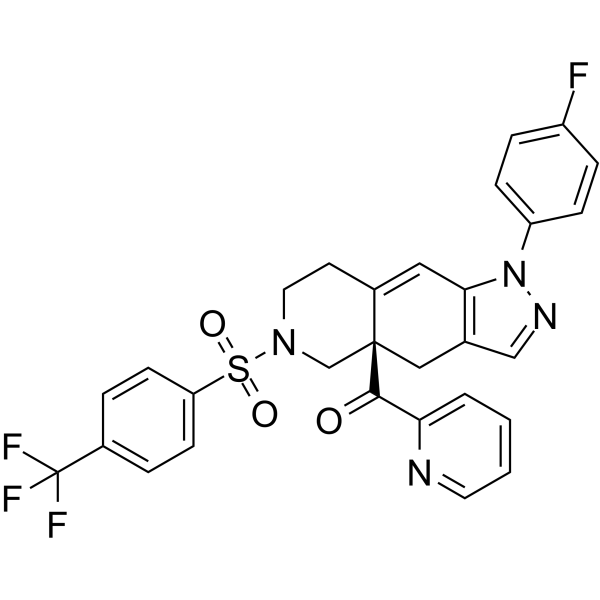
Dazucorilant structure
|
Common Name | Dazucorilant | ||
|---|---|---|---|---|
| CAS Number | 1496508-34-9 | Molecular Weight | 582.57 | |
| Density | N/A | Boiling Point | N/A | |
| Molecular Formula | C29H22F4N4O3S | Melting Point | N/A | |
| MSDS | N/A | Flash Point | N/A | |
Use of DazucorilantDazucorilant (CORT113176) is a selective and high affinity non-steroidal glucocorticoid receptor (GR) modulator with a Ki value <1 nM in vitro. Dazucorilant can be used for the research of neurological disorders[1][2]. |
| Name | Dazucorilant |
|---|
| Description | Dazucorilant (CORT113176) is a selective and high affinity non-steroidal glucocorticoid receptor (GR) modulator with a Ki value <1 nM in vitro. Dazucorilant can be used for the research of neurological disorders[1][2]. |
|---|---|
| Related Catalog | |
| Target |
GR[1] |
| In Vitro | In HepG2 human cells or in human hepatocytes, Dazucorilant acts as full antagonist since it is able to prevent the dexamethasone-induced increase in TAT activity and to induce non-measurable agonist activity in the absence of dexamethasone[3]. |
| In Vivo | Dazucorilant (30 mg/kg/day; s.c.) makes mice show reversed abnormalities of motoneurons and down-regulated proinflammatory mediators and glial reactivity[1]. Dazucorilant (5, 10 or 20 mg/kg; i.p.) reverses hippocampal amyloid-β peptide generation, neuroinflammation and apoptotic processes, restores the hippocampal levels of synaptic markers, reestablishes basal plasma levels of glucocorticoids and improves cognitive function at a dose of 10 mg/kg[2]. Animal Model: Wobbler mice (five-month-old)[1] Dosage: 30 mg/kg/day Administration: S.c. Result: Wobbler mice showed reversed abnormalities of motoneurons and down-regulated proinflammatory mediators and glial reactivity. Animal Model: Adult SD male rats[2] Dosage: 5, 10 or 20 mg/kg Administration: I.p. Result: Reversed hippocampal amyloid-β peptide generation, neuroinflammation and apoptotic processes, restored the hippocampal levels of synaptic markers, reestablished basal plasma levels of glucocorticoids and improved cognitive function at a dose of 10 mg/kg. |
| References |
| Molecular Formula | C29H22F4N4O3S |
|---|---|
| Molecular Weight | 582.57 |
| InChIKey | VXOBXKQLNWYQPQ-NDEPHWFRSA-N |
| SMILES | O=C(c1ccccn1)C12Cc3cnn(-c4ccc(F)cc4)c3C=C1CCN(S(=O)(=O)c1ccc(C(F)(F)F)cc1)C2 |