Opiranserin hydrochloride
Modify Date: 2025-08-25 10:33:40
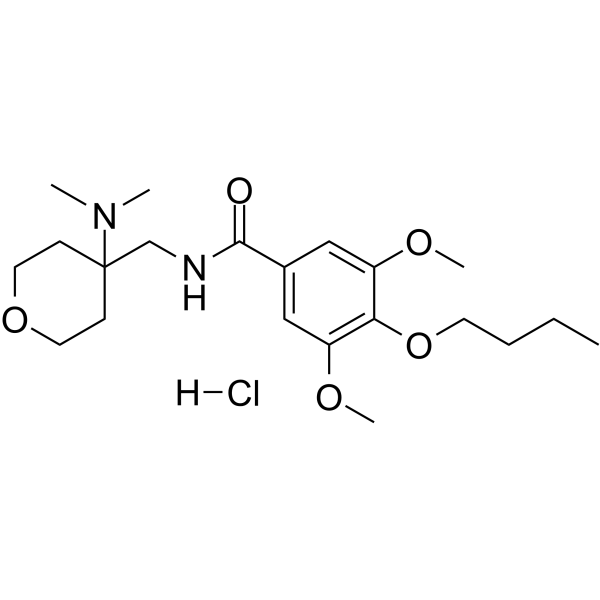
Opiranserin hydrochloride structure
|
Common Name | Opiranserin hydrochloride | ||
|---|---|---|---|---|
| CAS Number | 1440796-75-7 | Molecular Weight | 430.97 | |
| Density | N/A | Boiling Point | N/A | |
| Molecular Formula | C21H35ClN2O5 | Melting Point | N/A | |
| MSDS | N/A | Flash Point | N/A | |
Use of Opiranserin hydrochlorideOpiranserin (VVZ-149) hydrochloride, a non-opioid and non-NSAID analgesic candidate, is a dual antagonist of glycine transporter type 2 (GlyT2) and serotonin receptor 2A (5HT2A), with IC50s of 0.86 and 1.3 μM, respectively. Opiranserin hydrochloride shows antagonistic activity on rP2X3 (IC50=0.87 μM). Opiranserin hydrochloride is development as an injectable agent for the treatment of postoperative pain[1][2][3]. |
| Name | Opiranserin hydrochloride |
|---|
| Description | Opiranserin (VVZ-149) hydrochloride, a non-opioid and non-NSAID analgesic candidate, is a dual antagonist of glycine transporter type 2 (GlyT2) and serotonin receptor 2A (5HT2A), with IC50s of 0.86 and 1.3 μM, respectively. Opiranserin hydrochloride shows antagonistic activity on rP2X3 (IC50=0.87 μM). Opiranserin hydrochloride is development as an injectable agent for the treatment of postoperative pain[1][2][3]. |
|---|---|
| Related Catalog | |
| Target |
GlyT2:0.86 μM (IC50) 5-HT2A Receptor:1.3 μM (IC50) rP2X3:0.87 μM (IC50) |
| References |
| Molecular Formula | C21H35ClN2O5 |
|---|---|
| Molecular Weight | 430.97 |
| InChIKey | GSCGQHXDHYVKOL-UHFFFAOYSA-N |
| SMILES | CCCCOc1c(OC)cc(C(=O)NCC2(N(C)C)CCOCC2)cc1OC.Cl |