3,4,5,6-Tetrachlorobenzene-1,2-diol
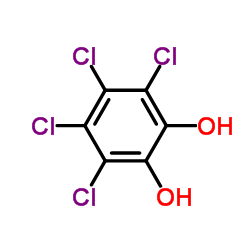
3,4,5,6-Tetrachlorobenzene-1,2-diol structure
|
Common Name | 3,4,5,6-Tetrachlorobenzene-1,2-diol | ||
|---|---|---|---|---|
| CAS Number | 1198-55-6 | Molecular Weight | 247.891 | |
| Density | 1.8±0.1 g/cm3 | Boiling Point | 309.1±37.0 °C at 760 mmHg | |
| Molecular Formula | C6H2Cl4O2 | Melting Point | 184-186°C (dec.) | |
| MSDS | USA | Flash Point | 140.7±26.5 °C | |
| Symbol |


GHS05, GHS07, GHS09 |
Signal Word | Danger | |
Use of 3,4,5,6-Tetrachlorobenzene-1,2-diolTetrachlorocatechol is a metabolite of pentachlorophenol. Tetrachlorocatechol is one of the most toxic chlorinated catechol produced by the chlorobleaching of pulp and frequently found in the kraft pulp mill effluents[1][2]. |
| Name | tetrachlorocatechol |
|---|---|
| Synonym | More Synonyms |
| Description | Tetrachlorocatechol is a metabolite of pentachlorophenol. Tetrachlorocatechol is one of the most toxic chlorinated catechol produced by the chlorobleaching of pulp and frequently found in the kraft pulp mill effluents[1][2]. |
|---|---|
| Related Catalog | |
| References |
| Density | 1.8±0.1 g/cm3 |
|---|---|
| Boiling Point | 309.1±37.0 °C at 760 mmHg |
| Melting Point | 184-186°C (dec.) |
| Molecular Formula | C6H2Cl4O2 |
| Molecular Weight | 247.891 |
| Flash Point | 140.7±26.5 °C |
| Exact Mass | 245.880890 |
| PSA | 40.46000 |
| LogP | 4.74 |
| Vapour Pressure | 0.0±0.7 mmHg at 25°C |
| Index of Refraction | 1.662 |
| Storage condition | 2-8°C |
CHEMICAL IDENTIFICATION
HEALTH HAZARD DATAACUTE TOXICITY DATA
|
| Symbol |
GHS05, GHS07, GHS09 |
|---|---|
| Signal Word | Danger |
| Hazard Statements | H302-H318-H400 |
| Precautionary Statements | P273-P280-P305 + P351 + P338 |
| Personal Protective Equipment | dust mask type N95 (US);Eyeshields;Faceshields;Gloves |
| Hazard Codes | Xn: Harmful; |
| Risk Phrases | R20/22 |
| Safety Phrases | S26-S36/37/39-S39 |
| RIDADR | 2811 |
| RTECS | UX2449000 |
| Packaging Group | III |
| Hazard Class | 6.1(b) |
| HS Code | 2908199090 |
| HS Code | 2908199090 |
|---|---|
| Summary | HS: 2908199090. derivatives of polyphenols or phenol-alcohols containing only halogen substituents and their salts. VAT:17.0%. tax rebate rate:9.0%. supervision conditions:None. MFN tariff:5.5%. general tariff:30.0% |
|
Polyhalogenated benzo- and naphthoquinones are potent inhibitors of plant and bacterial ureases.
FEBS Lett. 555(2) , 367-70, (2003) Polyhalogenated benzo- and naphthoquinones were found to be potent inhibitors of pure ureases from Bacillus pasteurii and Canavalia ensiformis. They also inhibited ureases in whole cells of Helicobact... |
|
|
Oxidative double dehalogenation of tetrachlorocatechol by a bio-inspired CuII complex: formation of chloranilic acid.
Chemistry 14(18) , 5567-76, (2008) Copper(II) complexes of the potentially tripodal N,N,O ligand 3,3-bis(1-methylimidazol-2-yl)propionate (L1) and its conjugate acid HL1 have been synthesised and structurally and spectroscopically char... |
|
|
Synergistic cytotoxic effect of tetrachlorocatechol and sodium azide in Escherichia coli: toxicity, metabolism, and mechanistic aspects.
Environ. Toxicol. Chem. 28(7) , 1380-9, (2009) Pentachlorophenol (PCP) is used in industrial and domestic applications, including as a biocide and a wood preservative. Metabolism of PCP undergoes oxidative dechlorination, forming tetrachlorocatech... |
| 1,2-Benzenediol, 3,4,5,6-tetrachloro- |
| MFCD00002190 |
| 3,4,5,6-Tetrachloro-1,2-benzenediol (9CI) |
| 3,4,5,6-tetrachlorobenzene-1,2-diol |
| 3,4,5,6-Tetrachloro-1,2-benzenediol |
| TETRACHLOROCATECHOL |
The content on this webpage is sourced from various professional data sources. If you have any questions or concerns regarding the content, please feel free to contact service1@chemsrc.com.
- Shanghai Nianxing Industrial Co., Ltd
- China
- Product Name: 3,4,5,6-Tetrachlorobenzene-1,2-diol
- Price: Check
- Purity: 98.0%
- Delivery: 10 Day
- Contact: Yang
- Email: sales@echemcloud.com
- Shanghai Jizhi Biochemical Technology Co., Ltd
- China
- Product Name: 3,4,5,6-Tetrachlorobenzene-1,2-diol
- Price: ¥818.0/1g ¥348.0/250mg
- Purity: 98.0%
- Delivery: 2 Day
- Contact: Liu jia


- Email: 2130147988@qq.com
- DC Chemicals Limited
- China
- Product Name: Tetrachlorocatechol
- Price: $Inquiry/250mg $Inquiry/100mg $Inquiry/1g
- Purity: 98.0%
- Delivery: 3 Day
- Contact: Tony Cao
- Email: sales@dcchemicals.com
- Dayang Chem (Hangzhou) Co., Ltd.
- China
- Product Name: Tetrachlorocatechol
- Price: $Inquiry/100g $Inquiry/1kg $Inquiry/100kg $Inquiry/1000kg
- Purity: 98.0%
- Delivery: Inquiry
- Contact: Ms Wang
- Email: enquiry@dycnchem.com
Get all suppliers and price by the below link: