Remacemide hydrochloride
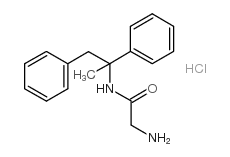
Remacemide hydrochloride structure
|
Common Name | Remacemide hydrochloride | ||
|---|---|---|---|---|
| CAS Number | 111686-79-4 | Molecular Weight | 304.81400 | |
| Density | N/A | Boiling Point | 466.4ºC at 760mmHg | |
| Molecular Formula | C17H21ClN2O | Melting Point | N/A | |
| MSDS | Chinese USA | Flash Point | 235.9ºC | |
| Symbol |


GHS05, GHS07, GHS09 |
Signal Word | Danger | |
Use of Remacemide hydrochlorideRemacemide hydrochloride (FPL 12924AA), a moderate inhibitor of the Na+ channel, is a weak uncompetitive NMDA receptor antagonist with IC50s of 68 μM and 76 μM for MK-801 binding and NMDA currents, respectively[1]. Remacemide hydrochloride is an anticonvulsant agent[2]. |
| Name | 2-amino-N-(1,2-diphenylpropan-2-yl)acetamide,hydrochloride |
|---|---|
| Synonym | More Synonyms |
| Description | Remacemide hydrochloride (FPL 12924AA), a moderate inhibitor of the Na+ channel, is a weak uncompetitive NMDA receptor antagonist with IC50s of 68 μM and 76 μM for MK-801 binding and NMDA currents, respectively[1]. Remacemide hydrochloride is an anticonvulsant agent[2]. |
|---|---|
| Related Catalog | |
| Target |
IC50: 68-76 μM (NMDA receptor)[1] IC50:160.6 μM(sodium channel)[2] |
| In Vitro | Remacemide (hydrochloride) (0-1000 μM) blocks voltage-gated Na+ channels in rat cortical synaptosomes in a concentration-dependent manner,with an IC50 value of 160.6 μM[2]. |
| In Vivo | Treatment with low- and high-dose Remacemide (100 mg/kg and 150 mg/kg) delays the acquisition of audio/visual discrimination (AVD) task performance in female Sprague-Dawley rats[3]. Animal Model: Female Sprague–Dawley rats ( 190-210 g )[3] Dosage: 100 mg/kg and 150 mg/kg Administration: Orogastric gavage; once a day; 7 days Result: Increased the number of sessions required to complete audio/visual discrimination (AVD) training. |
| References |
| Boiling Point | 466.4ºC at 760mmHg |
|---|---|
| Molecular Formula | C17H21ClN2O |
| Molecular Weight | 304.81400 |
| Flash Point | 235.9ºC |
| Exact Mass | 304.13400 |
| PSA | 55.12000 |
| LogP | 4.11260 |
| Vapour Pressure | 7.09E-09mmHg at 25°C |
| InChIKey | HYQMIUSWZXGTCC-UHFFFAOYSA-N |
| SMILES | CC(Cc1ccccc1)(NC(=O)CN)c1ccccc1.Cl |
CHEMICAL IDENTIFICATION
HEALTH HAZARD DATAACUTE TOXICITY DATA
|
| Symbol |
GHS05, GHS07, GHS09 |
|---|---|
| Signal Word | Danger |
| Hazard Statements | H302-H318-H400 |
| Precautionary Statements | P273-P280-P305 + P351 + P338 |
| Hazard Codes | C |
| RIDADR | UN 3077 9 / PGIII |
| RTECS | AB4349500 |
| HS Code | 2924299090 |
| HS Code | 2924299090 |
|---|---|
| Summary | 2924299090. other cyclic amides (including cyclic carbamates) and their derivatives; salts thereof. VAT:17.0%. Tax rebate rate:13.0%. . MFN tariff:6.5%. General tariff:30.0% |
|
The cognitive and psychomotor effects of remacemide and carbamazepine in newly diagnosed epilepsy.
Epilepsy Behav. 14(3) , 522-8, (2009) An international trial comparing remacemide hydrochloride with carbamazepine was undertaken in individuals with newly diagnosed epilepsy using a novel double-blind, parallel-group, double triangular s... |
|
|
Chronic exposure to NMDA receptor and sodium channel blockers during development in monkeys and rats: long-term effects on cognitive function.
Ann. N. Y. Acad. Sci. 993 , 116-22; discussion 123-4, (2003) The effects of chronic administration of MK-801 (NMDA-receptor antagonist) and remacemide (sodium channel blocker) on monkey learning of several brain function tasks was assessed in juveniles (nine mo... |
|
|
Coenzyme Q10 and remacemide hydrochloride ameliorate motor deficits in a Huntington's disease transgenic mouse model.
Neurosci. Lett. 315(3) , 149-53, (2001) Huntington's disease (HD) is a progressive inherited neurodegenerative disorder, for which there is no effective therapy. The CARE-HD study, recently published, evaluated the ability of a combination ... |
| PR 934-423A |
| Remacemide HCl |
| Remacemide hydrochloride |
| REMACEMIDE HYDROCHLORIDE |