204519-66-4
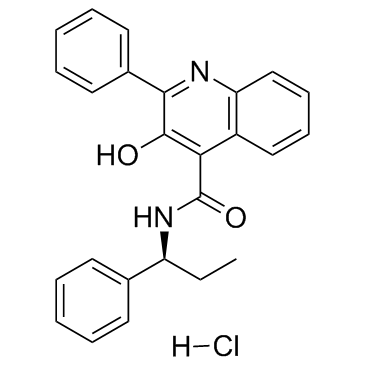
204519-66-4 structure
- Name: Talnetant (hydrochloride)
- Chemical Name: 3-Hydroxy-2-phenyl-N-[(1S)-1-phenylpropyl]-4-quinolinecarboxamide hydrochloride (1:1)
- CAS Number: 204519-66-4
- Molecular Formula: C25H23ClN2O2
- Molecular Weight: 418.91500
- Catalog: Signaling Pathways GPCR/G Protein Neurokinin Receptor
- Create Date: 2017-05-02 14:07:10
- Modify Date: 2026-08-04 10:44:59
-
Talnetant Hcl(SB 223412 Hcl) is a potent and selective NK3 receptor antagonist(ki=1.4 nM, hNK-3-CHO); 100-fold selective for the hNK-3 versus hNK-2 receptor, with no affinity for the hNK-1 at concentrations up to 100 uM.IC50 Value: 1.4 nM (hNK-3-CHO binding Ki) [1]Target: NK3 receptorin vitro: In vitro studies demonstrated that 53 is a potent functional antagonist of the hNK-3 receptor (reversal of senktide-induced contractions in rabbit isolated iris sphincter muscles and reversal of NKB-induced Ca2+ mobilization in CHO cells stably expressing the hNK-3 receptor), while in vivo this compound showed oral and intravenous activity in NK-3 receptor-driven models (senktide-induced behavioral responses in mice and senktide-induced miosis in rabbits) [1]. Talnetant has high affinity for recombinant human NK3 receptors (pKi 8.7) and demonstrates selectivity over other neurokinin receptors (pKi NK2 = 6.6 and NK1<4). In native tissue-binding studies, talnetant displayed high affinity for the guinea pig NK3 receptor (pKi 8.5) [3].in vivo: Rectal barostat tests were performed on 102 healthy volunteers, randomized to receive either oral talnetant 25 or 100 mg or placebo over 14-17 days [2]. Talnetant (3-30 mg/kg i.p.) significantly attenuated senktide-induced 'wet dog shake' behaviors in the guinea pig in a dose-dependent manner. Microdialysis studies demonstrated that acute administration of talnetant (30 mg/kg i.p.) produced significant increases in extracellular dopamine and norepinephrine in the medial prefrontal cortex and attenuated haloperidol-induced increases in nucleus accumbens dopamine levels in the freely moving guinea pigs [3].Toxicity: Talnetant had no effect on rectal compliance, sensory thresholds or intensity ratings compared with placebo [2].Clinical trial: Study Of Talnetant Versus Placebo And Risperidone In Schizophrenia. Phase 2
| Name | 3-Hydroxy-2-phenyl-N-[(1S)-1-phenylpropyl]-4-quinolinecarboxamide hydrochloride (1:1) |
|---|---|
| Synonyms |
Talnetant hydrochloride
Talnetant (hydrochloride) |
| Description | Talnetant Hcl(SB 223412 Hcl) is a potent and selective NK3 receptor antagonist(ki=1.4 nM, hNK-3-CHO); 100-fold selective for the hNK-3 versus hNK-2 receptor, with no affinity for the hNK-1 at concentrations up to 100 uM.IC50 Value: 1.4 nM (hNK-3-CHO binding Ki) [1]Target: NK3 receptorin vitro: In vitro studies demonstrated that 53 is a potent functional antagonist of the hNK-3 receptor (reversal of senktide-induced contractions in rabbit isolated iris sphincter muscles and reversal of NKB-induced Ca2+ mobilization in CHO cells stably expressing the hNK-3 receptor), while in vivo this compound showed oral and intravenous activity in NK-3 receptor-driven models (senktide-induced behavioral responses in mice and senktide-induced miosis in rabbits) [1]. Talnetant has high affinity for recombinant human NK3 receptors (pKi 8.7) and demonstrates selectivity over other neurokinin receptors (pKi NK2 = 6.6 and NK1<4). In native tissue-binding studies, talnetant displayed high affinity for the guinea pig NK3 receptor (pKi 8.5) [3].in vivo: Rectal barostat tests were performed on 102 healthy volunteers, randomized to receive either oral talnetant 25 or 100 mg or placebo over 14-17 days [2]. Talnetant (3-30 mg/kg i.p.) significantly attenuated senktide-induced 'wet dog shake' behaviors in the guinea pig in a dose-dependent manner. Microdialysis studies demonstrated that acute administration of talnetant (30 mg/kg i.p.) produced significant increases in extracellular dopamine and norepinephrine in the medial prefrontal cortex and attenuated haloperidol-induced increases in nucleus accumbens dopamine levels in the freely moving guinea pigs [3].Toxicity: Talnetant had no effect on rectal compliance, sensory thresholds or intensity ratings compared with placebo [2].Clinical trial: Study Of Talnetant Versus Placebo And Risperidone In Schizophrenia. Phase 2 |
|---|---|
| Related Catalog | |
| References |
| Boiling Point | 580.4ºC at 760 mmHg |
|---|---|
| Molecular Formula | C25H23ClN2O2 |
| Molecular Weight | 418.91500 |
| Flash Point | 304.8ºC |
| Exact Mass | 418.14500 |
| PSA | 65.71000 |
| LogP | 6.86530 |
| Vapour Pressure | 4.51E-14mmHg at 25°C |
| Storage condition | 2-8℃ |