Uridine 5'-diphosphate sodium salt
Modify Date: 2026-07-20 19:35:12
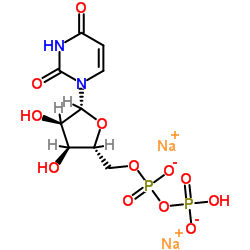
Uridine 5'-diphosphate sodium salt structure
|
Common Name | Uridine 5'-diphosphate sodium salt | ||
|---|---|---|---|---|
| CAS Number | 21931-53-3 | Molecular Weight | 448.125 | |
| Density | N/A | Boiling Point | N/A | |
| Molecular Formula | C9H14N2O12P2.xNa | Melting Point | N/A | |
| MSDS | USA | Flash Point | N/A | |
| Symbol |


GHS07, GHS08 |
Signal Word | Warning | |
Use of Uridine 5'-diphosphate sodium saltUridine 5'-diphosphate sodium salt is a potent, selective P2Y6 receptor native agonist (EC50=300 nM; pEC50=6.52) and a potent P2Y14 antagonist (pEC50=7.28). Uridine 5'-diphosphate sodium salt, an endogenous metabolite, catalyzes the glucuronidation of a wide array of substrates and is used in nucleic acid (RNA) biosynthesis[1][2]. |
| Name | Uridine 5,-Diphosphate Sodium Salt |
|---|---|
| Synonym | More Synonyms |
| Description | Uridine 5'-diphosphate sodium salt is a potent, selective P2Y6 receptor native agonist (EC50=300 nM; pEC50=6.52) and a potent P2Y14 antagonist (pEC50=7.28). Uridine 5'-diphosphate sodium salt, an endogenous metabolite, catalyzes the glucuronidation of a wide array of substrates and is used in nucleic acid (RNA) biosynthesis[1][2]. |
|---|---|
| Related Catalog | |
| Target |
Human Endogenous Metabolite |
| In Vitro | Uridine 5'-diphosphate sodium salt (100 μM; for 15 min) significantly induces microglial CCL2 and CCL3 mRNA expression[2]. Uridine 5'-diphosphate sodium salt (100 μM; 3 hours) induces chemokine expression in microglia[2]. Uridine 5'-diphosphate sodium salt (100 μM; 0.5, 1, 3, 6 12 hours) induces expression of mRNA encoding CCL2 and CCL3 within 30 min, and such expression reaches maximal levels at 1 h, returning to basal levels at 3-12 h[2]. UDP (10, 100, 1000 μM; 3 hours) induces a concentration-dependent increase in the expression of chemokines at both the mRNA and protein level[2]. Uridine 5'-diphosphate sodium salt (100 μM; for 15 min) induces activation of NFATc1 and NFATc2 in microglia[2]. RT-PCR[2] Cell Line: Primary microglia Concentration: 100 μM Incubation Time: For 15 min Result: Significantly induced microglial CCL2 and CCL3 mRNA expression. |
| References |
| Molecular Formula | C9H14N2O12P2.xNa |
|---|---|
| Molecular Weight | 448.125 |
| Exact Mass | 447.966095 |
| PSA | 243.12000 |
| Appearance of Characters | Powder | White |
| InChIKey | OCSYTSDILWGALR-IAIGYFSYSA-M |
| SMILES | O=c1ccn(C2OC(COP(=O)(O)OP(=O)([O-])O)C(O)C2O)c(=O)[nH]1.[Na+] |
| Storage condition | −20°C |
| Water Solubility | H2O: soluble100 mg/mL, clear, colorless to very faintly yellow | Soluble in water to 100mM |
| Symbol |
GHS07, GHS08 |
|---|---|
| Signal Word | Warning |
| Hazard Statements | H302-H371 |
| Precautionary Statements | P260 |
| Hazard Codes | Xn |
| Risk Phrases | R22;R48/22 |
| Safety Phrases | 36/37 |
| RIDADR | NONH for all modes of transport |
| WGK Germany | 3 |
| HS Code | 29349990 |
|
Enzyme-histochemical demonstration of microglial cells in the adult and postnatal rabbit retina.
J. Comp. Neurol. 282(2) , 249-63, (1989) Enzyme-histochemical methods for thiamine pyrophosphatase (TPPase) and nucleoside diphosphatase (NDPase) were applied to wholemounted rabbit retinae to demonstrate the shape and distribution of microg... |
|
|
P2X2 receptor mediates stimulation of parasensory cation absorption by cochlear outer sulcus cells and vestibular transitional cells.
J. Neurosci. 21(23) , 9168-74, (2001) Cochlear outer sulcus cells (OSC) and vestibular transitional cells (VTC) are part of the parasensory epithelium in the inner ear and are located in homologous positions between the sensory hair cells... |
|
Name: GPR151 activator identification: cell-based high-throughput counter-screen assay
Source: The Scripps Research Institute Molecular Screening Center
Target: RecName: Full=Glucose-dependent insulinotropic receptor; AltName: Full=G-protein coupled receptor 119
External Id: GPR119_PHUNTER_AG_LUMI_1536_3X%ACT CSRUN1
|
|
Name: GPR151 activator identification: cell-based high-throughput confirmation assay
Source: The Scripps Research Institute Molecular Screening Center
Target: RecName: Full=G-protein coupled receptor 151; AltName: Full=G-protein coupled receptor PGR7; AltName: Full=GPCR-2037; AltName: Full=Galanin receptor 4; AltName: Full=Galanin-receptor-like protein; Short=GalRL
External Id: GPR151_PHUNTER_AG_LUMI_1536_3X%ACT CRUN1
|
|
Name: Cell-based high throughput primary assay to identify activators of GPR151
Source: The Scripps Research Institute Molecular Screening Center
Target: RecName: Full=G-protein coupled receptor 151; AltName: Full=G-protein coupled receptor PGR7; AltName: Full=GPCR-2037; AltName: Full=Galanin receptor 4; AltName: Full=Galanin-receptor-like protein; Short=GalRL
External Id: GPR151_PHUNTER_AG_LUMI_1536_1X%ACT
|
|
Name: AlphaScreen-based biochemical high throughput primary assay to identify activators of...
Source: The Scripps Research Institute Molecular Screening Center
Target: N/A
External Id: FBW7_ACT_ALPHA_1536_1X%ACT PRUN
|
|
Name: AlphaScreen-based biochemical high throughput primary assay to identify inhibitors of...
Source: The Scripps Research Institute Molecular Screening Center
External Id: MITF_INH_Alpha_1536_1X%INH PRUN
|
Total 5, Current Page 1 of 1
1
| Uridine, 5'-(trihydrogen diphosphate), sodium salt (1:2) |
| Disodium 5'-O-{[(hydroxyphosphinato)oxy]phosphinato}uridine |
| trisodium,[[5-(2,4-dioxopyrimidin-1-yl)-3,4-dihydroxyoxolan-2-yl]methoxy-oxidophosphoryl] phosphate |
| MFCD00006524 |
| Uridine 5'-diphosphate sodium salt |