Paeoniflorin
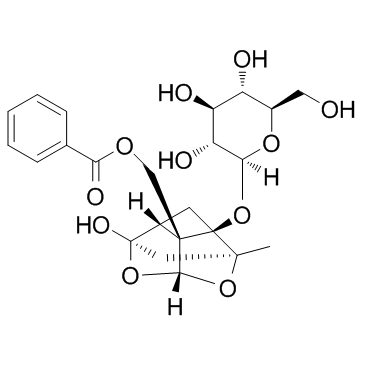
Paeoniflorin structure
|
Common Name | Paeoniflorin | ||
|---|---|---|---|---|
| CAS Number | 23180-57-6 | Molecular Weight | 480.462 | |
| Density | 1.6±0.1 g/cm3 | Boiling Point | 690.2±55.0 °C at 760 mmHg | |
| Molecular Formula | C23H28O11 | Melting Point | N/A | |
| MSDS | Chinese USA | Flash Point | 238.4±25.0 °C | |
Use of PaeoniflorinPaeoniflorin is a herbal constituent extracted from the root of Paeonia albiflora Pall.Target: OthersPaeoniflorin (PF) is the principal bioactive component of Radix Paeo- niae alba, which is widely used in Traditional Chinese Medicine for the treatment of neurodegenerative disorders such as Parkinson's disease(PD) [1]. Paeoniflorin, a compound found in white peony that inhibited the production of testosterone and promoted the activity of aromatase, which converts testosterone into estrogen [2]. Treatment of cells with paeoniflorin but not glycyrrhizin resulted in enhanced phosphorylation and acquisition of the deoxyribonucleic acid-binding ability of heat shock transcription factor 1 (HSF1), as well as the formation of characteristic HSF1 granules in the nucleus, suggesting that the induction of HSPs by paeoniflorin is mediated by the activation of HSF1. Also, thermotolerance was induced by treatment with paeoniflorin but not glycyrrhizin. Paeoniflorin had no toxic effect at concentrations as high as 80 microg/ mL (166.4 microM). To our knowledge, this is the first report on the induction of HSPs by herbal medicines [3]. |
This table lists Chinese names, IUPAC names and various aliases of this chemical substance.
| Name | Paeoniflorin |
|---|---|
| Synonym | More Synonyms |
This table contains bioactivity, target information and biological‑assay experimental data of this compound.
| Description | Paeoniflorin is a herbal constituent extracted from the root of Paeonia albiflora Pall.Target: OthersPaeoniflorin (PF) is the principal bioactive component of Radix Paeo- niae alba, which is widely used in Traditional Chinese Medicine for the treatment of neurodegenerative disorders such as Parkinson's disease(PD) [1]. Paeoniflorin, a compound found in white peony that inhibited the production of testosterone and promoted the activity of aromatase, which converts testosterone into estrogen [2]. Treatment of cells with paeoniflorin but not glycyrrhizin resulted in enhanced phosphorylation and acquisition of the deoxyribonucleic acid-binding ability of heat shock transcription factor 1 (HSF1), as well as the formation of characteristic HSF1 granules in the nucleus, suggesting that the induction of HSPs by paeoniflorin is mediated by the activation of HSF1. Also, thermotolerance was induced by treatment with paeoniflorin but not glycyrrhizin. Paeoniflorin had no toxic effect at concentrations as high as 80 microg/ mL (166.4 microM). To our knowledge, this is the first report on the induction of HSPs by herbal medicines [3]. |
|---|---|
| Related Catalog | |
| References |
This table shows physicochemical parameters including melting point, boiling point, density, solubility and optical rotation. Missing data is marked as N/A.
| Density | 1.6±0.1 g/cm3 |
|---|---|
| Boiling Point | 690.2±55.0 °C at 760 mmHg |
| Molecular Formula | C23H28O11 |
| Molecular Weight | 480.462 |
| Flash Point | 238.4±25.0 °C |
| Exact Mass | 480.163147 |
| PSA | 164.37000 |
| LogP | -0.42 |
| Vapour Pressure | 0.0±2.3 mmHg at 25°C |
| Index of Refraction | 1.683 |
| InChIKey | YKRGDOXKVOZESV-WRJNSLSBSA-N |
| SMILES | CC12CC3(O)OC(O1)C1(COC(=O)c4ccccc4)C3CC21OC1OC(CO)C(O)C(O)C1O |
| Storage condition | room temp |
This table provides MSDS information including hazard classification, first‑aid, fire‑fighting, spill handling, operation and storage instructions.
This table summarizes toxicological test data, acute & chronic toxicity and ecological hazard parameters for this chemical.
CHEMICAL IDENTIFICATION
HEALTH HAZARD DATAACUTE TOXICITY DATA
|
This table covers safety warnings, protective measures, incompatible substances and disposal guidelines for this compound.
| Hazard Codes | Xn,N,T,F |
|---|---|
| Risk Phrases | R22:Harmful if swallowed. R50:Very Toxic to aquatic organisms. R39/23/24/25:Toxic: danger of very serious irreversible effects through inhalation, in contact with skin and if swallowed . R23/24/25:Toxic by inhalation, in contact with skin and if swallowed |
| Safety Phrases | S61-S45-S36/37 |
| RIDADR | UN 3077 9/PG 3 |
| WGK Germany | 2 |
| RTECS | XZ3015000 |
| HS Code | 2932999099 |
This table presents publicly reported synthetic routes, reaction conditions, reactants and product information of the compound.

![(2R,2aR,2a1R,3aR,4S,5aR)-2a1-((benzoyloxy)methyl)-4-methyl-3a-(prop-1-en-2-yl)hexahydro-2H-1,5-dioxa-2,4-methanocyclobuta[cd]pentalene-2-carboxylic acid structure](https://image.chemsrc.com/caspic/401/154854-74-7.png)
![(1R,3R,4R,6S,9S)-methyl 4-((R)-2-methoxy-2-phenylacetoxy)-6-methyl-1-(prop-1-en-2-yl)-7-oxatricyclo[4.3.0.03,9]nonane-9-carboxylate structure](https://image.chemsrc.com/caspic/053/154854-70-3.png)
![((1aR,1a1R,2S,3aR,5S,5aR)-5-(((benzyloxy)carbonyl)oxy)-2-methyl-1a-(prop-1-en-2-yl)tetrahydro-1H-3,4-dioxa-2,5-methanocyclobuta[cd]pentalen-1a1(3aH)-yl)methyl benzoate structure](https://image.chemsrc.com/caspic/277/154854-77-0.png)
This table lists upstream starting materials and downstream derivative products related to this chemical.
| Precursor 3 | |
|---|---|
| DownStream 0 | |
This table records publicly available preparation methods, process key points and operation references.
This table shows customs‑related data including HS‑code, tariff and regulatory conditions for import and export.
| HS Code | 2932999099 |
|---|---|
| Summary | 2932999099. other heterocyclic compounds with oxygen hetero-atom(s) only. VAT:17.0%. Tax rebate rate:13.0%. . MFN tariff:6.5%. General tariff:20.0% |
This table lists relevant public references with title, journal and publication metadata for this compound.
|
Chemical profiling and quantification of Gua-Lou-Gui-Zhi decoction by high performance liquid chromatography/quadrupole-time-of-flight mass spectrometry and ultra-performance liquid chromatography/triple quadrupole mass spectrometry.
J. Chromatogr. B. Analyt. Technol. Biomed. Life Sci. 986-987 , 69-84, (2015) Gua-Lou-Gui-Zhi decoction (GLGZD) is a classical formula of traditional Chinese medicine, which has been commonly used to treat dysfunction after stroke, epilepsy and spinal cord injury. In this study... |
|
|
[Treatment of premenstrual syndrome with Chinese medicine formula, baixiangdan capsule: implications for neuron viability and GABA(A) receptor modulation in rat cortex].
Zhongguo Zhong Yao Za Zhi 36(11) , 1508-11, (2011) To explore the effects of Baixiangdan capsule (BXD), a Chinese medicinal formula, on the premenstrual syndrome (PMS) rats with Liver-qi invasion and the possible underlying micro-mechanisms.Wistar rat... |
|
|
Detection of paeoniflorin and albiflorin by immunostaining technique using anti-paeoniflorin monoclonal antibody.
Phytochem. Anal. 24(2) , 124-8, (2013) Paeoniae radix is one of the most important crude drugs used in Kampo medicines (KMs). A part of its pharmaceutical properties is due to the presence of paeoniflorin (PF) and albiflorin (AF).For the s... |
This table contains target information, in‑vitro & in‑vivo assay data for this compound.
This table collects all English aliases, systematic names and CAS‑related synonyms of the compound.
| paeoniflorine |
| Paeony root |
| Delmacinone |
| Paeonia moutan |
| peoniflorin |
| MFCD00869331 |
| Paeonia lactiflora P,E, |
| Paeoniflorm |
| EINECS 245-476-2 |
| PAEONIFLORIN(P) |
| ,Peoniflorin |
| PACLITAXEL |
This section contains frequently‑asked‑questions about this compound, including basic parameters, properties, storage conditions and corresponding answers.
| Q: What is the InChIKey of Paeoniflorin? |
| A: InChIKey of Paeoniflorin is YKRGDOXKVOZESV-WRJNSLSBSA-N. |
| Q: What is the molecular formula of Paeoniflorin? |
| A: Molecular formula of Paeoniflorin is C23H28O11. |
| Q: What English synonyms does Paeoniflorin have? |
| A: English synonyms of Paeoniflorin: paeoniflorine, Paeony root, Delmacinone, Paeonia moutan, peoniflorin, MFCD00869331, Paeonia lactiflora P,E,, Paeoniflorm, EINECS 245-476-2, PAEONIFLORIN(P), ,Peoniflorin, PACLITAXEL. |
| Q: What is the molecular weight of Paeoniflorin? |
| A: Molecular weight of Paeoniflorin is 480.462. |
| Q: What is the SMILES notation of Paeoniflorin? |
| A: SMILES notation of Paeoniflorin is CC12CC3(O)OC(O1)C1(COC(=O)c4ccccc4)C3CC21OC1OC(CO)C(O)C(O)C1O. |
| Q: What is the safety information for Paeoniflorin? |
| A: Safety information for Paeoniflorin: S61-S45-S36/37. |
| Q: What is the English name of Paeoniflorin? |
| A: The English name of Paeoniflorin is Paeoniflorin. |
| Q: What is the polar surface area (PSA) of Paeoniflorin? |
| A: Polar surface area (PSA) of Paeoniflorin is 164.37000. |
| Q: What are the storage conditions for Paeoniflorin? |
| A: Storage conditions for Paeoniflorin: room temp. |
| Q: What is the CAS number of Paeoniflorin? |
| A: CAS number of Paeoniflorin is 23180-57-6. |
This table lists manufacturers and suppliers of this compound, including vendor names and product supply reference information.
| Shanghai Nianxing Industrial Co., Ltd |
| BioBioPha |
| Dayang Chem (Hangzhou) Co., Ltd. |
| naturewill |
| Henan Tianfu Chemical Co., Ltd. |