H2DCFDA
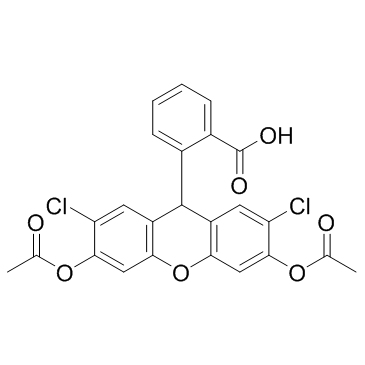
H2DCFDA structure
|
Common Name | H2DCFDA | ||
|---|---|---|---|---|
| CAS Number | 4091-99-0 | Molecular Weight | 487.286 | |
| Density | 1.5±0.1 g/cm3 | Boiling Point | 593.5±50.0 °C at 760 mmHg | |
| Molecular Formula | C24H16Cl2O7 | Melting Point | 209-210ºC(lit.) | |
| MSDS | Chinese USA | Flash Point | 312.7±30.1 °C | |
| Symbol |

GHS07 |
Signal Word | Warning | |
Use of H2DCFDAH2DCFDA is a cell-permeable probe used to detect intracellular reactive oxygen species (ROS). |
This table lists Chinese names, IUPAC names and various aliases of this chemical substance.
| Name | 2-(3,6-diacetyloxy-2,7-dichloro-9H-xanthen-9-yl)benzoic acid |
|---|---|
| Synonym | More Synonyms |
This table contains bioactivity, target information and biological‑assay experimental data of this compound.
| Description | H2DCFDA is a cell-permeable probe used to detect intracellular reactive oxygen species (ROS). |
|---|---|
| Related Catalog | |
| In Vitro | Analysis of H2DCFDA probe oxidation by means of flow cytometry technique showed that the basal level of ROS in difESCs is about 6–7 times larger than that in embryonic stem cells (ESCs). Both H2DCFDA and DCFDA probes are non-fluorescent in their initial form but they undergo multistep conversion inside the cell that results in the formation of fluorescent product dichlorofluorescein (DCF). The only difference between these two probes is that the conversion of H2DCFDA involves oxidation. Therefore, fluorescence of the H2DCFDA-treated cells depends on the intracellular ROS level, in contrast to fluorescence associated with the DCFDA probe. Surprisingly, flow cytometry analysis shows that the difference between fluorescence levels of ESCs and difESCs loaded with H2DCFDA is close to the difference between the signals from DCFDA-treated cells. The latter indicates a ROS-independent reason for low fluorescent signal of oxidized H2DCFDA in ESCs[1]. |
| Kinase Assay | H2DCFDA is dissolved in DMSO to obtain a 10 mM stock solutions and further diluted before use[1]. ROS Measurements[1] For the detection of intracellular ROS level ,ROS-sensitive probe H2DCFDA is used. Adherent cells (ESCs, difESCs, eMSCs, HeLa, U118) are incubated with 5 µM staining solution in PBS in the dark for 30 min at 37°C, then harvested with 0.05% trypsin-EDTA solution, suspended in a fresh medium, and immediately analyzed with flow cytometer. Lymphocytes, both control and PHA-activated, are resuspended in PBS, incubated with 5 µM of H2DCFDA in the dark for 30 min at 37°C, and immediately analyzed. Along with the H2DCFDA probe, if indicated, ROS-insensitive modification of the fluorescein dye DCFDA is used. The staining procedure is the same as for the H2DCFDA[1]. |
| References |
This table shows physicochemical parameters including melting point, boiling point, density, solubility and optical rotation. Missing data is marked as N/A.
| Density | 1.5±0.1 g/cm3 |
|---|---|
| Boiling Point | 593.5±50.0 °C at 760 mmHg |
| Melting Point | 209-210ºC(lit.) |
| Molecular Formula | C24H16Cl2O7 |
| Molecular Weight | 487.286 |
| Flash Point | 312.7±30.1 °C |
| Exact Mass | 486.027313 |
| PSA | 99.13000 |
| LogP | 4.62 |
| Vapour Pressure | 0.0±1.8 mmHg at 25°C |
| Index of Refraction | 1.635 |
| InChIKey | PXEZTIWVRVSYOK-UHFFFAOYSA-N |
| SMILES | CC(=O)Oc1cc2c(cc1Cl)C(c1ccccc1C(=O)O)c1cc(Cl)c(OC(C)=O)cc1O2 |
| Storage condition | 2-8°C |
This table provides MSDS information including hazard classification, first‑aid, fire‑fighting, spill handling, operation and storage instructions.
This table covers safety warnings, protective measures, incompatible substances and disposal guidelines for this compound.
| Symbol |
GHS07 |
|---|---|
| Signal Word | Warning |
| Hazard Statements | H315-H319-H335 |
| Precautionary Statements | P261-P305 + P351 + P338 |
| Personal Protective Equipment | Eyeshields;Gloves;type N95 (US);type P1 (EN143) respirator filter |
| Hazard Codes | Xi |
| Risk Phrases | 36/37/38 |
| Safety Phrases | S22-S24/25 |
| RIDADR | NONH for all modes of transport |
| WGK Germany | 3.0 |
| HS Code | 2932999099 |
This table lists upstream starting materials and downstream derivative products related to this chemical.
| Precursor 0 | |
|---|---|
| DownStream 2 | |
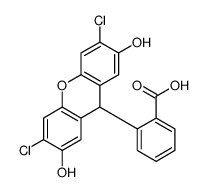 CAS#:106070-31-9
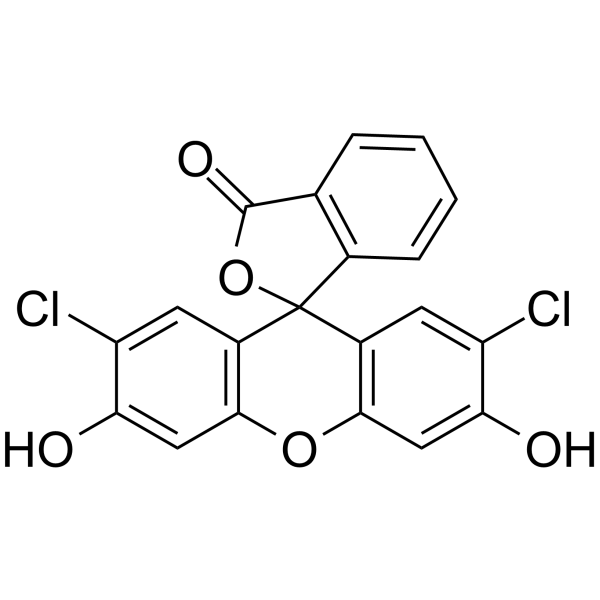 CAS#:76-54-0
This table shows customs‑related data including HS‑code, tariff and regulatory conditions for import and export.
| HS Code | 2932999099 |
|---|---|
| Summary | 2932999099. other heterocyclic compounds with oxygen hetero-atom(s) only. VAT:17.0%. Tax rebate rate:13.0%. . MFN tariff:6.5%. General tariff:20.0% |
This table lists relevant public references with title, journal and publication metadata for this compound.
|
Atmospheric-pressure plasma jet induces DNA double-strand breaks that require a Rad51-mediated homologous recombination for repair in Saccharomyces cerevisiae.
Arch. Biochem. Biophys. 560 , 1-9, (2014) Non-thermal plasma generated under atmospheric pressure produces a mixture of chemically reactive molecules and has been developed for a number of biomedical applications. Recently, plasma jet has bee... |
|
|
Heme oxygenase-1 protects corexit 9500A-induced respiratory epithelial injury across species.
PLoS ONE 10(4) , e0122275, (2015) The effects of Corexit 9500A (CE) on respiratory epithelial surfaces of terrestrial mammals and marine animals are largely unknown. This study investigated the role of CE-induced heme oxygenase-1 (HO-... |
|
|
Bilobalide attenuates hypoxia induced oxidative stress, inflammation, and mitochondrial dysfunctions in 3T3-L1 adipocytes via its antioxidant potential.
Free Radic. Res. 48(10) , 1206-17, (2014) Excessive expansion of white adipose tissue leads to hypoxia which is considered as a key factor responsible for adipose tissue dysfunction in obesity. Hypoxia induces inflammation, insulin resistance... |
This table contains target information, in‑vitro & in‑vivo assay data for this compound.
|
Name: Primary qHTS for inhibitors of NSP2Pro chikungunya virus (CHIKV)
Source: NCGC
External Id: APP-Toga-CHIKV-nsp2-p
|
This table collects all English aliases, systematic names and CAS‑related synonyms of the compound.
| 2,7-Dichlorodihydrofluorescein diacetate |
| H2DCFDA [2',7'-Dichlorodihydrofluorescein diacetate] |
| MFCD00128955 |
| 2-(3,6-Diacetoxy-2,7-dichloro-9H-xanthen-9-yl)benzoic acid |
| Leucodiacetyldichlorofluorescein |
| H2DCFDA |
| 2',7'-dichlorofluorescin diacetate |
| DCFH |
This section contains frequently‑asked‑questions about this compound, including basic parameters, properties, storage conditions and corresponding answers.
| Q: What is the InChIKey of 2-(3,6-diacetyloxy-2,7-dichloro-9H-xanthen-9-yl)benzoic acid? |
| A: InChIKey of 2-(3,6-diacetyloxy-2,7-dichloro-9H-xanthen-9-yl)benzoic acid is PXEZTIWVRVSYOK-UHFFFAOYSA-N. |
| Q: What is the molecular formula of 2-(3,6-diacetyloxy-2,7-dichloro-9H-xanthen-9-yl)benzoic acid? |
| A: Molecular formula of 2-(3,6-diacetyloxy-2,7-dichloro-9H-xanthen-9-yl)benzoic acid is C24H16Cl2O7. |
| Q: What is the safety information for 2-(3,6-diacetyloxy-2,7-dichloro-9H-xanthen-9-yl)benzoic acid? |
| A: Safety information for 2-(3,6-diacetyloxy-2,7-dichloro-9H-xanthen-9-yl)benzoic acid: S22-S24/25. |
| Q: What is the LogP of 2-(3,6-diacetyloxy-2,7-dichloro-9H-xanthen-9-yl)benzoic acid? |
| A: LogP of 2-(3,6-diacetyloxy-2,7-dichloro-9H-xanthen-9-yl)benzoic acid is 4.62. |
| Q: What is the melting point of 2-(3,6-diacetyloxy-2,7-dichloro-9H-xanthen-9-yl)benzoic acid? |
| A: Melting point of 2-(3,6-diacetyloxy-2,7-dichloro-9H-xanthen-9-yl)benzoic acid is 209-210ºC(lit.). |
| Q: What are the uses of 2-(3,6-diacetyloxy-2,7-dichloro-9H-xanthen-9-yl)benzoic acid? |
| A: Main uses of 2-(3,6-diacetyloxy-2,7-dichloro-9H-xanthen-9-yl)benzoic acid: H2DCFDA is a cell-permeable probe used to detect intracellular reactive oxygen species (ROS). |
| Q: What is the SMILES notation of 2-(3,6-diacetyloxy-2,7-dichloro-9H-xanthen-9-yl)benzoic acid? |
| A: SMILES notation of 2-(3,6-diacetyloxy-2,7-dichloro-9H-xanthen-9-yl)benzoic acid is CC(=O)Oc1cc2c(cc1Cl)C(c1ccccc1C(=O)O)c1cc(Cl)c(OC(C)=O)cc1O2. |
| Q: What is the CAS number of 2-(3,6-diacetyloxy-2,7-dichloro-9H-xanthen-9-yl)benzoic acid? |
| A: CAS number of 2-(3,6-diacetyloxy-2,7-dichloro-9H-xanthen-9-yl)benzoic acid is 4091-99-0. |
| Q: What is the molecular weight of 2-(3,6-diacetyloxy-2,7-dichloro-9H-xanthen-9-yl)benzoic acid? |
| A: Molecular weight of 2-(3,6-diacetyloxy-2,7-dichloro-9H-xanthen-9-yl)benzoic acid is 487.286. |
| Q: What is the boiling point of 2-(3,6-diacetyloxy-2,7-dichloro-9H-xanthen-9-yl)benzoic acid? |
| A: Boiling point of 2-(3,6-diacetyloxy-2,7-dichloro-9H-xanthen-9-yl)benzoic acid is 593.5±50.0 °C at 760 mmHg. |
This table lists manufacturers and suppliers of this compound, including vendor names and product supply reference information.
| Shanghai Nianxing Industrial Co., Ltd |
| Dayang Chem (Hangzhou) Co., Ltd. |