Trimipramine maleate
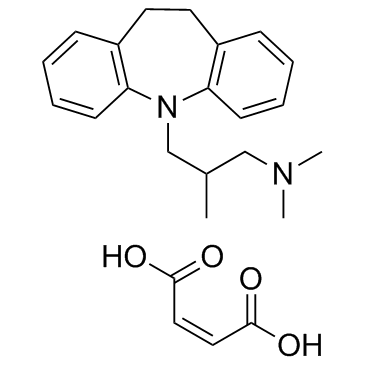
Trimipramine maleate structure
|
Common Name | Trimipramine maleate | ||
|---|---|---|---|---|
| CAS Number | 521-78-8 | Molecular Weight | 410.506 | |
| Density | 1.029g/cm3 | Boiling Point | 411.8ºC at 760mmHg | |
| Molecular Formula | C24H30N2O4 | Melting Point | 141-143ºC | |
| MSDS | Chinese USA | Flash Point | 183.3ºC | |
| Symbol |


GHS07, GHS08 |
Signal Word | Warning | |
Use of Trimipramine maleateTrimipramine maleate is a 5-HT receptor antagonist, with pKis of 6.39, 8.10, 4.66 for 5-HT1C, 5-HT2 and 5-HT1A, respectively. |
This table lists Chinese names, IUPAC names and various aliases of this chemical substance.
| Name | trimipramine maleate |
|---|---|
| Synonym | More Synonyms |
This table contains bioactivity, target information and biological‑assay experimental data of this compound.
| Description | Trimipramine maleate is a 5-HT receptor antagonist, with pKis of 6.39, 8.10, 4.66 for 5-HT1C, 5-HT2 and 5-HT1A, respectively. |
|---|---|
| Related Catalog | |
| Target |
5-HT1C Receptor:6.39 (pKi) 5-HT2 Receptor:8.10 (pKi) 5-HT1A Receptor:4.66 (pKi) |
| In Vitro | Trimipramine displays much higher affinity for 5-HT2 than for 5-HT1C receptors[1]. |
| In Vivo | The chronic administration of Trimipramine (5 mg/kg/day), as delivered by the osmotic minipump in 14 days produce significant increases in the regional concentration of 5-HT. The increases are highest in the frontal cortex and the hippocampus, followed by the olfactory tubercles and the hypothalamus. The Trimipramine treatment also produces marked increases in brain 5-HIAA concentrations ranging from 63% in the hippocampus to 25% in the nucleus accumbens with intermediate values for the hypothalamus, olfactory tubercles, frontal cortex and nucleus accumbens. Trimipramine treatment produces significant increases in DA concentrations in the nucleus accumbens, striaturn, and olfactory tubercles reaching 43, 21 and 11% respectively. Chronic administration of Trimipramine produces a marked reduction in the number of frontal cortex 5-HT2 and striatal DA D2 receptors. The chronic administration of Trimipramine produces an increase in the brain regional level of monoamines and metabolites indicating a greater synthesis rate for DA and 5-HT coinciding with an adaptive down regulation of 5-HT2 and DA D2 receptors[2]. |
| Animal Admin | Rats[2] Male Wistar rats weighing 220-250 g at the beginning of the experiment are used. The animals, housed in groups of 6-8 have free access to food and water and are kept on a 12 hr light/dark cycle (light on at 6a.m.) at a temperature. The rats are anaesthetized with pentobarbital (50 mg/kg i.p.) and an osmotic minipump is implanted subcutaneously in the dorsal thoracic interscapular region. Each pump delivers 5 mg/kg/day of Trimipramine or amitriptyline. Control rats are implanted with pumps filled with 0.9%, saline. The total volume of solution in the pump is sufficient for at least 14 days delivery of drugs. After implantation, the incision is cleaned and sutured and the animals kept warm until they recovered from anaesthesia[2]. |
| References |
This table shows physicochemical parameters including melting point, boiling point, density, solubility and optical rotation. Missing data is marked as N/A.
| Density | 1.029g/cm3 |
|---|---|
| Boiling Point | 411.8ºC at 760mmHg |
| Melting Point | 141-143ºC |
| Molecular Formula | C24H30N2O4 |
| Molecular Weight | 410.506 |
| Flash Point | 183.3ºC |
| Exact Mass | 410.220551 |
| PSA | 81.08000 |
| LogP | 3.89780 |
| InChIKey | YDGHCKHAXOUQOS-BTJKTKAUSA-N |
| SMILES | CC(CN(C)C)CN1c2ccccc2CCc2ccccc21.O=C(O)C=CC(=O)O |
| Storage condition | 2-8℃ |
This table provides MSDS information including hazard classification, first‑aid, fire‑fighting, spill handling, operation and storage instructions.
This table summarizes toxicological test data, acute & chronic toxicity and ecological hazard parameters for this chemical.
CHEMICAL IDENTIFICATION
HEALTH HAZARD DATAACUTE TOXICITY DATA
|
This table covers safety warnings, protective measures, incompatible substances and disposal guidelines for this compound.
| Symbol |
GHS07, GHS08 |
|---|---|
| Signal Word | Warning |
| Hazard Statements | H302-H315-H319-H335-H361 |
| Precautionary Statements | P280-P301 + P312 + P330-P305 + P351 + P338 |
| Personal Protective Equipment | Eyeshields;full-face particle respirator type N100 (US);Gloves;respirator cartridge type N100 (US);type P1 (EN143) respirator filter;type P3 (EN 143) respirator cartridges |
| Hazard Codes | Xn,T,F |
| Risk Phrases | 22-36/37/38-63-36/38-23/25 |
| RIDADR | UN 3249 |
| RTECS | HN9260000 |
| Packaging Group | III |
| Hazard Class | 6.1(b) |
This table lists relevant public references with title, journal and publication metadata for this compound.
|
Water determination in active pharmaceutical ingredients using ionic liquid headspace gas chromatography and two different detection protocols.
J. Pharm. Biomed. Anal. 94 , 111-7, (2014) A rapid, accurate, precise and versatile analytical method was developed for the detection and quantification of water in solid active pharmaceutical ingredients (APIs). The headspace gas chromatograp... |
|
|
Antidepressants for patients with tinnitus.
Cochrane Database Syst. Rev. 9 , CD003853, (2012) This is an update of a Cochrane review first published in The Cochrane Library in Issue 4, 2006 and previously updated in 2009.Tinnitus is described as the perception of sound or noise in the absence ... |
|
|
FPIN's clinical inquiries: Antidepressants for the treatment of insomnia in patients with depression.
Am. Fam. Physician 84(9) , 1-2, (2011)
|
This table collects all English aliases, systematic names and CAS‑related synonyms of the compound.
| 5H-Dibenz[b,f]azepine-5-propanamine, 10,11-dihydro-N,N,β-trimethyl-, (2Z)-2-butenedioate (1:1) |
| UNII:269K6498LD |
| Trimipramine maleate |
| (Z)-but-2-enedioic acid,3-(5,6-dihydrobenzo[b][1]benzazepin-11-yl)-N,N,2-trimethylpropan-1-amine |
| Trimipramine maleate salt |
| UNII:D28E1043W5 |
| 3-(10,11-Dihydro-5H-dibenzo[b,f]azepin-5-yl)-N,N,2-trimethylpropan-1-amine (2Z)-but-2-enedioate (1:1) |
| Trimipramine |
| 3-(10,11-Dihydro-5H-dibenzo[b,f]azepin-5-yl)-N,N,2-trimethyl-1-propanamine (2Z)-2-butenedioate (1:1) |
| UNII:I412286V22 |
This section contains frequently‑asked‑questions about this compound, including basic parameters, properties, storage conditions and corresponding answers.
| Q: What is the CAS number of trimipramine maleate? |
| A: CAS number of trimipramine maleate is 521-78-8. |
| Q: What are the uses of trimipramine maleate? |
| A: Main uses of trimipramine maleate: Trimipramine maleate is a 5-HT receptor antagonist, with pKis of 6.39, 8.10, 4.66 for 5-HT1C, 5-HT2 and 5-HT1A, respectively. |
| Q: What is the LogP of trimipramine maleate? |
| A: LogP of trimipramine maleate is 3.89780. |
| Q: What is the SMILES notation of trimipramine maleate? |
| A: SMILES notation of trimipramine maleate is CC(CN(C)C)CN1c2ccccc2CCc2ccccc21.O=C(O)C=CC(=O)O. |
| Q: What is the InChIKey of trimipramine maleate? |
| A: InChIKey of trimipramine maleate is YDGHCKHAXOUQOS-BTJKTKAUSA-N. |
| Q: What is the molecular formula of trimipramine maleate? |
| A: Molecular formula of trimipramine maleate is C24H30N2O4. |
| Q: What is the polar surface area (PSA) of trimipramine maleate? |
| A: Polar surface area (PSA) of trimipramine maleate is 81.08000. |
| Q: What is the molecular weight of trimipramine maleate? |
| A: Molecular weight of trimipramine maleate is 410.506. |
| Q: What is the English name of trimipramine maleate? |
| A: The English name of trimipramine maleate is trimipramine maleate. |
| Q: What is the boiling point of trimipramine maleate? |
| A: Boiling point of trimipramine maleate is 411.8ºC at 760mmHg. |
This table lists manufacturers and suppliers of this compound, including vendor names and product supply reference information.
| Shanghai Nianxing Industrial Co., Ltd |
| Dayang Chem (Hangzhou) Co., Ltd. |