Tazobactam
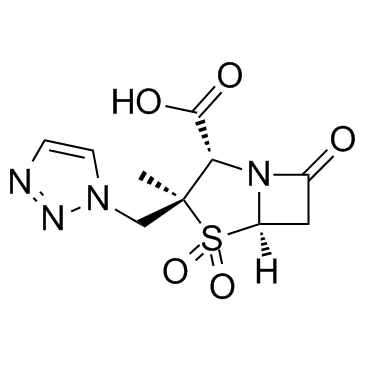
Tazobactam structure
|
Common Name | Tazobactam | ||
|---|---|---|---|---|
| CAS Number | 89786-04-9 | Molecular Weight | 300.291 | |
| Density | 1.9±0.1 g/cm3 | Boiling Point | 707.1±70.0 °C at 760 mmHg | |
| Molecular Formula | C10H12N4O5S | Melting Point | 172 °C(dec.) | |
| MSDS | N/A | Flash Point | 381.4±35.7 °C | |
Use of TazobactamTazobactam is a beta Lactamase Inhibitor with antibacterial activityTarget: AntibacterialTazobactam is a pharmaceutical drug that inhibits the action of bacterial β-lactamases, especially those belonging to the SHV-1 and TEM groups. It is commonly used as its sodium salt, Tazobactam sodium.Tazobactam is combined with the extended spectrum β-lactam antibiotic piperacillin in the drug piperacillin/Tazobactam, one of the preferred antibiotic treatments for nosocomial pneumonia caused by Pseudomonas aeruginosa. Tazobactam broadens the spectrum of piperacillin by making it effective against organisms that express β-lactamase and would normally degrade piperacillin. Tazobactam is derived from the penicillin nucleus and is a penicillinic acid sulfone. |
This table lists Chinese names, IUPAC names and various aliases of this chemical substance.
| Name | tazobactam |
|---|---|
| Synonym | More Synonyms |
This table contains bioactivity, target information and biological‑assay experimental data of this compound.
| Description | Tazobactam is a beta Lactamase Inhibitor with antibacterial activityTarget: AntibacterialTazobactam is a pharmaceutical drug that inhibits the action of bacterial β-lactamases, especially those belonging to the SHV-1 and TEM groups. It is commonly used as its sodium salt, Tazobactam sodium.Tazobactam is combined with the extended spectrum β-lactam antibiotic piperacillin in the drug piperacillin/Tazobactam, one of the preferred antibiotic treatments for nosocomial pneumonia caused by Pseudomonas aeruginosa. Tazobactam broadens the spectrum of piperacillin by making it effective against organisms that express β-lactamase and would normally degrade piperacillin. Tazobactam is derived from the penicillin nucleus and is a penicillinic acid sulfone. |
|---|---|
| Related Catalog |
This table shows physicochemical parameters including melting point, boiling point, density, solubility and optical rotation. Missing data is marked as N/A.
| Density | 1.9±0.1 g/cm3 |
|---|---|
| Boiling Point | 707.1±70.0 °C at 760 mmHg |
| Melting Point | 172 °C(dec.) |
| Molecular Formula | C10H12N4O5S |
| Molecular Weight | 300.291 |
| Flash Point | 381.4±35.7 °C |
| Exact Mass | 300.052826 |
| PSA | 130.84000 |
| LogP | -1.70 |
| Vapour Pressure | 0.0±2.4 mmHg at 25°C |
| Index of Refraction | 1.818 |
| InChIKey | LPQZKKCYTLCDGQ-WEDXCCLWSA-N |
| SMILES | CC1(Cn2ccnn2)C(C(=O)O)N2C(=O)CC2S1(=O)=O |
| Storage condition | Store at?0-5°C |
This table summarizes toxicological test data, acute & chronic toxicity and ecological hazard parameters for this chemical.
CHEMICAL IDENTIFICATION
HEALTH HAZARD DATAACUTE TOXICITY DATA
|
This table covers safety warnings, protective measures, incompatible substances and disposal guidelines for this compound.
| Hazard Codes | Xi: Irritant; |
|---|---|
| Risk Phrases | R36/37/38 |
| Safety Phrases | S26-S36/37/39-S45 |
| RIDADR | UN 1770 8/PG 2 |
| WGK Germany | 3 |
| Packaging Group | II |
| Hazard Class | 8 |
| HS Code | 29036990 |
This table presents publicly reported synthetic routes, reaction conditions, reactants and product information of the compound.
|
~%
Tazobactam CAS#:89786-04-9 |
| Literature: Synthesis, , # 3 art. no. F11904SS, p. 442 - 446 |
|
~%
Tazobactam CAS#:89786-04-9 |
| Literature: Synthesis, , # 3 art. no. F11904SS, p. 442 - 446 |
|
~%
Tazobactam CAS#:89786-04-9 |
| Literature: Synthesis, , # 3 art. no. F11904SS, p. 442 - 446 |
|
~%
Tazobactam CAS#:89786-04-9 |
| Literature: Synthesis, , # 3 art. no. F11904SS, p. 442 - 446 |
|
~%
Tazobactam CAS#:89786-04-9 |
| Literature: Synthesis, , # 3 art. no. F11904SS, p. 442 - 446 |
|
~%
Tazobactam CAS#:89786-04-9 |
| Literature: Synthesis, , # 3 art. no. F11904SS, p. 442 - 446 |
|
~%
Tazobactam CAS#:89786-04-9 |
| Literature: Synthesis, , # 3 art. no. F11904SS, p. 442 - 446 |
![[2S-(2alpha,5alpha,6alpha)]-6-bromo-3,3-dimethyl-7-oxo-4-thia-1-azabicyclo[3.2.0]heptane-2-carboxylic acid structure](https://image.chemsrc.com/caspic/459/24138-28-1.png)
![benzhydryl-3-methyl-7-oxo-3-(1H-1,2,3-triazol-1-ylmethyl)-4- thia-1-azabicyclo[3.2.0]heptane-2-carboxylate structure](https://image.chemsrc.com/caspic/220/122661-93-2.png)
![(2S,5R)-Benzhydryl 3,3-dimethyl-7-oxo-4-thia-1-azabicyclo[3.2.0]heptane-2-carboxylate 4-oxide structure](https://image.chemsrc.com/caspic/413/87579-78-0.png)
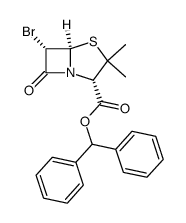
![(2S,5R,6S)-BENZHYDRYL 6-BROMO-3,3-DIMETHYL-7-OXO-4-THIA-1-AZABICYCLO[3.2.0]HEPTANE-2-CARBOXYLATE 4-OXIDE structure](https://image.chemsrc.com/caspic/043/80353-26-0.png)
This table lists upstream starting materials and downstream derivative products related to this chemical.
| Precursor 6 | |
|---|---|
| DownStream 2 | |
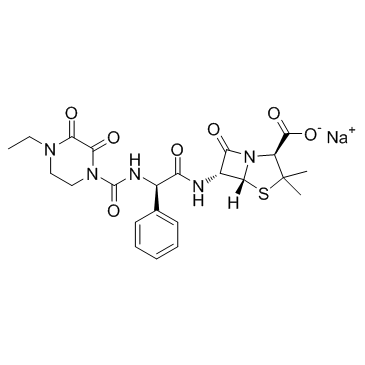 CAS#:59703-84-3
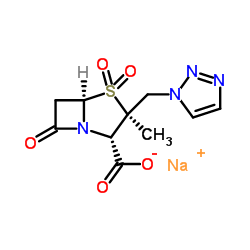 CAS#:89785-84-2
This table shows customs‑related data including HS‑code, tariff and regulatory conditions for import and export.
| HS Code | 29036990 |
|---|
This table collects all English aliases, systematic names and CAS‑related synonyms of the compound.
| MFCD00867002 |
| YTR 830H |
| Tazobactam |
| [2S-(2a,3b,5a)]-3-Methyl-7-oxo-3-(1H-1,2,3-triazol-1-ylmethyl)-4-thia-1-azabicyclo[3.2.0]heptane-2-carboxylic acid 4,4-dioxide |
| T45 ANV ESWTJ F1 GVQ F1- AT5NNNJ &&(2S,3S,5R)- Form |
| (2S,3S,5R)-3-Methyl-7-oxo-3-(1H-1,2,3-triazol-1-ylmethyl)-4-thia-1-azabicyclo[3.2.0]heptane-2-carboxylic acid 4,4-dioxide |
| UNII-SE10G96M8W |
| TAZOBACTANACID |
| YTR-830H |
| 2b-[(1,2,3-triazol-1-yl)methyl]-2a-methylpenam-3a-carboxylic acid 1,1-dioxide |
| Tazobactan acid |
| 2-METHANESULFONYL-5-(TRIFLUOROMETHYL)-1,3,4-THIADIAZOLE |
This section contains frequently‑asked‑questions about this compound, including basic parameters, properties, storage conditions and corresponding answers.
| Q: What is the LogP of tazobactam? |
| A: LogP of tazobactam is -1.70. |
| Q: What is the melting point of tazobactam? |
| A: Melting point of tazobactam is 172 °C(dec.). |
| Q: What is the CAS number of tazobactam? |
| A: CAS number of tazobactam is 89786-04-9. |
| Q: What is the boiling point of tazobactam? |
| A: Boiling point of tazobactam is 707.1±70.0 °C at 760 mmHg. |
| Q: What is the polar surface area (PSA) of tazobactam? |
| A: Polar surface area (PSA) of tazobactam is 130.84000. |
| Q: What are the storage conditions for tazobactam? |
| A: Storage conditions for tazobactam: Store at?0-5°C. |
| Q: What is the SMILES notation of tazobactam? |
| A: SMILES notation of tazobactam is CC1(Cn2ccnn2)C(C(=O)O)N2C(=O)CC2S1(=O)=O. |
| Q: What are the downstream products of tazobactam? |
| A: Related downstream products(CAS) of tazobactam: 59703-84-3;89785-84-2. |
| Q: What is the safety information for tazobactam? |
| A: Safety information for tazobactam: S26-S36/37/39-S45. |
| Q: What are the upstream materials of tazobactam? |
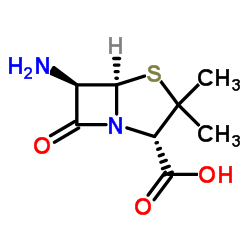
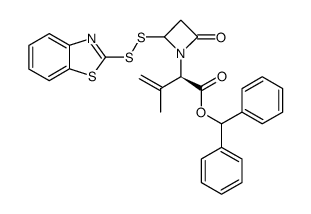
| A: Related upstream materials(CAS) of tazobactam: 551-16-6;122661-93-2;85573-72-4;74189-25-6;87579-78-0;80353-26-0. |
This table lists manufacturers and suppliers of this compound, including vendor names and product supply reference information.
| Shanghai Nianxing Industrial Co., Ltd |
| Henan Tianfu Chemical Co., Ltd. |