The plant-associated Bacillus amyloliquefaciens strains MEP2 18 and ARP2 3 capable of producing the cyclic lipopeptides iturin or surfactin and fengycin are effective in biocontrol of sclerotinia stem rot disease.
F Alvarez, M Castro, A Príncipe, G Borioli, S Fischer, G Mori, E Jofré
Index: J. Appl. Microbiol. 112(1) , 159-74, (2012)
Full Text: HTML
Abstract
This work was conducted to identify the antifungal compounds produced by two previously isolated Bacillus sp. strains: ARP(2) 3 and MEP(2) 18. Both strains were subjected to further analysis to determine their taxonomic position and to identify the compounds responsible for their antifungal activity as well as to evaluate the efficiency of these strains to control sclerotinia stem rot in soybean.The antifungal compounds were isolated by acid precipitation of cell-free supernatants, purified by RP-HPLC and then tested for antagonistic activity against Sclerotinia sclerotiorum. Mass spectra from RP-HPLC eluted fractions showed the presence of surfactin C(15) , fengycins A (C(16) -C(17)) and B (C(16)) isoforms in supernatants from strain ARP(2) 3 cultures, whereas the major lipopeptide produced by strain MEP(2) 18 was iturin A C(15) . Alterations in mycelial morphology and sclerotial germination were observed in the presence of lipopeptides-containing supernatants from Bacillus strains cultures. Foliar application of Bacillus amyloliquefaciens strains on soybean plants prior to S. sclerotiorum infection resulted in significant protection against sclerotinia stem rot compared with noninoculated plants or plants inoculated with a nonlipopeptide-producing B. subtilis strain.Both strains, renamed as B. amyloliquefaciens ARP(2) 3 and MEP(2) 18, were able to produce antifungal compounds belonging to the cyclic lipopeptide family. Our data suggest that the foliar application of lipopeptide-producing B. amyloliquefaciens strains could be a promising strategy for the management of sclerotinia stem rot in soybean.Sclerotinia stem rot was ranked as one of the most severe soybean disease in Argentina and worldwide. The results of this study showed the potential of B. amyloliquefaciens strains ARP(2) 3 and MEP(2) 18 to control plant diseases caused by S. sclerotiorum.© 2011 The Authors. Journal of Applied Microbiology © 2011 The Society for Applied Microbiology.
Related Compounds
| Structure | Name/CAS No. | Molecular Formula | Articles |
|---|---|---|---|
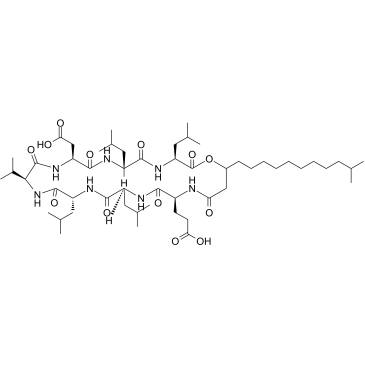 |
Surfactin
CAS:24730-31-2 |
C53H93N7O13 |
|
Pectin Enhances Bio-Control Efficacy by Inducing Colonizatio...
2015-01-01 [PLoS ONE 10 , e0127418, (2015)] |
|
Effects of surfactin on membrane models displaying lipid pha...
2013-02-01 [Biochim. Biophys. Acta 1828(2) , 801-15, (2013)] |
|
Direct surfactin-gramicidin S antagonism supports detoxifica...
2012-12-01 [Microbiology 158(Pt 12) , 3072-82, (2012)] |
|
The lipopeptide toxins anabaenolysin A and B target biologic...
2012-12-01 [Biochim. Biophys. Acta 1818 , 3000-9, (2012)] |
|
Microbial competition between Bacillus subtilis and Staphylo...
2011-09-01 [Microbiology 157(Pt 9) , 2485-92, (2011)] |