PNAS 2014-07-15

Positron emission tomography probe demonstrates a striking concentration of ribose salvage in the liver.

Peter M Clark, Graciela Flores, Nikolai M Evdokimov, Melissa N McCracken, Timothy Chai, Evan Nair-Gill, Fiona O'Mahony, Simon W Beaven, Kym F Faull, Michael E Phelps, Michael E Jung, Owen N Witte

Index: Proc. Natl. Acad. Sci. U. S. A. 111(28) , E2866-74, (2014)

Full Text: HTML

Abstract

PET is a powerful technique for quantifying and visualizing biochemical pathways in vivo. Here, we develop and validate a novel PET probe, [(18)F]-2-deoxy-2-fluoroarabinose ([(18)F]DFA), for in vivo imaging of ribose salvage. DFA mimics ribose in vivo and accumulates in cells following phosphorylation by ribokinase and further metabolism by transketolase. We use [(18)F]DFA to show that ribose preferentially accumulates in the liver, suggesting a striking tissue specificity for ribose metabolism. We demonstrate that solute carrier family 2, member 2 (also known as GLUT2), a glucose transporter expressed in the liver, is one ribose transporter, but we do not know if others exist. [(18)F]DFA accumulation is attenuated in several mouse models of metabolic syndrome, suggesting an association between ribose salvage and glucose and lipid metabolism. These results describe a tool for studying ribose salvage and suggest that plasma ribose is preferentially metabolized in the liver.

Related Compounds

Structure Name/CAS No. Articles
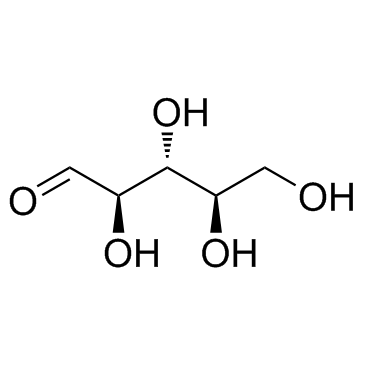
D-Ribose Structure D-Ribose
CAS:50-69-1
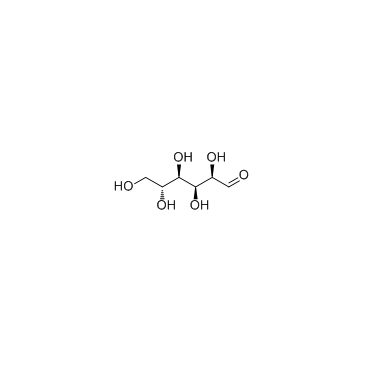
D-(+)-Glucose Structure D-(+)-Glucose
CAS:50-99-7
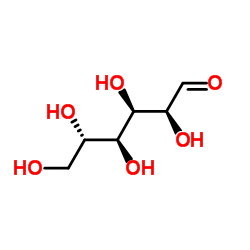
L-Glucose Structure L-Glucose
CAS:921-60-8
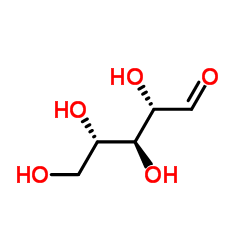
L-(+)-Ribose Structure L-(+)-Ribose
CAS:147-81-9