FLAG Peptide TFA salt
Modify Date: 2025-08-25 17:09:29
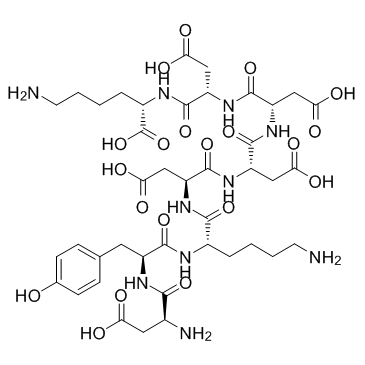
FLAG Peptide TFA salt structure
|
Common Name | FLAG Peptide TFA salt | ||
|---|---|---|---|---|
| CAS Number | 98849-88-8 | Molecular Weight | 1012.97000 | |
| Density | N/A | Boiling Point | N/A | |
| Molecular Formula | C41H60N10O20 | Melting Point | N/A | |
| MSDS | N/A | Flash Point | N/A | |
Use of FLAG Peptide TFA saltFLAG peptide is an eight amino acids peptide (Asp-Tyr-Lys-Asp-Asp-Asp-Asp-Lys) with an enterokinase-cleavage site; designed for antibody-mediated identification and purification of recombinant proteins. |
| Name | L-Lysine, L-α-aspartyl-L-tyrosyl-L-lysyl-L-α-aspartyl-L-α-aspartyl-L-α-aspartyl-L-α-aspartyl |
|---|---|
| Synonym | More Synonyms |
| Description | FLAG peptide is an eight amino acids peptide (Asp-Tyr-Lys-Asp-Asp-Asp-Asp-Lys) with an enterokinase-cleavage site; designed for antibody-mediated identification and purification of recombinant proteins. |
|---|---|
| Related Catalog | |
| In Vitro | Fusion protein technology has become an important tool for solving numerous problems linked to recombinant protein production. The properties of the additional tag facilitate identification and provide a one-step purification procedure of the fusion protein by passing cell extracts or supernatants through columns of an appropriate matrix. FLAG peptide allows elution under non-denaturing conditions. Several antibodies against FLAG peptide have been developed. One antibody, M1, binds the peptide in the presence of bivalent metal cations, preferably Ca2+. Elution is effected by chelating agents. Another strategy is competitive elution with excess of free FLAGe peptide. Antibodies M2 and M5 are applied in this procedure[1]. The Flag-tag is first described as a calcium-dependent epitope of a monoclonal antibody. It is a highly acidic octapeptide which can be N-terminally fused to the protein of interest. As a very hydrophilic peptide the Flag–tag has a high surface probability. Flag-fusion proteins can be captured by an immunoaffinity column in the presence of Ca2+ and eluted byEDTA at low concentrations, neutral pH and thus, nearly physiological conditions[2]. |
| References |
| Molecular Formula | C41H60N10O20 |
|---|---|
| Molecular Weight | 1012.97000 |
| Exact Mass | 1012.40000 |
| PSA | 525.79000 |
| InChIKey | XZWYTXMRWQJBGX-DQCYEUCQSA-N |
| SMILES | NCCCCC(NC(=O)C(CC(=O)O)NC(=O)C(CC(=O)O)NC(=O)C(CC(=O)O)NC(=O)C(CC(=O)O)NC(=O)C(CCCCN)NC(=O)C(Cc1ccc(O)cc1)NC(=O)C(N)CC(=O)O)C(=O)O |
| Storage condition | -20°C |
| FLAG Peptide |
| FLAG EPITOPE PEPTIDE |
| Trypsinogen (human pancreas isoenzyme 2 activation peptide), 1-L-aspartic acid-2-L-tyrosine-3-L-lysine- |
| FLAG tag Peptide |
| ASP-TYR-LYS-ASP-ASP-ASP-ASP-LYS |