(-)-Indolactam V
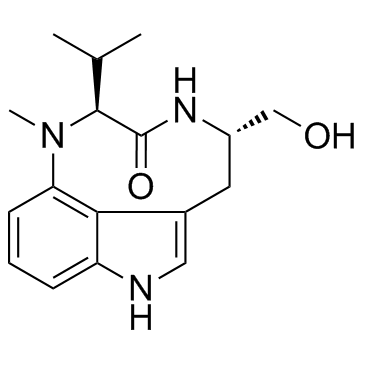
(-)-Indolactam V structure
|
Common Name | (-)-Indolactam V | ||
|---|---|---|---|---|
| CAS Number | 90365-57-4 | Molecular Weight | 301.383 | |
| Density | 1.2±0.1 g/cm3 | Boiling Point | 584.0±50.0 °C at 760 mmHg | |
| Molecular Formula | C17H23N3O2 | Melting Point | N/A | |
| MSDS | USA | Flash Point | 307.0±30.1 °C | |
Use of (-)-Indolactam V(-)-Indolactam V is a PKC activator, with Kis of 3.36 nM, 1.03 μM for η-CRD2 (PKCη surrogate peptide), γ-CRD2 (PKCγ surrogate peptide), and Kds of 5.5 nM (η-C1B), 7.7 nM (ε-C1B), 8.3 nM (δ-C1B), 18.9 nM (β-C1A-long), 20.8 nM (α-C1A-long), 137 nM (β-C1B), 138 nM (γ-C1A), 213 nM (γ-C1B), and has antitumor activity. |
| Name | (-)-Indolactam V,(2S,5S)-1,2,4,5,6,8-Hexahydro-5-(hydroxymethyl)-1-methyl-2-(1-methylethyl)-3H-pyrrolo[4,3,2-gh]-1,4-benzodiazonin-3-one |
|---|---|
| Synonym | More Synonyms |
| Description | (-)-Indolactam V is a PKC activator, with Kis of 3.36 nM, 1.03 μM for η-CRD2 (PKCη surrogate peptide), γ-CRD2 (PKCγ surrogate peptide), and Kds of 5.5 nM (η-C1B), 7.7 nM (ε-C1B), 8.3 nM (δ-C1B), 18.9 nM (β-C1A-long), 20.8 nM (α-C1A-long), 137 nM (β-C1B), 138 nM (γ-C1A), 213 nM (γ-C1B), and has antitumor activity. |
|---|---|
| Related Catalog | |
| Target |
PKCη-CRD2:3.36 nM (Ki) PKCη-C1B:5.5 nM (Kd) PKCε-C1B:7.7 nM (Kd) PKCδ-C1B:8.3 nM (Kd) PKCθ-C1B:8.7 nM (Kd) PKCβ-C1A-long:18.9 nM (Kd) PKCα-C1A-long:20.8 nM (Kd) PKCβ-C1B:137 nM (Kd) PKCγ-C1A:138 nM (Kd) PKCγ-C1B:213 nM (Kd) PKCγ-CRD2:1030 nM (Ki) PKCδ-C1A:1900 nM (Kd) PKCη-C1A:3770 nM (Kd) PKCα-C1B-long:4000 nM (Kd) PKCε-C1A:4110 nM (Kd) |
| In Vitro | (-)-Indolactam V is a PKC activator, with Kis of 3.36 nM, 1.03 μM for η-CRD2 (PKCη surrogate peptide), γ-CRD2 (PKCγ surrogate peptide), and has antitumor activity[1]. (-)-Indolactam V shows Kds of 5.5 nM (η-C1B), 7.7 nM (ε-C1B), 8.3 nM (δ-C1B), 18.9 nM (β-C1A-long), 20.8 nM (α-C1A-long), 137 nM (β-C1B), 138 nM (γ-C1A), 213 nM (γ-C1B), respectively[2]. (-)-Indolactam V (20 nM-5 μM) dose-dependently affects multiple hESC lines, such as HUES 2, 4 and 8. (-)-Indolactam V also increases the mRNA levels of Pdx1, HNF6, PTF1A, SOX9, HB9 and PROX1. In addition, (-)-Indolactam V (300 nM) functions in both mouse and human cells and confirms that some signals for pancreatic development[3]. |
| Cell Assay | For induced differentiation to endocrine or exocrine cells, the (-)-Indolactam V (300 nM)-treated populations are cultured in DMEM/F12 supplemented with 1 N2, 2 mg/mL albumin fraction V and 10 ng/mL bovine FGF for the first 4 d. 10 mM nicotinamide is then added and maintained for an additional 8 d, changing the medium every 3 d[3]. |
| References |
| Density | 1.2±0.1 g/cm3 |
|---|---|
| Boiling Point | 584.0±50.0 °C at 760 mmHg |
| Molecular Formula | C17H23N3O2 |
| Molecular Weight | 301.383 |
| Flash Point | 307.0±30.1 °C |
| Exact Mass | 301.179016 |
| PSA | 68.36000 |
| LogP | 0.75 |
| Vapour Pressure | 0.0±1.7 mmHg at 25°C |
| Index of Refraction | 1.590 |
| InChIKey | LUZOFMGZMUZSSK-LRDDRELGSA-N |
| SMILES | CC(C)C1C(=O)NC(CO)Cc2c[nH]c3cccc(c23)N1C |
CHEMICAL IDENTIFICATION
HEALTH HAZARD DATAACUTE TOXICITY DATA
|
| RIDADR | NONH for all modes of transport |
|---|
|
Structural basis of RasGRP binding to high-affinity PKC ligands.
J. Med. Chem. 45(4) , 853-60, (2002) The Ras guanyl releasing protein RasGRP belongs to the CDC25 class of guanyl nucleotide exchange factors that regulate Ras-related GTPases. These GTPases serve as switches for the propagation and dive... |
|
|
Tumor promoter binding of the protein kinase C C1 homology domain peptides of RasGRPs, chimaerins, and Unc13s.
Bioorg. Med. Chem. 12(17) , 4575-83, (2004) Recent investigations discovered nonkinase-type phorbol ester receptors, RasGRPs, chimaerins, and Unc13s. Phorbol ester binding occurs at the cysteine-rich sequences of about 50 residues in the C1 dom... |
|
|
Indolactam and benzolactam compounds as new medicinal leads with binding selectivity for C1 domains of protein kinase C isozymes.
Curr. Pharm. Des. 10(12) , 1371-85, (2004) Protein kinase C (PKC) isozymes (alpha, betaI, betaII, gamma, delta, epsilon, eta, theta) are major receptors of tumor promoters and also play a crucial role in cellular signal transduction via the se... |
| (2S,5S)-5-(hydroxymethyl)-1-methyl-2-(propan-2-yl)-1,2,4,5,6,8-hexahydro-3H-[1,4]diazonino[7,6,5-cd]indol-3-one |
| 3H-1,4-Diazonino[7,6,5-cd]indol-3-one, 1,2,4,5,6,8-hexahydro-5-(hydroxymethyl)-1-methyl-2-(1-methylethyl)-, (2S,5S)- |
| (-)-indolactam |
| Indolactam V |
| (2S,5S)-5-(Hydroxymethyl)-2-isopropyl-1-methyl-1,2,4,5,6,8-hexahydro-3H-[1,4]diazonino[7,6,5-cd]indol-3-one |