Levocabastine hydrochloride
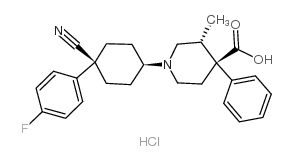
Levocabastine hydrochloride structure
|
Common Name | Levocabastine hydrochloride | ||
|---|---|---|---|---|
| CAS Number | 79547-78-7 | Molecular Weight | 456.98000 | |
| Density | N/A | Boiling Point | 611ºC at 760 mmHg | |
| Molecular Formula | C26H30ClFN2O2 | Melting Point | N/A | |
| MSDS | Chinese USA | Flash Point | 323.3ºC | |
| Symbol |

GHS07 |
Signal Word | Warning | |
Use of Levocabastine hydrochlorideLevocabastine (R 50547) hydrochloride is a long acting, highly potent and selective histamine H1-receptor antagonist with anti-allergic activity. Levocabastine hydrochloride is also a selective, high affinity neurotensin receptor subtype 2 (NTR2) antagonist, with a Ki of 17 nM for mNTR2[1][2]. |
| Name | (3S,4R)-1-[4-cyano-4-(4-fluorophenyl)cyclohexyl]-3-methyl-4-phenylpiperidine-4-carboxylic acid,hydrochloride |
|---|---|
| Synonym | More Synonyms |
| Description | Levocabastine (R 50547) hydrochloride is a long acting, highly potent and selective histamine H1-receptor antagonist with anti-allergic activity. Levocabastine hydrochloride is also a selective, high affinity neurotensin receptor subtype 2 (NTR2) antagonist, with a Ki of 17 nM for mNTR2[1][2]. |
|---|---|
| Related Catalog | |
| Target |
H1 Receptor NTR2:17 nM (Ki) |
| In Vivo | Levocabastine (0.25 mg/kg; i.p.; twice a day for five successive days; guinea-pigs) inhibits the virus-induced airway hyperresponsiveness, suppresses the influx of broncho-alveolar cells and increase in albumin content, and corrects the reduced chemiluminescence production by broncho-alveolar cells in response to zymosan[1]. In mice that receivedβ-LT, Levocabastine (0.05 mg/kg; i.p.) blocks the anxiolytic effect of β-LT and the number of head-dips decreased[2]. |
| References |
| Boiling Point | 611ºC at 760 mmHg |
|---|---|
| Molecular Formula | C26H30ClFN2O2 |
| Molecular Weight | 456.98000 |
| Flash Point | 323.3ºC |
| Exact Mass | 456.19800 |
| PSA | 64.33000 |
| LogP | 5.63398 |
| Appearance of Characters | solid | white |
| Storage condition | 2-8°C |
| Water Solubility | DMSO: ~10 mg/mL, soluble |
| Symbol |
GHS07 |
|---|---|
| Signal Word | Warning |
| Hazard Statements | H315-H319-H335 |
| Precautionary Statements | P305 + P351 + P338 |
| Personal Protective Equipment | dust mask type N95 (US);Eyeshields;Gloves |
| Hazard Codes | Xi |
| Risk Phrases | 36/37/38 |
| Safety Phrases | 26-36 |
| RIDADR | NONH for all modes of transport |
| WGK Germany | 3 |
|
Treatment of allergic conjunctivitis: results of a 1-month, single-masked randomized study.
Eur. J. Ophthalmol. 20(5) , 811-8, (2010) To compare the effects of topical antiallergic eyedrops in relieving the signs and symptoms of patients with allergic conjunctival pathology.In this multicenter, single-masked, randomized study, 240 p... |
|
|
Neurotensin decreases high affinity [3H]-ouabain binding to cerebral cortex membranes.
Regul. Pept. 172(1-3) , 35-40, (2011) Previous work from this laboratory showed the ability of neurotensin to inhibit synaptosomal membrane Na(+), K(+)-ATPase activity, the effect being blocked by SR 48692, a non-peptidic antagonist for h... |
|
|
Neurotensin is a regulator of insulin secretion in pancreatic beta-cells.
Int. J. Biochem. Cell Biol. 42(10) , 1681-8, (2010) Neurotensin (NT) is secreted from neurons and gastrointestinal endocrine cells. We previously reported that the three NT receptors (NTSRs) are expressed in pancreatic islets and beta cell lines on whi... |
| R 50,547 |
| levocabastin |
| Livostin |
| LEVOCABASTINE HYDROCHLORIDE |
| Levocabastine HCl |
| Levocabastine |
| Levophta |
| levocobastine |
| UNII-124XMA6YEI |