PIRIBEDIL HYDROCHLORIDE
Modify Date: 2025-08-26 13:40:17
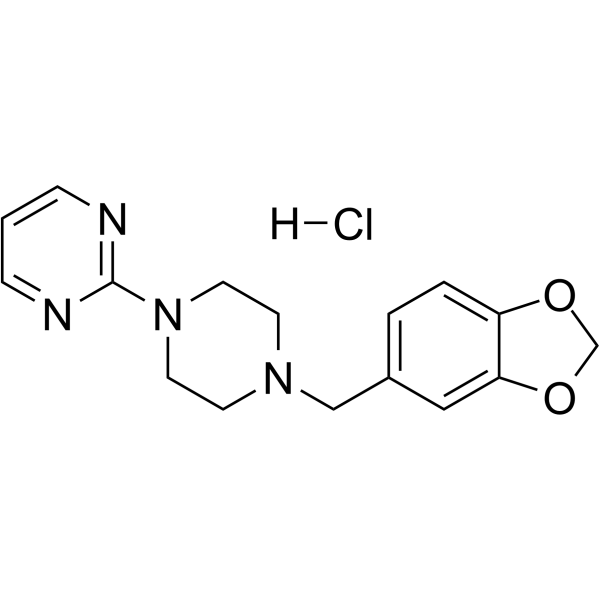
PIRIBEDIL HYDROCHLORIDE structure
|
Common Name | PIRIBEDIL HYDROCHLORIDE | ||
|---|---|---|---|---|
| CAS Number | 78213-63-5 | Molecular Weight | 334.80100 | |
| Density | N/A | Boiling Point | 469.4ºC at 760 mmHg | |
| Molecular Formula | C16H19ClN4O2 | Melting Point | N/A | |
| MSDS | N/A | Flash Point | 237.7ºC | |
Use of PIRIBEDIL HYDROCHLORIDEPiribedil hydrochloride is a potent and orally active dopamine D2 and dopamine D3 agonist. Piribedil hydrochloride is also a α2-adrenoceptors antagonist. Piribedil hydrochloride can inhibit MLL1 methyltransferase activity (EC50: 0.18 μM). Piribedil hydrochloride has the potential for the research of parkinson's disease, circulatory disorders, cancers[1][2][3][4]. |
| Name | 2-[4-(1,3-benzodioxol-5-ylmethyl)piperazin-1-yl]pyrimidine,hydrochloride |
|---|---|
| Synonym | More Synonyms |
| Description | Piribedil hydrochloride is a potent and orally active dopamine D2 and dopamine D3 agonist. Piribedil hydrochloride is also a α2-adrenoceptors antagonist. Piribedil hydrochloride can inhibit MLL1 methyltransferase activity (EC50: 0.18 μM). Piribedil hydrochloride has the potential for the research of parkinson's disease, circulatory disorders, cancers[1][2][3][4]. |
|---|---|
| Related Catalog | |
| Target |
D2 Receptor D3 Receptor |
| In Vitro | Piribedil hydrochloride (0-160 μM, 7 days) specifically inhibits MLL1 methyltransferase activity and selectively suppresses MLL-r cell proliferation[4]. Piribedil hydrochloride (0-160 μM, 4 days) selectively decreases the H3K4 methylation in MLL-r cells (THP-1 and MV4;11), by disturbing the MLL1-WDR5 interaction[4]. Piribedil hydrochloride (0-160 μM, 4 days) induces cell-cycle arrest, apoptosis and differentiation in MLL-r cells (THP-1 and MV4;11)[4]. Cell Proliferation Assay[4] Cell Line: MLL-r AML cells (THP-1 and MV4;11), non-MLL leukemia cell line (K562) Concentration: 0, 20, 40, 80 and 160 μM Incubation Time: 0-7 days Result: Inhibited the growth rate of the THP-1 and MV4;11 cells in a time-dependent manner. Western Blot Analysis[4] Cell Line: THP-1 and MV4;11 cells Concentration: 0, 20, 40, 80 and 160 μM Incubation Time: 4 days Result: Decreased the levels of H3K4me2 and H3K4me3 without affecting the methylation of other histones, such as H3K79, H3K36 and H3K27. |
| In Vivo | Piribedil hydrochloride (intraperitoneal injection, 5, 15, 40 mg/kg ) alleviates the L-DOPA-induced dyskinesias in rats model of Parkinson’s disease[2]. Piribedil hydrochloride (oral gavage, 4-5 mg/kg, daily for 2 weeks) increases locomotor activity and reversal of motor deficits in adult common marmosets[3]. Piribedil hydrochloride (oral gavage, 150 mg/kg, daily for 21 days) inhibits MLL-r tumor growth and decreases the expression of MLL1 target genes in MV4;11 tumor xenografts[4]. Animal Model: Rat model of Parkinson’s disease[2] Dosage: 5, 15, 40 mg/kg Administration: Intraperitoneal injection, administered 5 min before administration of L-DOPA. Result: Reduced turning behaviour and AD (axial dystonia), OD (orolingual dyskinesia) and FD (forelimb dyskinesia) at 5 and 40 mg/kg. Increased LD (locomotive dyskinesias) at the 40 mg/kg. Animal Model: Adult common marmosets[3] Dosage: 4-5 mg/kg Administration: Oral gavage, daily for 2 weeks Result: Increased vigilance and alertness and reversed the downregulation of preprotachykinin mRNA induced by MPTP in rostral and caudal striatum. |
| References |
| Boiling Point | 469.4ºC at 760 mmHg |
|---|---|
| Molecular Formula | C16H19ClN4O2 |
| Molecular Weight | 334.80100 |
| Flash Point | 237.7ºC |
| Exact Mass | 334.12000 |
| PSA | 50.72000 |
| LogP | 2.33240 |
| InChIKey | VRSRBPOCDOKYKT-UHFFFAOYSA-N |
| SMILES | Cl.c1cnc(N2CCN(Cc3ccc4c(c3)OCO4)CC2)nc1 |
CHEMICAL IDENTIFICATION
HEALTH HAZARD DATAACUTE TOXICITY DATA
|
| Piribedil hydrochloride |
| Piribedil Mono-hydrochloride |
| Piribedil dihydrochloride |